My first experience on the French Camino
The Camino was an experience I had dreamed of living for many years. The main obstacle, however, is that although the idea appeals to several of my friends, there’s always a catch: Either they can’t walk long distances for various reasons, or they’re so busy I’d almost would have to send them an invitation years in advance! And then, some aren’t simply not interested; fair enough!
Setting out alone was out of the question, partly for safety reasons (of course, you can call 112 if you fall or get injured, but that doesn’t help much if you lose consciousness…), and because everything is far more enjoyable when you share and help each other along the way.
Luck was on my side the day a friend of a friend confided that she had already completed several sections of the Camino solo, raising funds for a charity in the process! She was delighted at the idea of me joining her. However, even if I’m a good walker, I didn’t have the nerve to commit to a 20- or 30-day Camino, averaging 30 km per day, as she had done in previous years. I preferred to test my abilities with one week, and walking about 20 km a day seemed like the perfect way to find out if the Camino was for me!
After doing plenty of research, she suggested a section of the Via Tolosana, starting in Arles (in the Var department) and ending in Lodève (in the Hérault), passing via Montpellier. The icing on the cake was that, at the end of our hike, we could both visit friends living in the region. It was a done deal!
Why walk the Camino?
Now, the big question: Why walk the Camino?
For me the Camino was a unique way to test my limits, physically, spiritually, mentally, and emotionally. At first, I saw it primarily as an opportunity to discover new regions at a slower pace, and to truly immerse myself in unfamiliar landscapes. But the Camino holds surprises in store. The hours spent in solitude and reflection have a powerful effect: you begin to rethink what really matters and let go of what doesn’t.
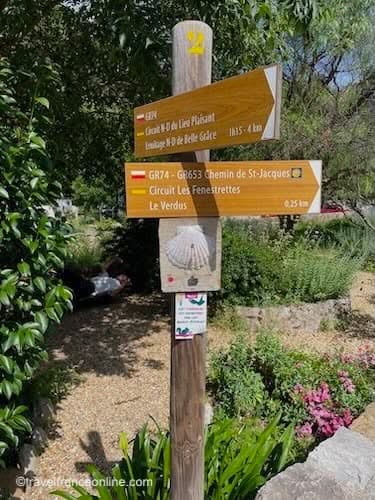
Although religious motivations were secondary to me, I deeply respect the pilgrimage’s spiritual roots. Magical might not be a standard religious term, but I can honestly say I felt something magical on the trail. Even if you have doubts about faith, chances are you will reconnect with something greater before the journey ends. The Camino, whether you see it as a simple trail or a personal journey, demands preparation, endurance, and inner determination, regardless of your beliefs. There are physical challenges: cramps, blisters (though good, broken-in shoes help), as well as moments of doubt during steep climbs or solitary days in the rain. Yet these trials are an integral part of the transformation!
And there’s also the undeniable camaraderie and sense of belonging. Each time you cross paths with another pilgrim and exchange a heartfelt “Bon chemin”, you feel like part of a large family. It always touches the soul. Everyone walks for their own reasons, to recharge, step back from daily worries, gain clarity, or raise funds for charity, and the route provides the time and space needed for proper introspection, even when walking with others. The support from locals is equally moving; in many villages, strangers offer water or a patch of shade in their gardens. The Camino indeed radiates a unique aura in every region it traverses.
The physical rhythm of the Camino fosters meditation. Breath and footsteps fall into sync, body and mind move in harmony. You find yourself enveloped by nature, with only the song of birds, the breeze in the trees, or the murmur of a stream for company. Your minds grows calm, and you set out to discover your true self. It’s an exceptional experience that resonates deep within. That’s the Magic of the Camino.
Camino, a journey back in time
In many respects, the Camino is an experience defined by striking contrasts. Despite the conveniences of modern technology, it transports you back in time!

Indeed, this pilgrimage spans 12 centuries. In 325 AD, the Roman Emperor Constantine convened the Council of Nicaea, which established freedom of worship. The following year, he commissioned the Church of the Holy Sepulchre in Jerusalem. This provided Christians, who until then were persecuted, with a place for gathering and pilgrimage, and the freedom to practice their faith fully.
Saint-James, one of Jesus’ twelve apostles, journeyed to Galicia in the northwest of the Iberian Peninsula with seven companions after the Christ’s death to evangelise the local population. Their mission was unsuccessful, and the group returned to Rome in 42 AD. Saint-James was captured and executed on the orders of Emperor Herod Agrippa.
His companions recovered his remains and brought them back to Galicia on a makeshift boat; they landed on the shores of Iria Flavia (today Padrón), in the territory of Queen Lupa. Though initially wary, Lupa was soon won over by the numerous miracles said to have occurred near Saint-James’s remains. She eventually converted to Christianity and bequeathed her palace to serve as the apostle’s burial place. The Cathedral of Santiago de Compostela was later built on this site.
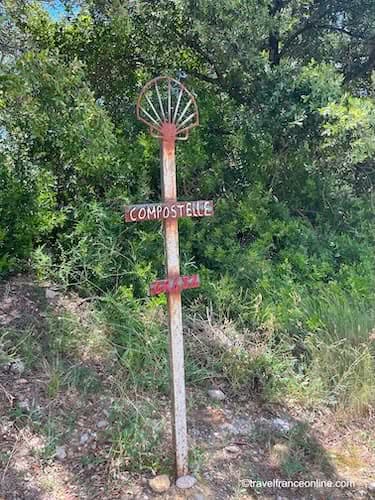
Over time, the memory of Saint-James’s tomb and its power to draw pilgrims faded, until the legend was revived around 820. A hermit living near the burial mound had a vision in which a shower of stars guided him to the site; this gave rise to the name Campus Stellae (Field of Stars), which evolved into Compostela. King Alfonson II had the first church built on the site and encouraged pilgrimage.
The discovery of Saint-James’s tomb also sparked renewed efforts to reclaim the land from Moorish rule, which had begun in 711 AD. Many Iberian victories were attributed to the saint’s protection, and the determination to regain freedom remained steadfast, despite a struggle that lasted until the mid-15th century. The Muslims destroyed Compostela in the 10th century, yet they spared Saint-James’s tomb, perhaps out of superstition? The cathedral was rebuilt around the year 1000.
However, the pilgrimage truly began to flourish in 950, when Godescalc, Bishop of the city of Le Puy-en-Velay, undertook the journey to Compostela. The ancient Roman road from Le Puy southward became known as the Via Podensis, or Le Puy Way (now also known as the GR®65), the most popular and heavily traveled Camino route. While this was the first documented pilgrimage, it wasn’t until the 11th century that significant infrastructure was established to accommodate pilgrims, who were primarily monks and the wealthy. In 1120, the Pope decreed that pilgrims could obtain a plenary indulgence upon completing their Camino, in other words a total remission of sins and a clear path to Paradise! That helped!

The pilgrimage to Santiago de Compostela flourished over the next two centuries, with a network of inns and hospices established by religious communities to assist pilgrims. However, its popularity started to decline in the 14th century, and nearly vanished altogether in the 16th century following the loss of Saint-James’s relics; the Bishop of Santiago had hidden them during the English invasion, but their location was lost after the prelate’s death.
The pilgrimage resumed in the late 19th century when the then Bishop of Santiago undertook the renovation of the cathedral. During the work, an urn containing bones was discovered behind a vault near the main altar; identified as the relics of Saint-James, they were officially authenticated in 1884. Nevertheless, it took nearly another century for the pilgrimage to regain its full popularity. The ultimate seal of recognition came when the Camino de Santiago was inscribed on the UNESCO World Heritage List.
Today, more than 200,000 pilgrims walk the Camino each year, each with their own reason. And I was one of them!
Camino: a journey of contrasts
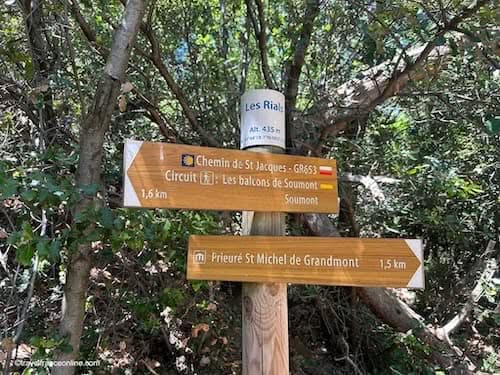
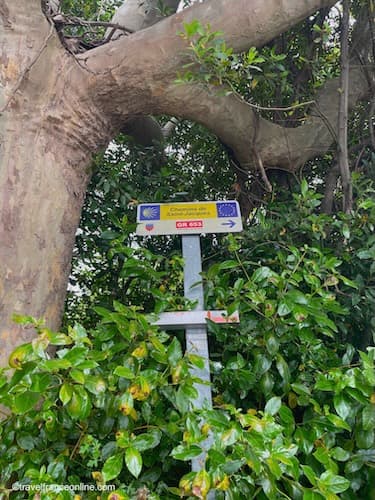
Walking the Camino is like stepping into the past while remaining firmly rooted in the present. Nowadays, the experience is transformed by modern comforts and convenience, as we’re constantly connected. Thanks to smartphones and GPS apps, our walk is tracked in real time, and we’re guided along the route, often marked by a yellow line on our screen that complements the Camino’s iconic yellow arrows along the trails. Getting lost is virtually impossible! That said, my friend and I still managed to stray a few hundred metres off then trail once; we were too busy chatting to notice!
And should any trouble arise, the emergency number 112 is always close at hand. We also have the luxury of booking accommodations in advance via online platforms or entrusting the arrangements to a company that handles every detail: route planning, lodging, evening meals, taxis if needed, even luggage transport. That is the option we chose as neither of us was keen on hauling 30-kilogram backpacks from one stage to the next!
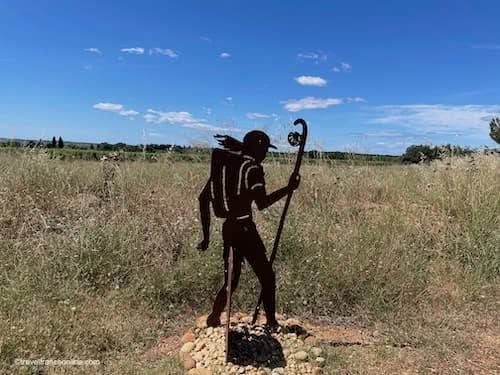
Gone, too, are the days of highwaymen, thieves and the constant fear of ambushes! What a contrast to the experience of medieval pilgrims, who set out with nothing but a small purse, a warm cloak (if they could afford one), and a sturdy staff. They were also at the mercy of wolves (they still roamed then), and the elements, navigating by the sun during the day and the stars at night, and forced to sleep under the open sky if they failed to reach a monastery on time. Nobles and clerics often travelled with an entourage and armed guards, yet even they weren’t immune to attack, robbery, or worse.

These dangers persisted until 1120, when Adalard, a Flemish viscount, and his companions were ambushed in the mountains near Aubrac. They survived, continued their pilgrimage, but on the return journey, a snowstorm stranded them at the same spot. Taking this as a divine sign, Adalard vowed to build a hospice for pilgrims there should he make it home safely. No trace remains of the Hospice Notre-Dame-des-Pauvres, once managed by the Domerie d’Aubrac (monastery) or of the medieval ramparts that protected the village of Saint-Chely d’Aubrac.
After leaving the safety of the hospice, pilgrims would resume their solitary journey, relying entirely on faith for protection. In this sense, the medieval path and the modern one converge across the divide of technology progress, and the inner journey remains unchanged. Nowadays, even in a hyper-connected world, we often feel isolated, alone in a crowd, absorbed in our screens.
But on the Camino, we’re invited to slow down and reconnect: to move to the rhythm of our own steps, to embrace solitude, to live simply with nothing but a backpack, and to let go of the illusion of control. Along the way, you encounter fellow travellers from all walks of life, united by a shared goal. And ultimately, you rediscover yourself, at the very core of your being.
On the way to Arles, the starting point of my Camino
After weeks of preparation, the long-awaited day finally arrived. My friend and I were ready to embark on our six-day hike, starting form Arles!

Our flight was on time, and upon arriving in Marseille Airport, we quickly collected our minimalist luggage; the shuttle connecting the airport to the Vitrolles-Aéroport Marseille train station arrived just as were stepping out of the terminal. Fare: €1.20; payable by card on board, and ten minutes later, we were on the platform. Everything seemed to be off to a good start.
However, since it was a Sunday, trains ran less frequently; we had to wait an hour in a shelter in 30°C heat; something to keep in mind when planning your own trip! You should also know that Vitrolles station has no manned ticket counter, only ticket machines. The train journey (via the Zou! service) cost €14 one-way (2026 price) and took about 45 minutes. Once in Arles, it was a ten-minute walk to our hotel in the old town.
We had intentionally set aside an extra full day to explore Arles’ monuments, which have been inscribed on the UNESCO World Heritage List since 1981: the Cathedral Saint-Trophime and its Cloister, the Alyscamps necropolis and the Church of Saint-Honorat, the Ancient Theatre, the Forum Cryptoporticus, the Roman Obelisk, the Baths of Constantine, and the iconic Amphitheatre, which, unsurprisingly, is the most visited monument in the city. You can discover the exceptional artefacts excavated in the Arles ancient history museum, near the former Roman circus.
Everything got off to a great start. The Hôtel les Acacias, where we stayed, is a 10-minute walk from the station, and right next to the recently restored Porte de la Cavalerie, a fortified gate part of the former ramparts; I was lucky enough to have a room overlooking it!
I highly recommend this family-run hotel, as its location is ideal: just two minutes from the river and from the Amphitheatre at the heart of the Roman city. We also received a warm welcome, the rooms were perfect, and the breakfast buffet was excellent. I especially recommend the homemade rice pudding with lavender essence, a real treat!
Since we arrived in the mid-afternoon, we had plenty of time to scout the area and plan our next day visits. After finding our bearings, we sat at a café terrace on nearby Place Voltaire, and watched the world go by while sipping a delicious mocktail.
Summer Sundays in Arles are truly enchanting: cafés and restaurants terraces are packed, and a local DJ livens up the square while people dance. What an ideal way to start our Camino, soaking up the early June sunshine and immersing ourselves in the lively atmosphere!
Starting our Camino
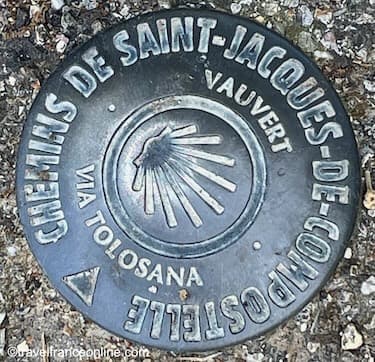
Thus, it was with a touch of regret, but with wonderful memories and hundreds of photos, that we had to leave the following morning!
Our first 20-km leg took us to Saint-Gilles-du-Gard, whose abbey was once the 4th most important pilgrimage site after Jerusalem, Rome, and Santiago de Compostela!
On the way, we cross the Petite Camargue, a vast marshland area stretching between the Vidourle and the Petit Rhône, the western branch of the Rhône delta (Camargue).
Although it was only early June, it had already largely dried up; however, the paths were lined with broom and spring flowers, winding among fields and paddies where the famous Camargue rice is grown.
Our second leg (17 km) led us to Vauvert, a small town nestled in the heart of the Gard Camargue. Despite its modest size, Vauvert boasts several remarkable monuments.
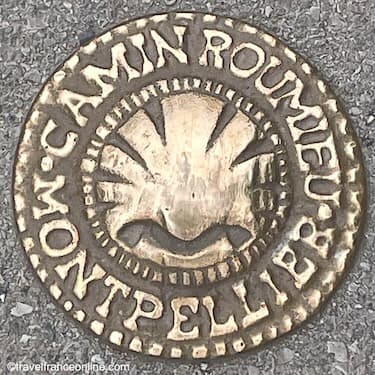
After exploring them and enjoying a much-needed cold drink, we were picked up in front of the church by a pre-booked taxi (arranged through our agency) to travel to Montpellier, 50 km to the west.
This saved us two additional days of walking (bearing in mind that we had planned a six-day itinerary).
Arriving in the mid-afternoon gave us plenty of time to discover Montpellier’s must-see sights. I couldn’t hep but fall under the spell of this vibrant student city, but also the spectacular cathedral, France’s oldest medical school, the Arc de Triomphe, and the bustling medieval city…
The next day, we set off for Montarnaud, another 20-km leg and passed through the charming medieval town of Grabels, nestled on the bank of the Mosson River.

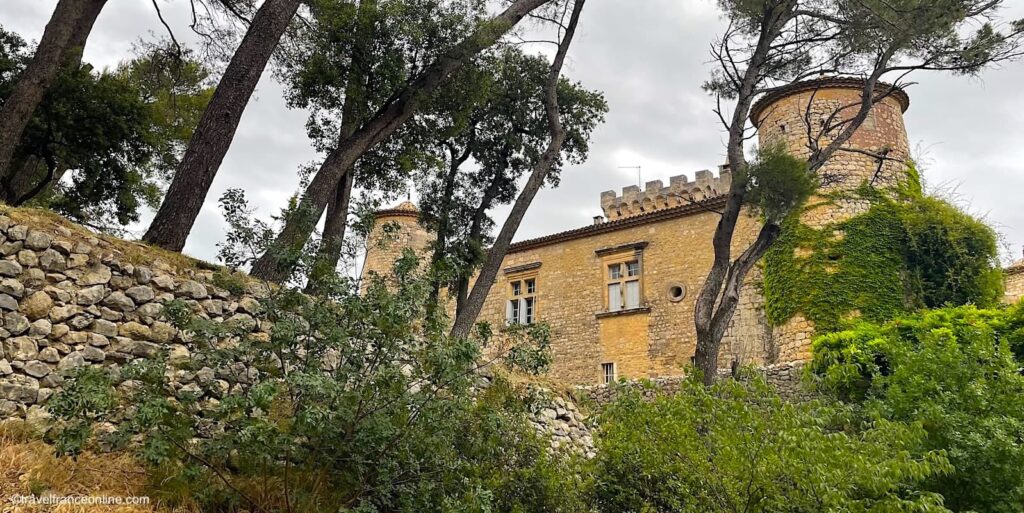
Montarnaud is a quintessential French little town, modest in size yet rich in historical and architectural heritage, that boasts the oldest castle in Lower Languedoc! Our guesthouse was near the château, which is not open to the public yet (though plans are in place).
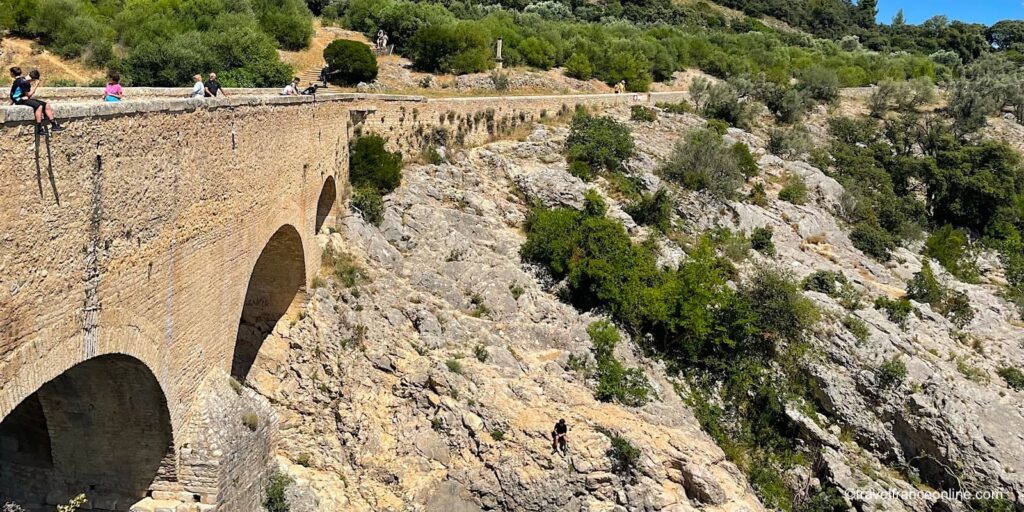
The next leg was a 22-km walk to Saint-Guilhem-le-Désert. A few kilometres before reaching it, we discovered the spectacular Gorges de l’Hérault, listed Grand Site de France and UNESCO World Heritage Site, and the Pont du Diable (Devils’ Bridge), one of France’s oldest bridges that marks their entrance. We then made our way to Saint-Guilhem by walking along the gorges.
Saint-Guilhem-le-Désert is truly an exceptional village ranked among the Most Beautiful Villages In France. The village and the Abbey of Genone, are also inscribed on the UNESCO World Heritage List, and it’s easy to see why!
The penultimate stage took us from Saint-Guilhem to Saint-Saturnin-de-Lucian.
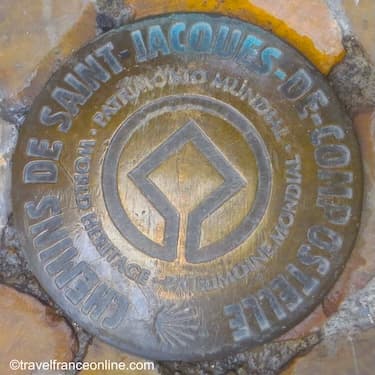
Here, the walk took a whole new dimension for me, a the majority of the 22-km involved climbing up and down mountainous terrain.
To be honest, this stretch was particularly gruelling; despite the spectacular scenery, including a Neolithic enclosure and the Château du Pirou perched on the mountainside before the descend into the valley, I was delighted to, at last, reach our destination!
The final leg, 20-km long, proved just as demanding, and I was genuinely happy to arrive in Lodève, especially since my friends were waiting for me!
However, while the last two legs were somewhat arduous, they didn’t feel like an obstacle; instead, they offered a chance to test my limits and rise to a challenge and proclaim proudly, “I made it!”
Tips for the first-time pilgrim
Given the growing popularity of the Camino, many companies now make organising your trip easier by taking care of everything. You only need to specify the route or section you wish to walk, the duration, and your preferred daily walking distance and they’ll make your life easy by organising the following:
Accommodation with breakfast (B&B style): some places also serve dinner or provide a list of recommended restaurants that welcome pilgrims.
Luggage transport services (if you choose this option): you’re generally allowed only one bag per person, with a weight limit of 13 or 15 kg, depending on the route and the service provider. You’ll receive a luggage tag and must leave your bag at the reception of your lodgings by 8:00 a.m. It’ll be delivered to your next stop before 5:00 p.m. (check with your provider). Naturally, this requires startegic packing: i.e. lightweight, quick-drying clothes, versatile evening wear etc…
Taxi transfers between stages, if necessary, will be booked for you.
Detailed maps and a guidebook describing your route and points of interest along the way, as well as emergency numbers and email contacts. These documents are either sent to your home or made available at your first accommodation.

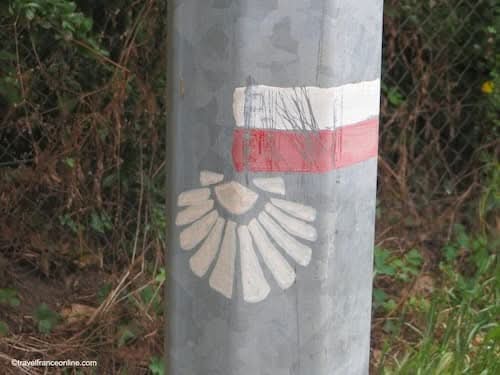
In France, hiking trails are well-marked under GR® (Grande Randonnées) designation. Follow the red-and-white stripes (pointing straight ahead, right, and left). On the Camino, these markers may be replaced by the iconic scallop shells signs.
Backpack: if you want the full Camino experience and plan to carry your own gear, try not to over-pack; walking with extra kilos is a real challenge, but the choice is yours! Even if your luggage is being transported, you’ll still need a backpack for essentials such as at least 2 litres of water (dehydration sets in quickly, even in mild weather). In France, you’ll find plenty of public fountains with drinking water to refill your bottle.
Pack a picnic and snacks; nothing beats a break by a river or atop a hill to admire the view while you eat.
Don’t forget your waterproof gear (it does rain in France too!), a basic first-aid kit (with disinfectant and bandages), tissues, safety pins (for that button that always seems to pop off), insect repellent(yes, mosquitoes love pilgrims), your camera, a portable charger for your phone, as you’ll be using it for navigation, and any other must-haves (glasses, medication etc…)
And above all, sun-cream and sunglasses; don’t hesitate to use SPF 50, whether you’re walking in spring, summer, or autumn. Don’t worry you’ll get a tan!

Footwear: Leave brand new shoes at home. Opt for comfortable, broken-in hiking shoes that fit your feet like a glove, as they’ll swell, and wear specialised hiking socks. Upon arrival each day, the first thing you’ll want to do is take off your shoes and let your toes relax. Bring sandals or any open-toed shoes that feel comfy to give your feet a well deserved break.
Trekking poles: highly recommended! Walking on ‘all fours’ is much easier and less tiring than on just two legs! Uphill sections are tough, but descents can be even harder; poles provide better balance on rocky, muddy, or slippery terrain. They can reduce the strain on your legs, ankles, and knees by up to 25%. Take care of your legs, they must carry you for a lifetime.
Clothing: Opt for light weight, quickly drying sportswear. Shorts are practical but be sure to pack waterproof gear, jacket and trousers.
Finally, don’t forget to take a comprehensive travel insurance. It’s not included in your Camino package, and your safety is your responsibility. And remember, 112 is the emergency number throughout Europe!
The scallop shell

The next question is: why do pilgrims carry a scallop shell on their backpack?
In the past, even after arriving in Santiago and paying their respect at the tomb of Saint-James, pilgrims had not yet completed their journey. They still had to walk another 90 km or so to reach Cap Finisterre, (The end of the World), on the coast, where they would burn their old clothes on the beach and receive new clothes. This ritual, at once practical and deeply symbolic, embodied rebirth and a fresh start; it was about shedding the past at the end of the long, transformative journey.
It also served a sanitary purpose by preventing the spread of disease; it’s easy to imagine the state of clothing worn for months on the road under rudimentary hygienic conditions!
Pilgrims also collected scallop shells on the beach as a tangible proof of their achievement, an enduring memento attesting that they had indeed reached the end of their journey.
Scallop shell signs come in many styles along the Camino; they’ll guide you!
The credential or pilgrim passport
Throughout the Camino, everyone carries a credential, a small pilgrim passport stamped at each stage, which entitles the holder to a certificate upon reaching Compostela.

Finally, the credentiale, or pilgrim passport, is essential for accessing designated accommodation (traditional pilgrims hostels) and for obtaining the Compostela, the official certificate issued upon your arrival in Santiago.
This document entitles you also to free entry to most religious buildings along the Camino and, at times, discounts at other locations.
You can order it online before setting off or pick one up at a major religious monument along the Camino, as we did. You’ll need to have it stamped at each stage of your journey; you’ll sometimes find self-service stamps in small churches that aren’t manned along the route.
All that remains for me, is to wish you Bon Chemin – Buen Camino!
Wikimedia Commons: St James’s Tomb by Roy r lindman is CC BY 4.0