Grabels along the Via Tolosana
As we set out from Montpellier on the fourth leg of our six-day Hike along the Via Tolosana towards Montarnaud, we little suspected that one of the towns we would pass through would leave such a lasting impression on us!
That town was Grabels!
Located about 8 kilometres northwest of Montpellier along the banks of the Mosson River, Grabels has been a welcoming stop for thousands of pilgrims on the way to Santiago de Compostela over the centuries. Naturally, our first stop in town was the church, where we could get our credential (pilgrim passport) stamped.
We found the self-service stamp station in the Rectory Garden (Jardin du Presbytère), right next to the Church of Saint-Julien-et-Sainte-Basilisse.
The entrance gate immediately set the tone with its superb designs featuring the silhouette of a pilgrim and the village fountain. The local ironworker who crafted it also created the stamp, which bears a pilgrimage-themed design.
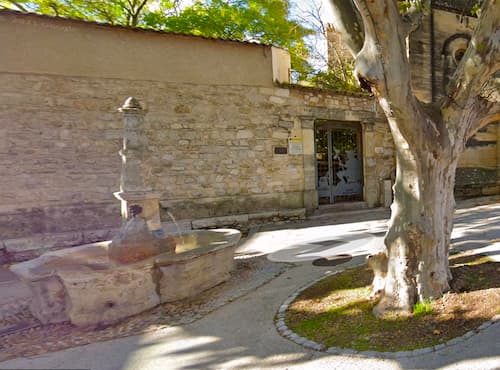
The small, quaint walled garden provides a lush green setting for a large stone scallop embedded in the church wall.
Its origin is unknown, but that matters little; the scallop is the emblem of the Way of St. James!
For centuries, pilgrims have worn it on their cloaks or backpacks as a protective talisman and used it as a makeshift cup to drink from fountains, wells, and springs along the way.
Naturally, the scallop also allowed locals to identify these travellers as pilgrims.
The Church of Saint-Julien-et-Sainte-Basilisse
The church is dedicated to Julian and Basilissa, an Egyptian couple who embraced Christianity in the 4th century and transformed their home into a hospital. Their devotion led to persecution and martyrdom, and this rare dedication suggests that an early oratory may have stood on this site from the very beginning of the Christian era.

The Early Gothic church that replaced it at the beginning of the 12th century was destroyed during the Wars of Religion in 1621-1622. Once peace was restored, the community rebuilt their church in 1666 upon the 12th century foundations. The church was restored and enlarged in 1826, and again in the 1850s, to accommodate a growing congregation.
One of its remarkable features is that it possesses not just one, but two bell towers!
The first, a round, crenellated tower dating from the 12th century, dominates the Place de la Fontaine. This sturdy, fortress-like structure stood next to the Porte du Porquier, one of the town’s two main entrances, and was part of the fortifications.
Its survival creates a tangible link to the old church and symbolises the town’s renewal following the destruction caused by the Wars of Religion. In 1879, a Neo-Gothic bell tower was added to the main facade overlooking the Place de l’Eglise, a symbol of the town’s expansion during the 19th century.
The church thus blends architectural features from the 12th, 17th, and 19th centuries, giving it a unique character.
Grabels’ medieval ramparts
As you stroll through Grabels, don’t be deceived by its present-day residential character; this charming commune boasts a rich history!

The earlier recorded mention of Grabels dates to 1120, when Bernard IV, Count of Melgueil (present-day Mauguio), married Guillemette, daughter of Guilhem V, Lord of Montpellier.
During the Middle Ages, Grabels was part of the Bishopric of Montpellier and its strategic position along the Via Tolosana made it an important crossroads. By the 13th century, it was enclosed by stone ramparts with watchtowers to shield inhabitants from bandits and religious strife.
However, much of these medieval fortifications, including the Porte du Porquier, the church, and the rectory, were destroyed during the Wars of Religion in 1621-1622.
Yet, many remnants survived and were incorporated into the village reconstruction in 1666. The severely ruined sections were demolished during the French Revolution.
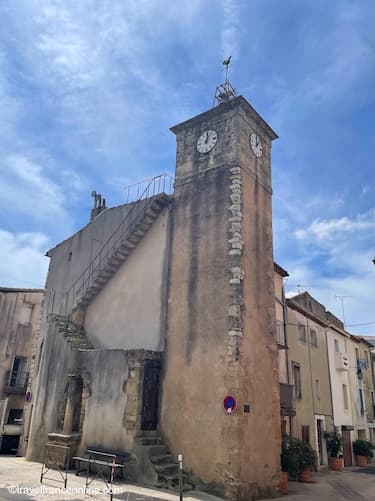
The Tour de l’Horloge (Clock Tower), once known as Tour Carrée (Square Tower), is another remnants of the ramparts.
In 1824, a mechanical clock was installed at its summit, giving it its present name. Every two weeks, the caretaker would climb the tower’s external stairs to wind the mechanism, a practice that continued until a fire damaged the historic clock in the 20th century.
Grabels’ medieval defences also included the Tour de Montredon, an outpost that monitored the roads leading to and from Montpellier.
Perched on Mont Redon (Round Hill in Occitan), this imposing square tower (seven metres on each side, over six metres high, with metre-thick walls) has retained its battlements and arrow slits and offers sweeping, panoramic views, despite its partial ruin.
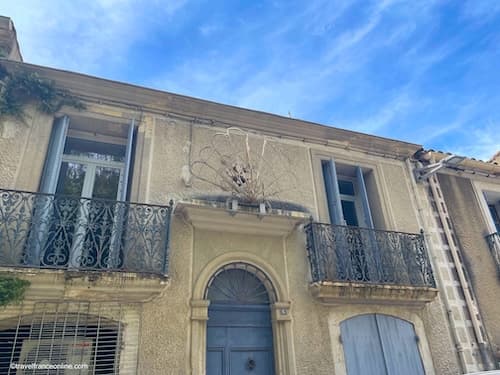
Although the town ramparts are gone, Grabels has preserved its medieval network of winding lanes lined with quaint stone houses. As you explore, you’ll notice countless ornaments on building facades and wrought-iron balconies, a nod to the town’s connection to the pilgrimage route.
The Bugadières, the washerwomen of Grabels
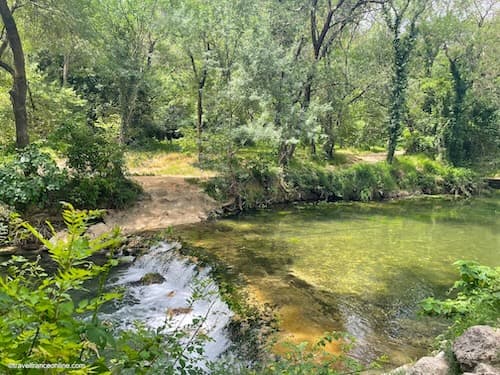
Grabels owes much of its historical wealth to the Avy Spring and the Mosson River.
Both the river and the spring were vital to the town’s economy.
The reconstruction of Grabels in 1666 was indeed made possible by the success of the local laundry industry, known as La Bugada (Steam in Occitan).
As early as the 17th century, Grabels gained a reputation for its washerwomen.
The Bugadières would travel to Montpellier to collect laundry from affluent families, then return home to wash the linens in the exceptionally pure water of the Avy Spring.

So far, thus was nothing unusual.
What set the Bugadières apart from the other washerwomen was their unique drying method: they would spread the freshly washed laundry over beds of aromatic garrigue plants, such as lavender, thyme, and rosemary, imbuing the fabrics with a distinctive, natural fragrance.
The next week, they would return the delicately scented linens back to Montpellier.
The mighty source of the Avy River
Once the Bugadières‘ bustling workplace, the Avy Spring has become Grabels’ natural treasure. Nestled at the foot of the garrigue-covered hills, the spring gushes from rocks formations locals affectionately call Les Fesses de Madame (Lady’s Buttocks) for their suggestive shape.
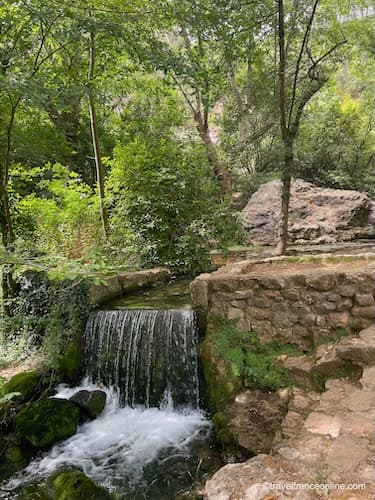
Fed by rainwater that seeps through the stony plateaus, the Avy carves its way through a labyrinth of underground passages before erupting from a deep chasm. The water flow is usually calm and steady, but autumn floods can transform it into a roaring torrent that thunders through the landsacpe, sweeping everything in its path.
This mighty force gave rise to a legend: locals once said that a fearsome dragon (Lou Dragas) inhabited these depths, demanding the sacrifice of the village’s fairest maidens, until the courageous knight Jean de l’Ours slew the beast and freed the village from terror!
Water is, of course, the source of life, and for millennia, it has drawn people to this place. Archaeological excavations thus uncovered pottery fragments showing that humans settled here as early as 9000 BC.
Local legend has it that Hannibal stopped by the spring in 218 BC, pausing with his army and 37 elephants to refresh themselves on their legendary march from Cartagena (in southern Spain) to Rome. Fact or fable? Hard to say, but it adds to the site’s mystique.
What history confirms, though, is that the formidable Bertrand du Guesclin and his troops camped by the spring in 1365, during the Hundred Years’ War, taking advantage of its limitless waters before marching to Spain to intervene on the Castilian Civil War.
Throughout the Middle Ages, the pure, clear waters of the Avy already attracted those seeking healing; they were indeed credited with the power to cure skin conditions and, it was said, even leprosy!
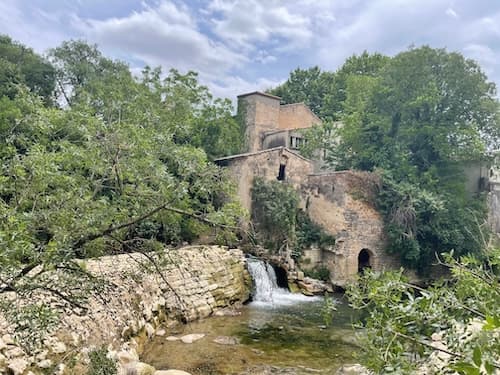
That said, despite its legendary status, the Avy is a very short river! It indeed flows for just 200 metres before joining the Mosson, increasing its flow rate. Together, their waters powered the mighty millstones of the Moulin de la Grave.
Built in 1660 on a site known as La Paissière (Occitan for weir or dam), the Moulin de la Grave was in fact two mills in one: one for grinding grain, the other for producing olive oil.
The mill operated until the turn of the 20th century. As the region’s vineyard expanded in the 19th century, flour and oil production waned, and the mill briefly shifted to stone-cutting, then to milling cocoa powder, and finally to powdered sulphur, vital for protecting Languedoc vines.
The devastating cholera outbreak of 1884 marked the end of the mill’s productive era, as stagnant waters were blamed for spreading the disease. The buildings were converted into homes, but in 2014, a catastrophic flood forced residents to evacuate by helicopter.
Today, the mill is one of the most picturesque and romantic ruins along the banks of the Mosson. A quaint stone footbridge crosses the river at its foot, creating a lovely cascade, best admired from a nearby viewpoint.
Château de Grabels
At the height of its production, the Moulin de la Grave generated substantial revenue, and it belonged to the Château de Grabels, also known as the Château de Solas.
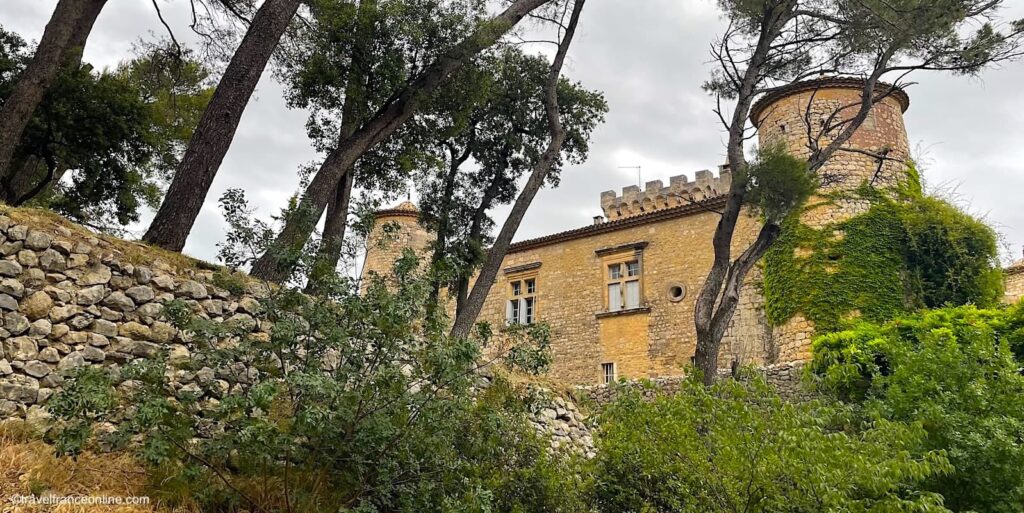
This grand 17th-century estate stands on the outskirts of the town, nestled along the banks of the Mosson and a stone’s throw from the Avy Spring and Moulin de la Grave. It started as a large agricultural estate, known as Mas de la Font, established around 1645 by the Massane family, prominent landowners.
In 1747, Louis de Solas purchased the property, and by 1755, he had also acquired the rights and lordship of Grabels, auctioned by the Bishop of Montpellier. He renamed the mansion Château de Grabels and commissioned a wall linking it to the heart of the village. The Solas family retained ownership until the French Revolution of 1789, which abolished feudal privileges.
The mansion then passed through several owners before the municipality of Grabels acquired it in 2015. Today, the estate serves as a vibrant cultural centre and hosts art exhibitions.
Decades earlier, in 1954, the town had acquired the Avy Spring, transforming its surroundings into the Parc de l’Avy, a natural park complete with picnic tables, fitness trails, and children’s playgrounds.
The park’s atmosphere is serene and inviting. Towering trees offer welcome shade, providing cool respite during the summer heat.
This was where my hiking companion and I paused for our picnic, relaxing on a riverside bench and admiring the Mosson’s clear waters mirror the lush green canopy above.
Wikimedia Commons: Washerwomen in 1915 by Bardou, Alexandre (photographe-éditeur) ; Azéma (éditeur) – Collections Archives Départementales de l’Hérault is Domaine public –