Saint-Trophime Cathedral, a UNESCO World Heritage Site
Imagine having a UNESCO-listed (former) cathedral as your parish church. Impressive, isn’t it? That is the incredible privilege enjoyed by the residents of Arles!
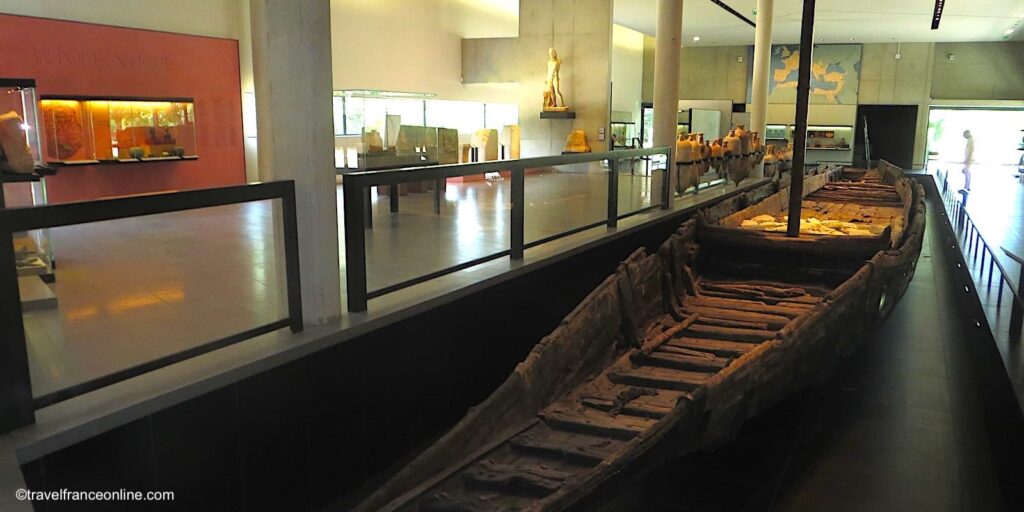
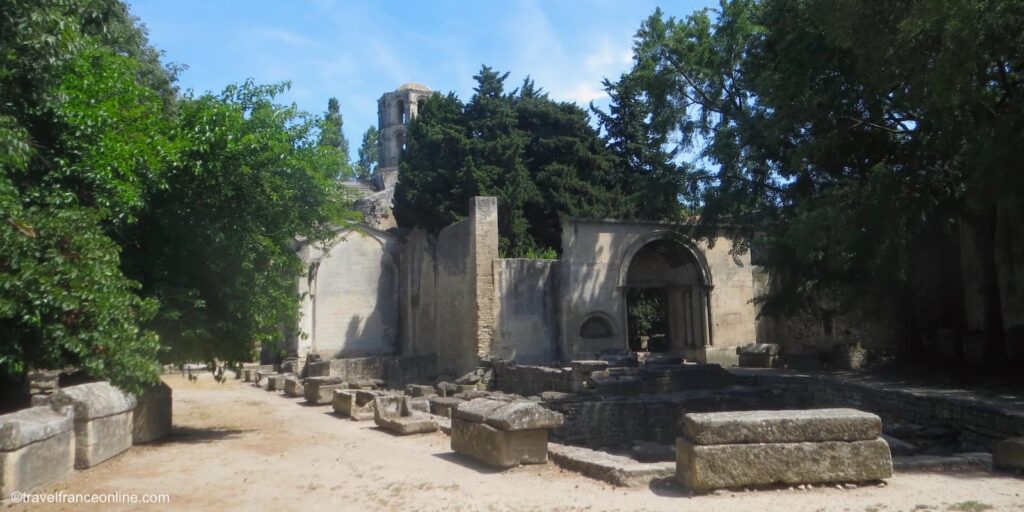
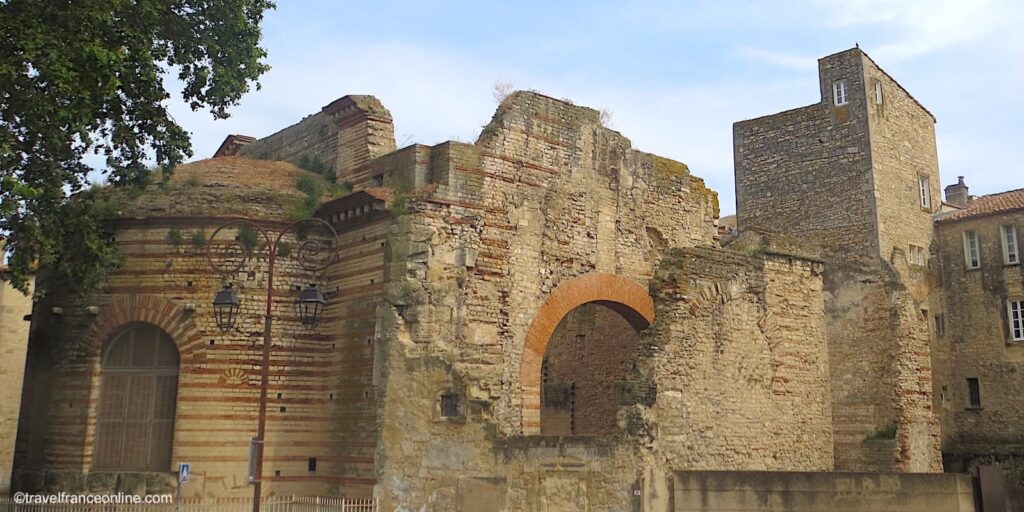
Saint-Trophime Cathedral and its cloister are indeed among the city’s eight monuments inscribed on the World Heritage List, alongside the Roman Amphitheatre, Ancient Theatre, Obelisk, the Forum Cryptoporticus (underneath the Town Hall, next door to the cathedral), the Baths of Constantine, the Alyscamps necropolis, and the Church of Saint-Honorat.
A jewel of Provencal Romanesque architecture, Saint-Trophime Cathedral also houses several holy relics and is a major stop on the pilgrimage route to Santiago de Compostela.
Visiting it was thus meaningful for my friend and me, as Arles was the starting point of our six-day hike along the Via Tolosana, one of the French sections of the Camino. In fact, we even bought our credentials, our pilgrim passports, there. Saint-Trophime was the fourth monument of our sightseeing list, right after the Crytoporticus, and moving from one cool spot to another was welcome.
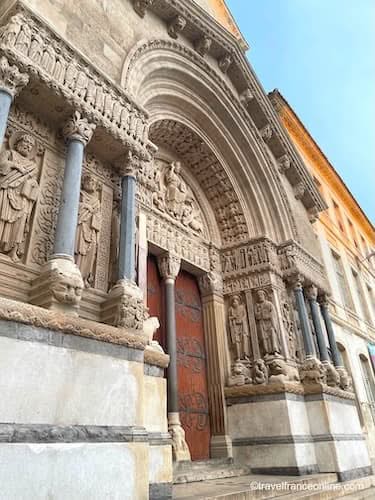
Perched atop its flight of steps, the cathedral’s magnificent facade and portal caught our eye the moment we set foot on the square, Place de la République. Once inside, we were enveloped in silence and semi-darkness, yet there was enough light to admire the varied furnishing and appreciate the beauty of the building.
Saint-Trophime Cathedral through the centuries
The origins of Saint-Trophime Cathedral date back to the 3rd century, a time when Arles was home to one of the earliest Christian communities.
The original church was dedicated to Saint-Etienne (St. Stephen). His relics were discovered in 425 AD in a village north of Jerusalem. Legend has it that the earth shook as his coffin was opened, the air filled with a wondrous fragrance, and those present at the exhumation were healed of their ailments! Naturally, this event sparked a wave of religious fervour across the Christian world, and the bishops of Arles seized the opportunity to build a cathedral in his honour!
By the end of the 11th century, Arles was a major Provencal city and thriving river port and hub with a population of nearly 20,000! It naturally attracted numerous religious orders, notably the Knights Templar who settled in the Cavalerie district near the fortified gate, as well as many mendicant orders who erected several churches throughout the city.
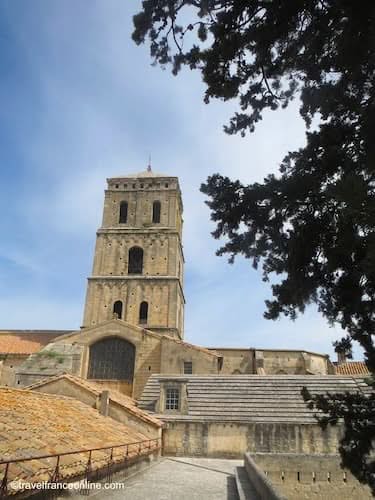
The Saint-Etienne Cathedral was thus deemed too small. The apse and transept of the new cathedral were constructed during this period, while the nave, the bell tower, and the magnificent facade and portal were completed around the mid-12th century, at the height of the Romanesque architecture. So were the columns with acanthus-leaf capitals (inspired from the city’s many Roman remains) that support the soaring nave and enhance its refine, understated elegance.

The relics of Saint-Trophime were then transferred, and the old church was renamed Saint-Trophime Cathedral. Who was Saint-Trophime? Surprisingly, little is known about him, other than he became the first bishop of Arles in 250 AD. Legend has it that he was one of the seven priests sent from Rome to evangelise Gaul (Modern-day France). He died in 280 AD and was buried in the Alyscamps necropolis. He is, of course, the city’s patron saint!
The Saint-Trophime Cathedral underwent its first major alteration in the 15th century, when the Gothic chancel, with its ambulatory and radiating chapels, replaced the earlier Romanesque one. Two centuries later, balconies with balustrade were added to the transept, along with two large stained-glass windows and two new portals.
Arles remained the seat of an archbishopric until the French Revolution, a period during which the cathedral’s original furnishings were unfortunately destroyed, and the building transformed into a Temple of Reason! Yet, as if by a miracle, the stunning 12th-century main portal facing the Place de la République was spared!
Saint-Trophime Cathedral returned to its past splendour
However, it was not until the late 19th century that the Historic Monuments authorities restored Saint-Trophime Cathedral to its original Provencal Romanesque style. This work involved dismantling a small bell tower on the facade, reopening the nine chancel bays (which had been walled up during the French Revolution), replacing the 18th century portal, and making various modifications to the nave, side aisles, and galleries, and new furnishings were installed.
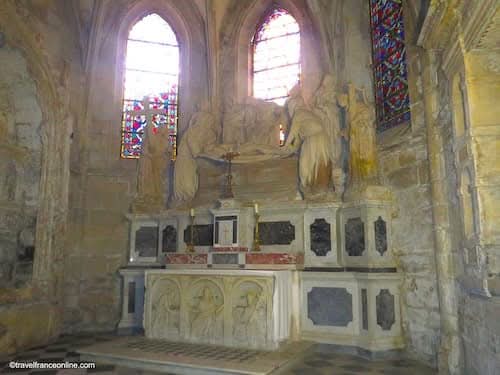
Saint-Trophime Cathedral is intentionally kept dim lit to preserve its Romanesque atmosphere, evoking the days when candlelight was the only illumination and creating a setting conducive to quiet contemplation. It is also renowned for its understated decor and minimalist furnishings, reflecting the Provencal Romanesque aesthetic.
Despite this simplicity, it houses remarkable treasures, such a series of 17th century Aubusson tapestries (one of which depicting the Life of the Virgin Mary), as well as several paintings by celebrated Baroque grand masters, such as Louis Finson, and three sarcophagi dating from the 4th and 5th centuries AD, all now classified as Historic Monuments.
Among these is the Carrara marble sarcophagus of Paulus Geminius, the Roman administrator of the five provinces of Gaul (modern-day Southern France) at the turn of the 5th century. His tomb was brought from the Alyscamp necropolis in the early 19th century and installed in the Chapel of the Holy Sepulchre. It serves both as an altar and a base for The Entombment, a 15th-century masterpiece sculpture depicting the Christ’ burial.
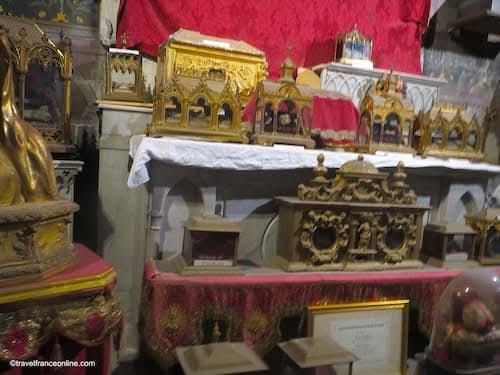
As its name suggest, the Chapelle des Reliques houses numerous reliquaries containing the bones and skulls of saintly martyrs, including those of Saint-Etienne and Saint-Trophime. The shrine of Saint-Trophime was a significant stop on the Via Tolosana (one of the routes of the French Camino), where pilgrims would pause to pray.
The veneration of relics dates to the early days of Christianity, when the faithful would pray at the tomb of their first martyrs; the oratories they erected over these graves eventually evolved into chapels and, later churches.
The chapel dates to the 15th century, but the reliquaries have only been on display there since the 19th century. While the chapel is closed to the public, you can view these reliquaries, most of which are richly ornamented, through a metal grille. And if you want to to admire their intricate details, you’ll need to insert a €2 coin into a timed lightning unit that’ll give you 5 minutes of light.
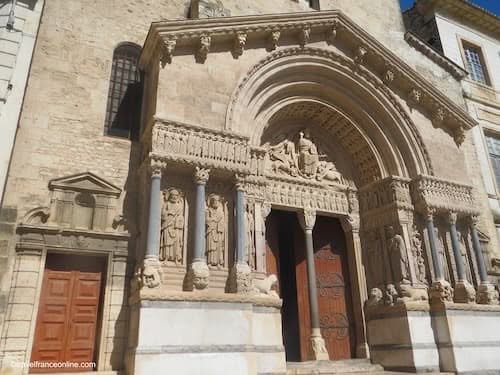
Further restoration work was carried out on the roof and bell tower in the late 20th century. However, the most urgent project involved the magnificent 12th-century portal and its statuary, which had been damaged by pollution over the years.
This portal is one of the two largest Romanesque sculptural ensembles in Provence, alongside the portal of the Basilica of Saint-Gilles-du-Gard. It depicts the Last Judgment and is structured around three major themes: the assembly of patron saints, the divine epic, and the human epic, all centred on the solemn, triumphant sculpture of Christ.
As with most churches, admission to Saint-Trophime Cathedral is free and open every day from 7:15 a.m. to 7:00 p.m, except Saturdays from 9:15 a.m. to 7:00 p.m.
Saint-Trophime Cloister
The cloister of Saint-Trophime Cathedral is another exceptional structure, ranking among the largest in Provence (28 metres by 25 metres).
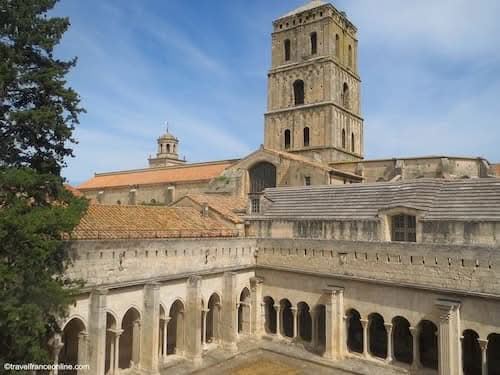
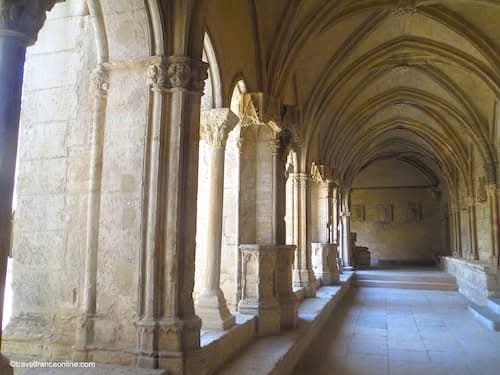
Construction began in the mid-12th century and spanned two centuries, thus reflecting the evolution of architectural styles: from Romanesque for the north and east galleries to Gothic for the west and south galleries.
Like Saint-Trophime Cathedral, the cloister is renowned for its remarkable architecture and statuary, particularly its carved columns and capitals depicting scenes from the Old and New Testaments, as well as countless statues of Saint-Etienne and Saint-Trophime. Unsurprisingly, it was designated as a Historical Monument in the mid-19th century.
The Chapter House regularly displays Flemish-styles tapestries depicting scenes from the First Crusade; however, as these works are sensitive to light, humidity, and temperature fluctuations, they are frequently taken down, meaning we didn’t have the opportunity to admire them. On the other hand, a fine reproduction of a statue of Saint-Trophime stood in the corner of the room, in front of a stained-glass window.
Tip: the roof terrace above the cloister galleries is accessible to the public, and offers of the finest views of the 12th-century bell tower and the neighbouring town hall.
Originally, monks accessed the cloister via a staircase leading from the cathedral chancel; today, public access is through the Bishop’s Palace courtyard (Palais de l’Evêché), where the ticket office is located. To get there, you must exit the cathedral on Place de la République and enter through the portal of the Bishop’s Palace, located immediately to the left upon exiting.
Cloister’s opening hours: 2th November to 28th February: 10:00 a.m. to 5:00 p.m. – 1st March to 30th April: 9:00 a.m. to 6:00 p.m. – 2nd May to 30th September: 9:00 a.m. to 7:00 p.m.
The visit to Saint-Trophime Cathedral and its cloister took us an hour.