The Alyscamps necropolis, a pagan burial ground
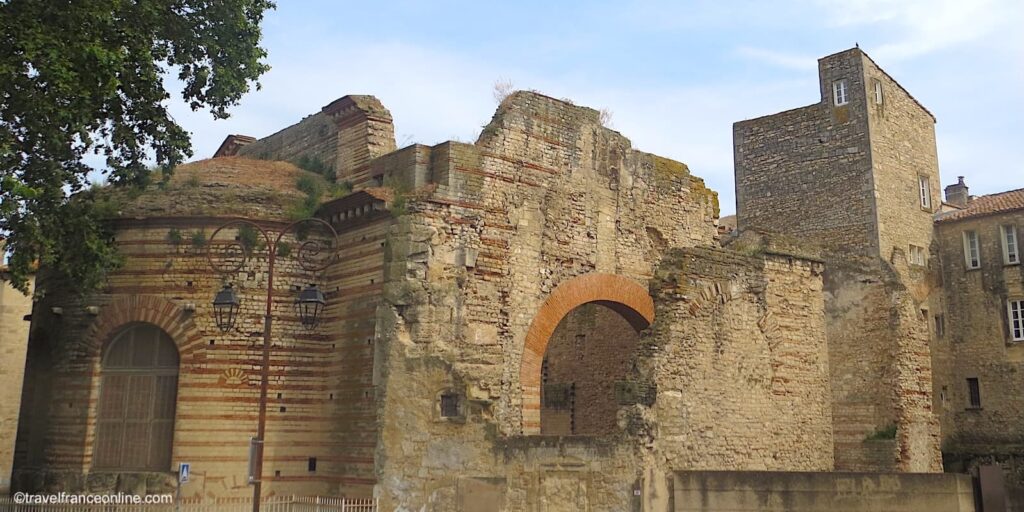
The Alyscamps necropolis is one of eight sites in the city of Arles inscribed on the UNESCO World Heritage List in 1981, alongside the Roman Amphitheatre, the Théâtre Antique, the Obelisk, the Forum Cryptoporticus, Saint-Trophime Cathedral and cloister, Saint-Honorat Church, and the Baths of Constantine.

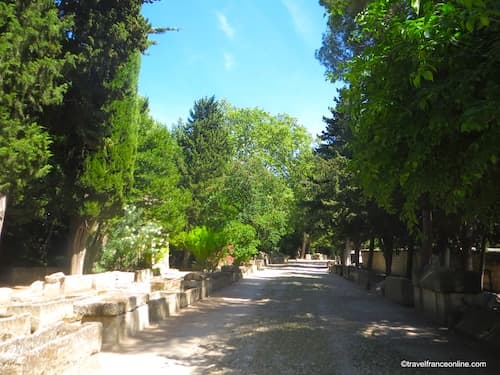
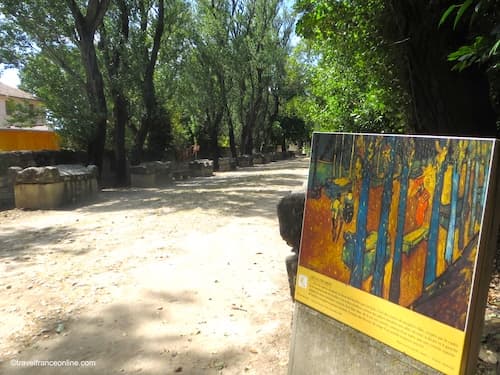
Why list an ancient necropolis? Because the Alyscamps is the most famous and unusual necropolis in Europe, a fact immediately apparent upon entering the site, which begins with a long, shaded avenue lined with ancient sarcophagi: the Allée des Tombeaux (Avenue of Tombs).
The Alyscamps necropolis was established during the Roman era along the Via Aurelia, outside the city walls. Romans didn’t bury their dead within the city ramparts, due to both obvious public health concerns and a lack of space.
However, this tradition also had a social dimension. Influential families spared no expense in erecting lavish funerary monuments along the roads leading to their cities, proudly displaying their wealth or their political and military status.
There was also a religious dimensions: the Romans believed that the deceased could only attained immortality if the living kept their memory alive. In that regard, they were certainly right!
They thus named the necropolis Alisii Campi (the Elysian Fields – Champs-Elysées), a name that eventually evolved into Alyscamps in the Occitan language.
The Alyscamps necropolis, a Christian burial site

The Church of Rome continued to use the pagan necropolis.
This transition began in 303 AD, when Genesius, a Roman scribe who had secretly converted to Christianity, refused to translate an imperial edict ordering the persecution of Christians.
Predictably, he fled but was soon captured and, naturally, beheaded, a favourite Roman punishment! His fellow Christians secretly recovered his remains (and, one hopes, his head!) to bury them in the Alyscamps necropolis.
Genesius thus became a Christian martyr (Saint-Genest in French).
Ten years later, Emperor Constantine signed the Edict of Milan with his Eastern counterpart, Emperor Licinius, granting Christians freedom of worship, a decision ratified by the Council of Nicaea in 325 AD.
The inhabitants of Arles followed Constantine’s example after his conversion to Christianity in 312 AD. Unsurprisingly, it was also from that moment that countless miracles began to occur at the tomb of Saint-Genest, quickly attracting crowds of pilgrims!
Everybody wanted to be buried at the Alyscamps, close to the holy man, as they hoped that he would intercede on their behalf at the Last Judgement!

The problem was that the Alyscamps necropolis became so sought-after that, within a few decades, burial plots were scarce and worth their weight in gold.
The solution? Stacking the coffins in three layers at each site, a practice that now seems somewhat shocking, but was then effective.
What is even more amazing is that the Alyscamps necropolis became the most coveted burial site of all. Some coffins were indeed transported by river from all over Europe, arriving in Arles via the Rhône.
Needless to say, local boatmen made a fortune transporting these coffins from the river!
The Alyscamps necropolis in the Middle Ages
In the 1040s, the Alyscamps necropolis came under the ownership of the influential Abbey of Cluny in Burgundy, which built the Church of Saint-Honorat among the tombs.

The necropolis’ popularity reached new heights when the church became the official gathering and departure point for pilgrims setting out on the Camino de Santiago. Imagine the hundreds, or even thousands, of pilgrims who walked the Allée des Tombeaux!
Although Arles was the starting point for our section of the Camino, we began at Saint-Trophime Cathedral to avoid retracing our steps. Still, we made sure to have our pilgrim credential stamped at the Alyscamps during our visit the previous day!
Returning to the necropolis: sadly, all things come to an end. The necropolis’ popularity and that of Saint-Genest began to fade in 1152, when the relics of Saint-trophime were brought back from the Holy Land and placed in the newly rebuilt Saint-Etienne Cathedral, which was then renamed Saint-Trophime Cathedral.
The Alyscamps necropolis, forgotten, rediscovered, and damaged!
Tragically, the Alyscamps necropolis not only lost its appeal but also served as a stone quarry during the 16th century Renaissance, when sarcophagi were sometimes repurposed as building materials.

Even more shocking, prelates and nobles pilfered them to enrich their private collections, showing little respect, if any, for the deceased!
However, in the 19th century, as interest in antiquity saw a widespread revival, the immense historical and architectural value of the Alyscamps was finally recognised, leading to its classification as a Historical Monument in 1840.
Unfortunately, despite this recognition, the site suffered severe damaged during the construction of the Paris-Lyon-Méditerranée (PLM) railway line. Clearly, at the time, the concept of national heritage carried less weight than industrial progress, and greed!
The Alyscamps necropolis was literally cut in two: railway tracks sliced through the heart of the site and the magnificent, tree-lined Allée des Tombeaux.
Worse still, many sarcophagi were broken open, and their human remains were never reburied with religious rites; it is said that they were simply dumped beneath the foundations of the tracks and the railway depot built on the site!
Remarkably, despite all these upheavals, what is left of the Alyscamps necropolis has retained most of its romantic atmosphere.
In the 1880s, Van Gogh and his friend Gauguin drew great inspiration from this blend of decay and beauty, setting their easels in the shade of the majestic trees to immortalise this unique site in many of their paintings.
Strolling along the beautiful Allée des Tombeaux
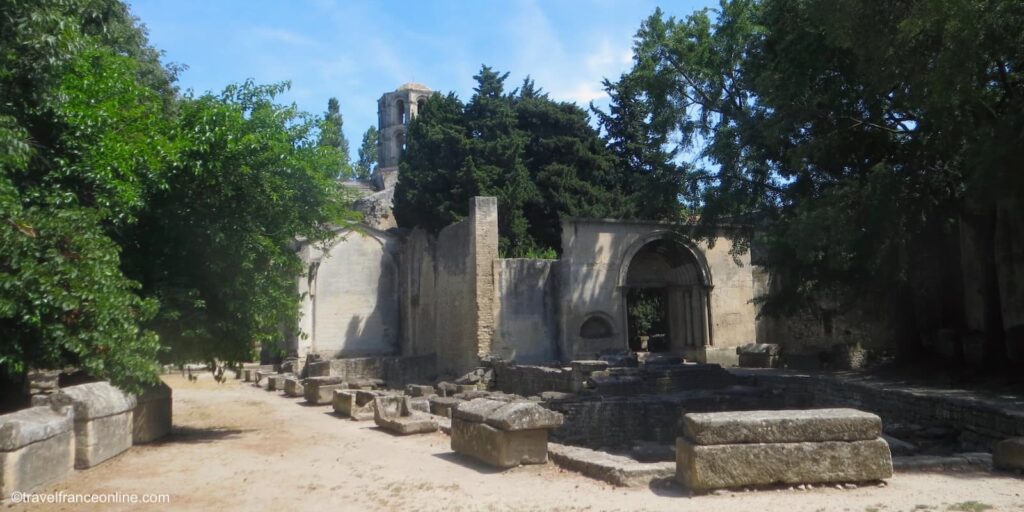
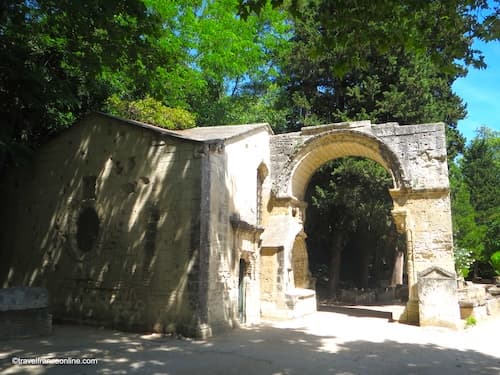
As you walk along the charming avenue, you’ll discover remnants of several oratories built in the previous centuries, such as the Chapel of Saint-Accurse, first used for atonement and later as a funerary chapel, and the adjoining Porch of Saint-Césaire-le-Vieux.
You’ll also come across the Porcelet Chapel (also known as Chapel of Our-Lady-of-Mercy), built in the 16th century for the Porcelet family, and the imposing Monument of the Consuls. It was erected in the 18th century to pay tribute to the city’s magistrates and officials who died while assisting residents during the great plague epidemic of 1720-1721.
Today, the Alyscamps necropolis is a wonderful and peaceful open-air museum, still romantic as ever! It’s easy to spend time wandering under the shade of the trees. The site is also an ideal place to visit on hot summer days, when the gentle breeze rustling through the leaves cools your face.
Finally, the Alyscamps necropolis is open from 9:00 a.m to 6:00 p.m. You’ll find the ticket office on site, by the entrance (€5 – 2026 rate).
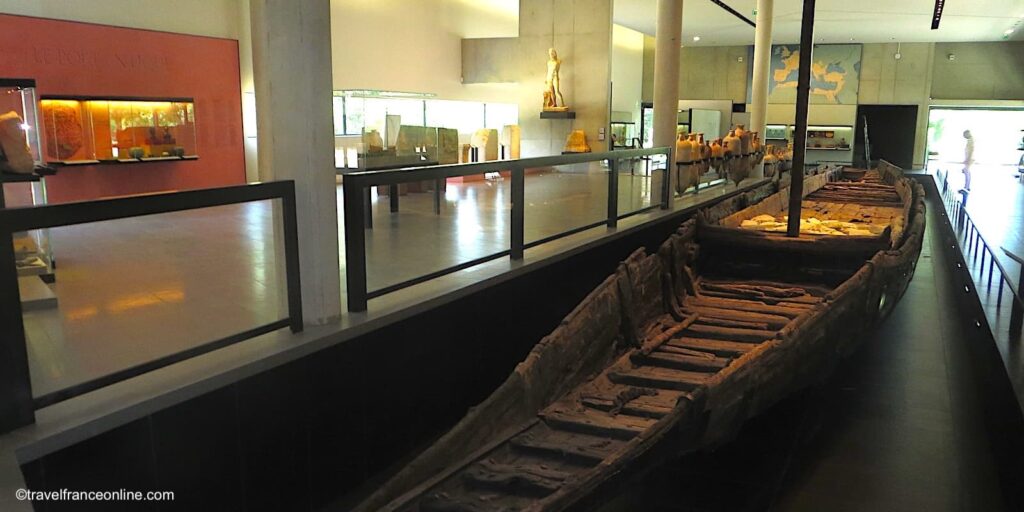
N.B. You can discover the finest sarcophagi (and the exceptional artefacts excavated form the city’s Roman monuments) in the Arles ancient history museum, near the former Roman circus.
And if you have plenty of time on hand, visit the Parc des Ateliers – LUMA Arles, a contemporary art and culture centre created by the city of Arles in the former railway workshops. The entrance is at No. 35 Avenue Victor Hugo, at the back of the Alyscamps.
N.B. You can discover the finest sarcophagi (and the exceptional artefacts excavated from the city’s Roman monuments) in the Arles ancient history museum, near the former Roman circus.