Saint Gilles du Gard
After a full day of walking through the Camargue, my friend and I crossed the Petit Rhône and arrived in Saint Gilles du Gard, the gateway to the Petite Camargue.
It was the first stop on our six-day hike along the Via Tolosana, one of the four major Camino routes in France.
Saint Gilles du Gard is a charming medieval town that developed around its magnificent 12th century abbey church, a UNESCO World Heritage Site, that houses the tomb of Saint-Gilles.
The legend of Saint-Gilles
In the 7th century, the hermit Gilles (Aegidius), a native of Athens, withdrew to a secluded cave in the woods that covered the region. Free from all earthly concerns, he devoted himself entirely to God. The monastery he founded, later became the Abbey of Saint Gilles du Gard, along the Via d’Arles (or Via Tolosana).
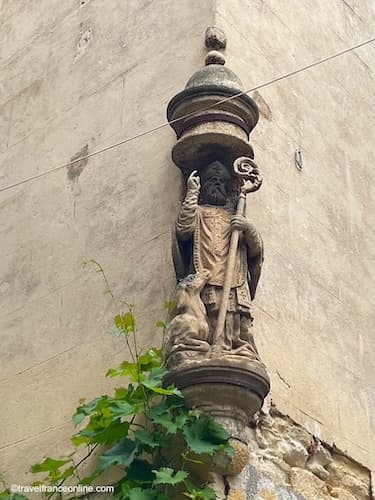
Saint-Gilles is traditionally depicted accompanied by a hind. According to legend, God sent him the hind to keep him company and provide him with milk.
One day, the Visigoth King of Spain, Wamba, went hunting with his retinue in the forest where saint-Gilles lived. The king’s hounds gave chase to the hind, which, exhausted, sought refuge at the hermit’s feet. Saint-Gilles shielded the animal from the hunters’ arrows with his own body, taking the blows in its place.
He chose not to treat the wound; it never healed, leaving him physically impaired. He viewed this physical frailty as a way to draw closer to God. Moved by the hermit’s sacrifice and holiness, the king ordered the hunt to cease.
To make amends and obtain forgiveness from Saint-Gilles, he had a monastery built on the site, at the holy man’s request.
Saint-Gilles became the patron saint of people with physical disabilities, the lame, and the outcasts.
The Benedictine abbey church of Saint Gilles du Gard
The abbey church of Saint Gilles du Gard replaced the monastery in the 12th century and became the fourth most important pilgrimage site in the Christian world, after Jerusalem, Rome, and Santiago de Compostela! The church, the abbey’s only remaining building, was inscribed on the UNESCO World Heritage List in 1998 as part of the Routes of Santiago de Compostela.
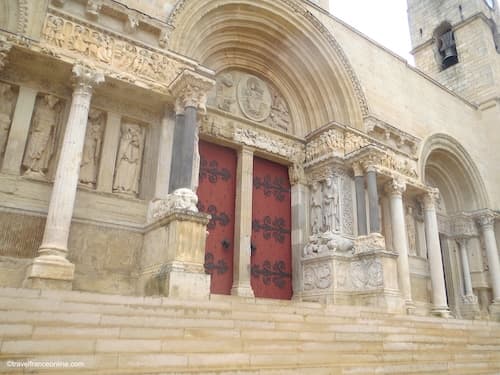
You can’t help but be in admiration upon entering the square, when you discover the church’s magnificent Romanesque facade with its three distinct bays linked by a single colonnade! The low-reliefs, depicting the Passion, Christ in Majesty, and the Betrayal of Judas, were originally painted in vivid hues, though most have faded over the centuries. However, you can still see some traces on the left-hand bay.
The Corinthian columns separating the bays, along with the geometric framing, were salvaged from Arles and Nîmes and added during a 19th-century restoration; this somewhat eclectic ensemble fits perfectly with the original architectural features.
The abbey indeed suffered severe damage throughout its history. This began in 1208 when the papal legate was assassinated there by a servant of the Count of Toulouse, a tragic event that triggered the Albigensian Crusade.
The Wars of Religion in the late 16th century brought even more disastrous consequences. Huguenots looted and set fire to the abbey, causing the collapse of the Romanesque chancel and part of the nave.
Only the crypt and the main facade escaped destruction, though both sustained serious damage, and the facade was once again vandalised during the French Revolution!
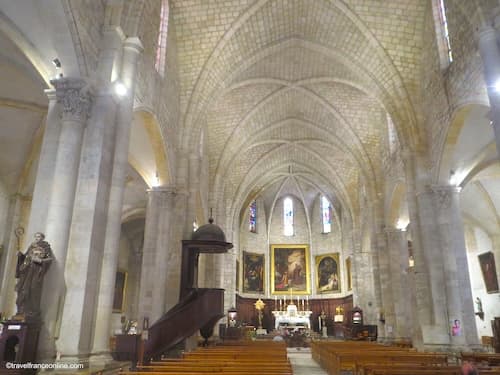
The current church was built in the 17th century, but due to a lack of funds, it couldn’t be rebuilt to its original dimensions; it is thus only half the size of the medieval structure!
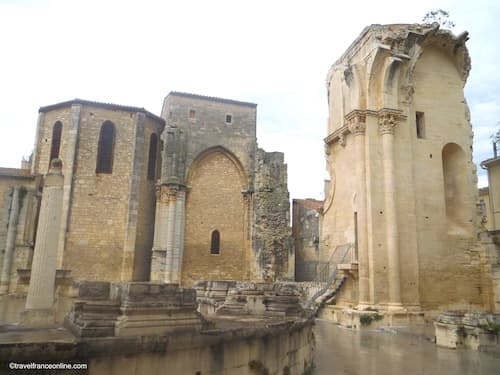
You can see the remains of the chancel and a spiral staircase in the courtyard that was created on site of the non-rebuilt section of the medieval church, at the rear of the current building.
The underground church-crypt
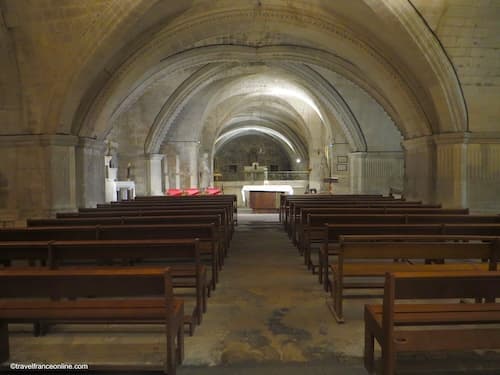
The abbey church of Saint Gilles du Gard is unique in that it consists of two distinct churches: the church at street level and the monumental underground church, often referred to as ‘crypt’.
This 50-metre-long Romanesque underground church boasts Early Gothic vaults that alone supported the medieval upper church!
It was built in the 11th century around the burial site of Saint-Gilles, which was rediscovered in 1865 and is now protected in a small enclosure.
The monks had moved the holy man’s relics to the Abbey of Saint-Sernin in Toulouse for safekeeping when Protestants looted the abbey in 1562.
Severely damaged once again during the French Revolution, the abbey church of Saint Gilles du Gard was then abandoned and the crypt served a s a dumping ground for rubble, which eventually covered Saint-Gilles’ tomb.
The tomb of Saint-Gilles
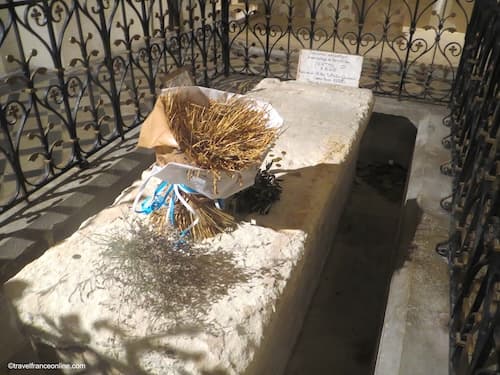
In 1865, The Historical Monuments Commission undertook the much-needed restoration of the abbey church of Saint Gilles du Gard, starting with the clearing of the church-crypt, where workers uncovered an intact stone sarcophagus.
Once cleaned, the stone revealed Latin inscriptions dating to the 10th century; these left no doubt as to the authenticity of the tomb: it was indeed that of Saint-Gilles!
The sarcophagus was left in place and, once the crypt’s structure was stabilised and secured, the relics of Saint-Gilles were brought back from Toulouse.
Today, pilgrims on the Way of Saint-James can pray at the tomb of Saint-Gilles and ask for his protection for the rest of their journey, just as thousands of pilgrims did in the Middle Ages.
The abbey church of Saint Gilles du Gard’s spiral staircase

The abbey church of Saint Gilles du Gard is renowned for its exceptional spiral staircase (Vis de Saint-Gilles), located in the open courtyard at the rear of the church.
Its reputation is well-deserved, as it is a truly unique architectural wonder. In 1562, Protestant troops destroyed the abbey and its church, leaving just a section of the spiral staircase that stood where the north transept met the chancel.
However, what remains of it offers a glimpse of its design, considered an architectural feat and masterpiece of stone-masonry: a self-supporting stone vault shaped like a snail shell.
Throughout the Middle Ages, master masons and guild members from across Europe thus made the pilgrimage to Saint Gilles du Gard to study the staircase and unlock the secrets of its stone construction!
The fortified Porte des Maréchaux
During the 11th and 12th centuries, Saint Gilles du Gard was one of Christendom’s most prosperous towns and a major stop on the pilgrimage trail, at the crossroads of two important routes.
The Via Regordane (or Chemin de Saint-Gilles), a 240-kilometre secondary route linked Le Puy-en-Velay in the north to Saint-Gilles. The Via of Arles or Via Tolosana, one of the four great French pilgrimage routes, started in Arles and traversed the country from east to west via Saint-Gilles.
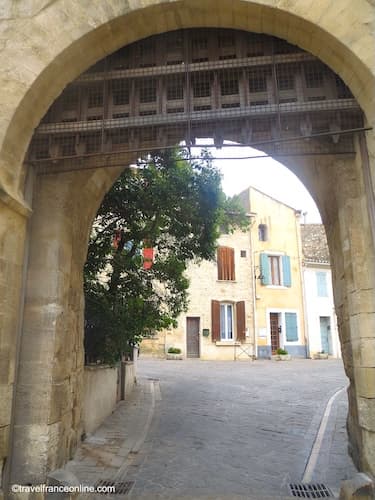
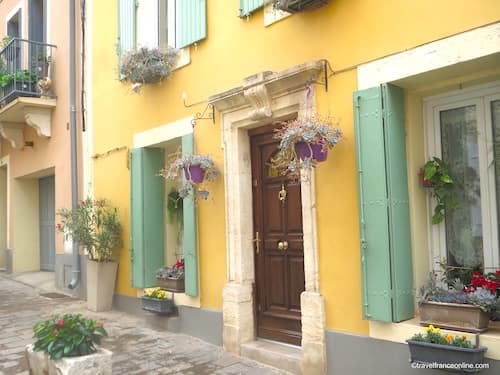
Remarkably, the town has preserved its medieval cobblestone streets line with 12th-century houses (a rare feature), though the Porte des Maréchaux is the only remnant of its fortifications. The fortified gate opens directly onto the lane (today known as Rue de la Porte des Maréchaux) taken by pilgrims arriving on the Via Regordane to reach the tomb of Saint-Gilles in the abbey church.
Originally named the Porte de Mazel (or Macel), an old Occitan term referring to the nearby slaughterhouse and meat market, the gate was renamed in the 19th century. This change followed the relocation of the slaughterhouse and meat market and the arrival of numerous farriers (maréchaux-ferrants) who set up shop by the gate to shoe the horses of passing travellers.
Built from Beaucaire stone, its semi-circular arch still bears remnants of the mechanism that once operated its heavy iron portcullis.
Amazingly, the Porte des Maréchaux escaped destruction during the Wars of Religion and the French Revolution, unlike the other fortifications, as it had been integrated into the town’s second defensive wall in 1360.
The Maison du Grand Prieur
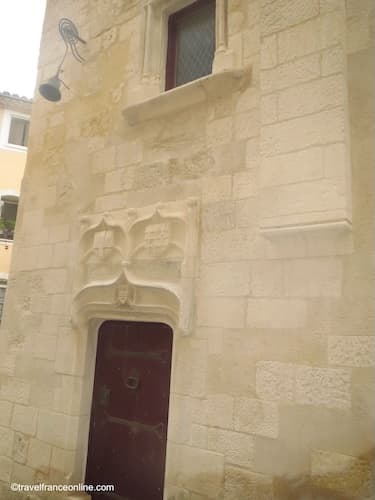
You’ll find Rue Rouget de l’Isle and the Maison du Grand Prieur a few steps away from the Porte des Maréchaux. The house belonged to the Order of Saint-John of Jerusalem (also known as the Order of the Hospitallers), which became known in the 16th century as the Order of Malta.
The Hospitallers established a first hostel in Saint-Gilles during the 14th century, outside the city walls, near the present-day Bas-Rhône-Languedoc Canal, to welcome and protect pilgrims and the destitute.
Their Grand Prior resided within the city walls in the Maison du Grand Prieur. An influential figure, he oversaw some fifty establishments across Provence. Jean de la Valette, Grand Master of the Order of Malta, and founder of the Monastery of Valetta during the 16th century, initially served as Grand Prior in Saint Gilles du Gard.
That said, the Knights Templar built the original residence during the 12th century, at the height of the Crusades.
Saint-Gilles was then a strategic river port from which soldiers, pilgrims, and supplies departed for the Holy Land. The Templars acquired land to establish a fortified monastery, as Saint-Gilles served as their primary military port.
Yet the Order of the Temple, deemed too wealthy and powerful, was dissolved by order of the King of France in 1312, and its assets were transferred to the Hospitallers in 1313.
In the late 15th century, the Hospitallers Grand Prior, Cellion de Demandolx, had the Templar residence demolished to build the current Maison du Grand Prieur.
The building has retained many stunning Gothic architectural features, such as mullioned windows and an ancient doorway adorned with ogee arches and coats of arms. A beautifully restored rammed-earth borders the garden along the street.
The medieval lanes of Saint Gilles du Gard all boast a remarkable history in their own right; together with the abbey church, they turn the town into a must-visit destination in the region!