
Gruesome & Ghostly Paris – Paperback and Kindle editions
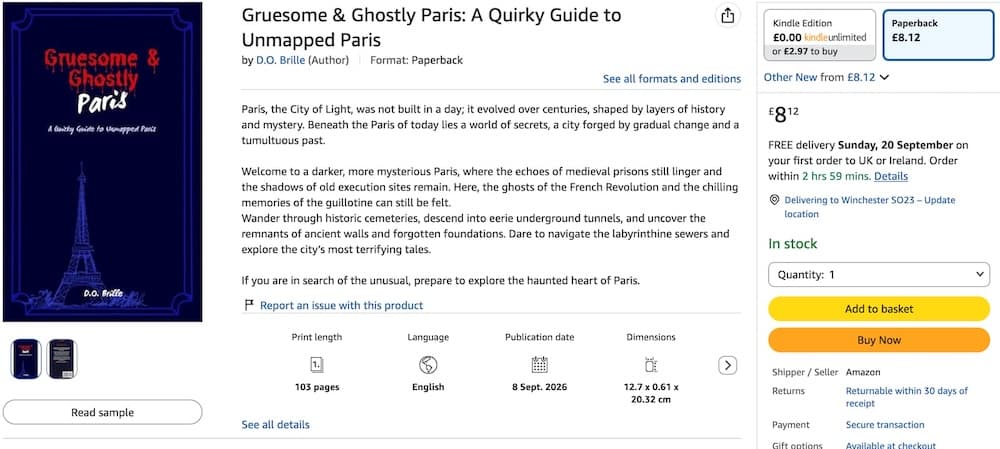
Gruesome & Ghostly Paris isn’t about Paris of glossy guidebooks, it’s a Quirky Guide to Unmapped Paris and you GET IT ON AMAZON!

Paperback

Kindle edition
A few months ago, I released the Kindle edition (E-book) of Gruesome & Ghostly Paris on AMAZON, and the print edition has now arrived letting you hold the secrets of Paris in your hands! I couldn’t have chosen a better month than October to introduce my book, as we’re in the countdown to Halloween, a time well-suited for spooky, unsettling stories…
When you think of Paris, you might picture yourself on a sun-drenched café terrace with a steaming café-crème in hand, admiring the city’s grand monuments as you glide along the Seine on a bateau-mouche, or strolling through the picturesque, steep lanes of Montmartre before gazing out over the city’s rooftops from the heights of Notre-Dame Cathedral.
So, forget the picture-postcard city! In Gruesome & Ghostly Paris, I invite you to explore Paris’s dark corners, far from the crowds and the clichés. This is not Paris of glossy guidebooks, but a metropolis rich in hidden histories, strange places, and tales etched into the very stone.
Paris was not built in a day; it took centuries for it to become the City of Light and Romance. But beyond these familiar images and beneath its polished appearance lies another Paris, a city shaped as much by shadow as by light. Its beauty is undeniable, yet its secrets run just as deep; echoes of violence, stories of the condemned, and shadows of turbulent eras are woven into the city’s fabric.
As you turn the pages of Gruesome & Ghostly Paris, you will discover medieval prisons where despair and suffering were an everyday occurrence, as well as the chilling places where sentences were carried out by blade or rope. You will meet the city’s most infamous executioner and follow in the footsteps of those sacrificed amidst the chaos of the French Revolution.
Gruesome & Ghostly Paris will take you to haunted sites, mass graves, and the vast city cemeteries, where generations of Parisians, both famous and forgotten, rest. You will descend into the city’s depths to discover forgotten ramparts and the Catacombes, where the remains of six-million Parisians were gathered after the city’s old parish cemeteries were closed, and finally to the sewers, the capital’s true belly. You will also discover rare relics and the stories of the patron saints who have watched over Paris through the centuries.
Gruesome & Ghostly Paris will take you to discover a multifaceted, secret, and unforgettable Paris.
Want to skip straight to the book’s details on Amazon?
How did I come up with the idea for Gruesome & Ghostly Paris?
Since 2011, I have invited you to discover the regions of France and Paris through the articles I enjoy sharing on this site. France is a magnificent country with diverse landscapes and climates, each one worth exploring thoroughly. But, without being overly parochial, Paris holds and special place in my heart; it is the city where I was born, grew up, and attended university. Although I have lived abroad for many years, Paris will always be “my city”, a multifaceted place that never ceases to intrigue me.
Paris’s history is indeed fascinating; like any ancient metropolis, it has constantly reinvented itself over the centuries, shaped by political regimes, territorial and religious wars, invasions, and epidemics. True to its motto, “Fluctuat nec mergitur“, it has sailed on (for over 2,000 years) without ever sinking, even when it teetered on the brink of disaster.
So, after years of research for my articles, I gradually uncovered many of the city’s secrets, which I have now compiled in Gruesome & Ghostly Paris to produce A Quirky Guide to Unmapped Paris!
Let me offer you a sample of Gruesome & Ghostly Paris
“Chapter I : Gruesome jails and places of public executions
Over the centuries, Paris had a considerable number of prisons, all under the control of various authorities, including the Counts of Paris, the Kings of France, and abbeys.
That said, this is where things get grim. Criminals of the time were subjected to particularly atrocious ordeals. Interrogated under torture, they were put to death by an executioner. The methods of execution were extremely brutal and varied according to social rank.
Nobles and aristocrats were beheaded with a sword, while commoners were condemned to the axe; heretics were burned at the stake; forgers were plunged into a boiling cauldron, and regicides and major criminals were drawn and quartered, a punishment as horrific as it sounds! From 1534 onward, thieves and murderers were subjected to the breaking wheel, another atrocious form of torture. Imagine being tied to a large, X-shaped wooden frame, limbs outstretched, while the executioner breaks your bones and chest with an iron bar!
As macabre as it sounds, the crowds of the time were morbidly fascinated by all the blood and guts. Public executions were important events, always held on Sundays and holidays. Crowds came from far and wide to secure a front-row place and brought food and drink to pass the time, eagerly awaiting this horrific spectacle which satisfied their morbid impulses.
But things became a little more humane in 1791 with the introduction of the guillotine. Calling the guillotine “humane” may seem strange, but compared to centuries of torture, it was a considerable advance! Let’s though correct a misconception: Mr Guillotin didn’t invent the guillotine but “promoted” its use. He indeed claimed that it guaranteed equality of punishment, resulted in instant death and spared unnecessary suffering. The military surgeon Antoine Louis perfected the machine, which had existed in a rudimentary form since the 16th century.
The guillotine thus made its debut in 1792 in the Place de Grève (now the Place de l’Hôtel-de-Ville). It was later moved to various locations, such as the Place du Carrousel (Louvre), the Place de la Révolution (Now the Place de la Concorde), the Place de la Bastille, the Place Saint-Jacques, and the Place du Trône Renversé (the Place de la Nation).
It was only installed for executions and stored away the rest of the time. However, from 1851 to 1870, it stood in front of the Grande Roquette prison (11th district), where imprints of its base are still embedded in the pavement. The Prison de la Santé (14th district) replaced the Grande Roquette in 1909, and the guillotine was installed at the corner of Boulevard Arago and Rue de la Santé.
The last public execution took place in Versailles on June 7, 1939. However, the executioner, Marcel Chevalier, carried out the last execution in the Marseille jail on September 10, 1977. Fortunately, those dark days are now a thing of the past, but the sites remain, and where there’s an executioner, there’s bound to be an executioner…”
Want to read the rest of Gruesome & Ghostly Paris? Click on the universal link: GET IT ON AMAZON
Paperback


