Montpellier, the city of the Guilhem dynasty
Let me take you on a journey of discovery through Montpellier, the third stopover on our six-day trek along the Via Tolosana, one of the four major routes of the Camino in France.

Montpellier is a historic and vibrant university city, yet its origins differ significantly from those of the other cities in southern France, which were founded by the Greeks or Romans.
Montpellier indeed came into existence on November 26, 985, when Count Bernard II of Melgueil (modern-day Maugio) granted a plot of land to the knight Guilhem to reward him for his unwavering support in repelling rival lords and bandits who sought to encroach on his county.
The land was strategically situated between the ancient Roman Via Domitia, which linked Rome to the Iberian Peninsula via the Gallia Narbonensis, and the Lez and Mosson rivers, and just a stone’s throw from the Mediterranean ports.
Guilhem built a stronghold on a hill once covered in scrub-land, which earned it its original name Mont Pestelario (Bald Hill). However, fields of woad, a plant used to produce a magnificent blue dye, had replaced the scrub-land by the time Guilhem took possession of his estate. His fortress on Mont Pislerianus, or Woad Hill, protected merchants, travellers, and pilgrims from bandit attacks.
His descendants continued this tradition of protection, and soon, several communities sprang up around the stronghold. Markets trading in spices, silks, and dyes flourished, attracting people from all ways of life as they journeyed between Italy and Spain.
However, the prosperity of the medieval city stemmed not only from its exceptional geographical situation but also from the spirit of openness and tolerance of Lord Guilhem VIII. In 1180, he indeed issued a decree allowing Jewish and Muslim communities to settle and play a major role in the city’s commercial expansion.
In 1204, the city came under the rule of the Crown of Aragon when Marie of Montpellier, the last heiress of the Guilhem dynasty, married King Peter II of Aragon. This alliance had a highly positive impact on the city until 1359, when it was sold to the French Crown. It was during this period that Mont Pislerianus, which had become known as Montepestlerio, and Montpeilier, officially adopted its current name: Montpellier.
The ramparts of Montpellier
In 1196, Guilhem VIII commissioned a two-kilometre-long wall to protect Montpellier, which then experienced rapid demographic and economic growth and had already expanded beyond its original boundaries.
Completed in 1284, this defensive structure had 25 towers and 8 fortified gates. The medieval city came to be known as L’Écusson (Escutcheon) because the ramparts, which followed the lay of the land, gave it a pentagonal shape reminiscent of a coat-of-arms or shield (Écusson).

Montpellier became a major Protestant stronghold in the 1560s as the Protestant Reformation spread like wildfire across Southern France. Many inhabitants revolted against the Catholic Crown and converted to Calvinism during the Wars of Religion. The Edict of Nantes, in 1598, granted them freedom of worship and full control over Montpellier for the next sixty years.
The Catholic Louis XIII captured the city in 1622 after a 50-day siege. Believing the strength of the ramparts had allowed the inhabitants to hold out for too long, he ordered their total demolition to assert his authority, restore Catholicism, and prevent future uprisings.
Of the original 25 towers, only 2 remain: the Tour Babote and the Tour des Pins. The first was spared because it had been incorporated into an adjacent public building, while the second was preserved as it flanked a Catholic bastion. The Tour Babote stands at the southern end of L’Écusson, and the Tour des Pins to the north, alongside the Jardin des Plantes. The latter was named after two wild pine trees that had taken root atop the ramparts! As for the name Babote (Babota in Occitan), it means ghost: locals once believed that restless spirits haunted the tower!
However, although the ramparts disappeared long ago, their memory lives on in the current circular boulevards that follow their pentagonal layout.
L’Écusson, Montpellier’s historic district
The medieval city, L’Écusson, is today completely closed to vehicular traffic and is Europe’s largest pedestrian urban zone. Its cobbled streets, locally known as circulades, are laid out in concentric circles within the footprint of the long-vanished city walls.

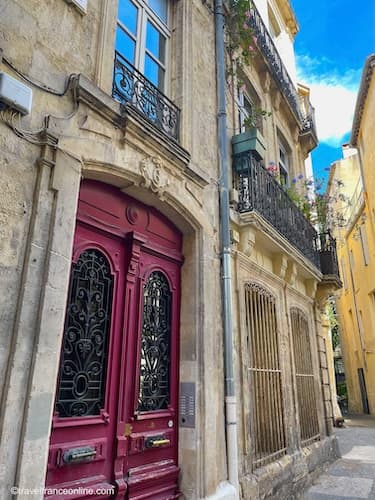
The architecture of L’Écusson is a unique blend: 10th-century medieval structures stand alongside Classical-style buildings from the 17th and 18th centuries, including nearly 80 magnificent private mansions built for the local elite, as well as grandiose 19th-century edifices.
The medieval houses, packed closely together, are linked by a maze of narrow alleys, while the grand mansions are concealed behind austere, imposing facades. Their grands porches open onto splendid Italian-inspired courtyards, featuring majestic staircases, wrought-iron balconies, and a wealth of carved details; every feature was designed to impress and reflect the prosperity of their owners!
Part of L’Écusson was modernised in the 19th century, drawing inspiration from Haussmann’s Paris. Wide avenues, such as the Avenue Foch, were cut through the medieval quarter near Place de la Comédie, lined with imposing limestone buildings boasting elegantly decorated facades.
This blend of urban architecture styles perfectly reflects the city’s expansion and evolution over the centuries.
L’Écusson is home to several popular public squares. The oldest, the Place de la Canourgue, located just steps from the cathedral, is a small green oasis featuring the charming 1776 Fontaine de la Licorne (Unicorn). Canourgue derives from the Old Occitan word canorga, meaning Canons’ House, the residence of the clergy attached to the cathedral.

The Place de la Comédie, the city’s vibrant heart, was named after the theatre. Locals affectionately nicknamed it L’Oeuf (The Egg) because of its distinctive oval shape. It is Europe’s largest pedestrian square!
Laid out in 1755 with an oval design to facilitate the movement of horse-drawn carriages around the theatre, it was later significantly enlarged, although the original central paving, featuring grey and cream marble, was preserved. It is home to the Fontaine des Trois Grâces (Three Graces), a bronze replica of the original 1773 statue, which is now kept inside the theatre to protect it from pollution.
The Opéra Comédie, renowned for its stunning Italian-style facade, was built in 1888 by Joseph-Marie Cassien-Bernard, a student of Charles Garnier, the architect of the Paris Opera house. It replaced two theatres previously erected on the same site: the first, built in the mid-18th century, was destroyed by fire in 1785; the second, built in 1878, also burned down in 1881!
University and Faculty of Medecine of Montpellier
Medieval Montpellier saw the birth of one of France’s most iconic institutions: the oldest medical school in the world still in operation, having functioned continuously for over 800 years!
By 1180, Montpellier was already a bustling, vibrant city. Situated at the crossroads of major trade routes, it flourished thanks to a decree by the enlightened Lord Guilhem VIII, who authorised the settlement of Jewish and Muslim communities.
Montpellier thus became a true melting pot, where merchants and physicians, Christian, Jewish, Muslim, and Greek, could freely practice.
These physicians introduced medical treatises translated into all languages spoken in the city. Such intellectual and practical freedom was unique in the medieval world, where knowledge and education was the exclusive prerogative of the Catholic clergy!
The physicians of Montpellier formed a guild, and in 1220, the papal legate granted it its first official statutes. The Montpellier medical school was born! In 1289, Pope Nicholas IV issued a papal bull officially establishing its status as a university.
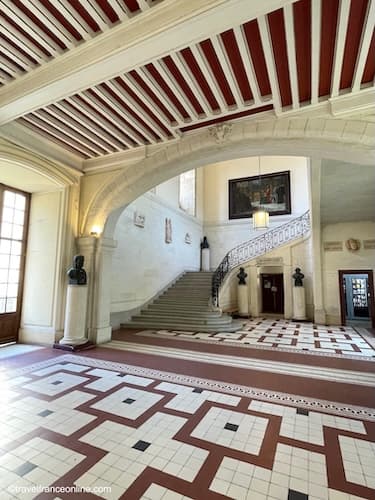
From then on, Montpellier became a prime destination for medical students from across France and Europe. The quality of education was exceptional; as early as 1340, the university was indeed officially allowed to conduct anatomical dissections, a practice forbidden elsewhere, enabling students to gain a deep understanding of human anatomy and physiology.
Many students who studied there went on to achieve worldwide renown, most notably Michel de Nostredame, better known as Nostradamus, who enrolled in1529. Legend has it that he was expelled for working as an apothecary, an activity prohibited by university regulations.
Another famous name associated with the Faculty of Medecine of Montpellier is François Rabelais, one of the most illustrious French humanists of the Renaissance; he earned his doctorate in medicine in 1537 and even taught anatomy at the school.
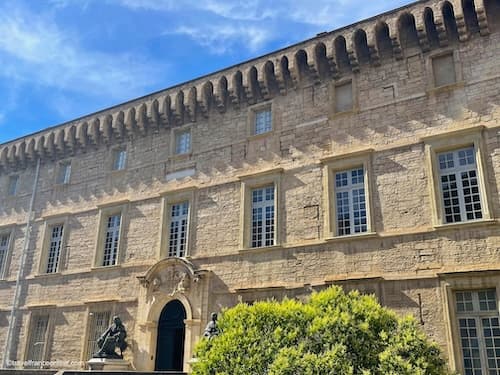
Since 1795, the Faculty of Medicine has occupied the magnificent buildings of the Benedictine monastery of Saint-Benoît-Saint-Germain, which housed the relics of Saint-Germain, one of France’s early Christian bishops.
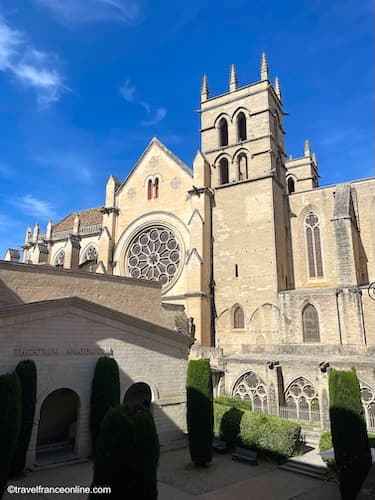
The monastic school, founded at the request of Pope Urban V in 1354, flanks the church, which became the Cathédrale Saint-Pierre when the bishopric was transferred to Montpellier in 1536.
It operated until 1790 (French Revolution), when it became state property; the monks were expelled, and the buildings were striped of their religious features to make way for the medical school. Until then, classes had been held in various buildings scattered throughout L’Écusson district.
Although all French universities were abolished during the Revolution, the Montpellier Faculty of Medicine was spared; the revolutionaries obviously recognised the nation’s need for physicians and reopened the faculty as the École de Santé!
Today, the historic building can no longer accommodate all of Montpellier’s medical students. A new site, the Arnaud de Villeneuve Campus, has been established in the north of the city.
However, the magnificent building still houses the Dean’s office, the spectacular Anatomy Museum, and a library containing thousands of rare medical volumes. The courtyard is that of the former cloister, and a side door directly connects the school the the cathedral transept, a remnant of the monastic era!
Jardin des Plantes of Montpellier
The Jardin des Plantes de Montpellier is the oldest botanical garden in France and even served as the model for the Jardin des Plantes in Paris!
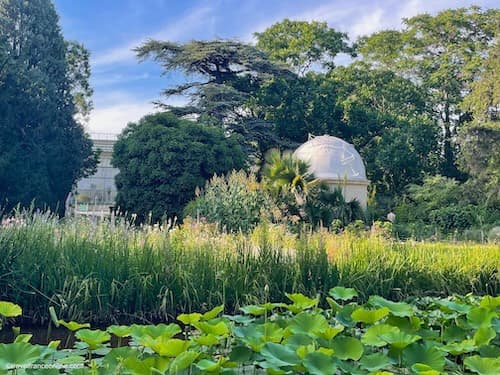
In 1593, King Henri IV ordered the creation of the botanical garden for the Montpellier Faculty of Medicine and commissioned the botanist Pierre Richer de Belleval to design it. Intended exclusively for practical and scientific purposes, this garden enabled students to cultivate and study live medicinal plants, rather than relying solely on texts and sketches.
This garden was destroyed in 1622, when Louis XIII besieged the Protestants entrenched behind the city ramparts. Situated right at the foot of the city’s northern walls, near the Tour des Pins, it indeed became a battlefield!
Once peace was restored, Belleval worked tirelessly to rebuild the garden from scratch. The ‘new’ Jardin des Plantes reopened its doors to Montpellier medicine students in 1629. Over the centuries, it has expanded from 1 hectare to its current size of 4.6 hectares.
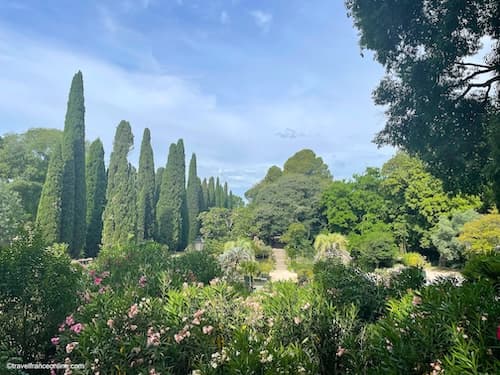
However, all that remains of the first garden is the artificial mound Belleval created to enable students to observe the impact of microclimates on various plants. Its southern slope is home to Mediterranean species adapted to full sun, while its northern slope shelters plants from cooler climates.
At the top of the mound, you’ll also find the Phillyrea latifolia,or WishingTree, planted by Belleval in 1620. It indeed miraculously survived the 1622 Siege of Montpellier, likely because of its youth and hardiness. It is the only survivor from the original garden; at 400 years old, it is also considered the oldest specimen of its species in France! According to tradition, residents and students slip little love notes or handwritten wishes, (perhaps for success int heir exams!), into the tree’s gnarled trunk.
The splendid Orangerie was built in 1804 to house plants and citrus trees during the winter months.
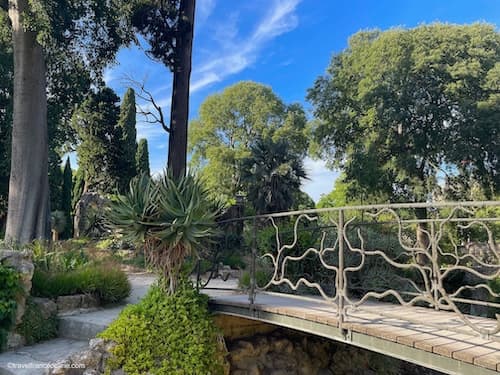
The equally beautiful Serre Martins (greenhouse named after botanist Charles Frederic Martins, the garden’s director from 1851 to 1880) was added in 1860 to cultivate succulents from tropical regions such as cacti, aloes, and agave. It is also known as Serre des Cactus.
The Faculty of Medicine opened the botanical garden to the public in the late 18th century, after the Revolution. Technically, the garden belongs to the French State, but the faculty manages its operations and maintenance in collaboration with the City of Montpellier.
Unsurprisingly, this magnificent public garden was designated a Historical Monument in 1992, and in 2022, the Ministry of Culture awarded it the Remarkable Garden label.
Arc de Triomphe or Porte du Peyrou
Although Montpellier’s ramparts were demolished in the 1620s, a monumental triumphal arch was erected some sixty years later on their site to link L’Écusson, Montpellier’s historic centre, to the Promenade Royale du Peyrou. Once the rubble from the ramparts had been cleared, the open space indeed called for a monument to mark the city’s western entrance.
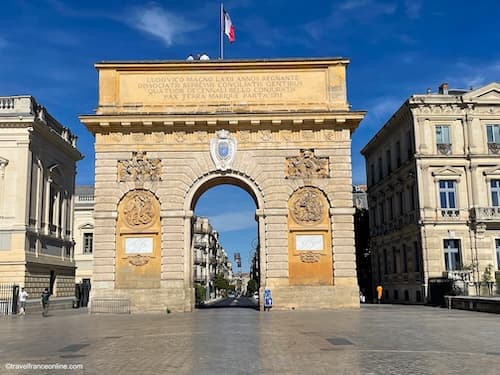
However, the arch was designed in 1693 primarily to pay tribute to Louis XIV. The plans were drawn up by François d’Orbay, a royal architect trained under Jules Hardouin-Mansart, who had worked on the expansion of the Palace of Versailles.
D’Orsay drew inspiration from the triumphal Porte Saint-Denis in Paris, adopting its style and dimensions ; the 15-metre-high and 18-metres-wide Arc de Triomphe of Montpellier is indeed equally imposing!
The sculptures illustrate Louis XIV’s military victories, and historical events: the capture of Namur during the War of the League of Augsburg, depicting the United Provinces kneeling before Louis XIV, who is portrayed as the Roman hero Hercules being crowned by Victory; the creation of the Canal du Midi, a vital link between the Mediterranean and the Atlantic; and the Revocation of the Edict of Nantes, which stripped Protestants of their religious freedom, recalling the 1622 Siege of Montpellier.
This stunning triumphal arch was designated a Historical Monument in 1954.
Promenade du Peyrou

The Arc de Triomphe faces the Promenade du Peyrou, a square originally laid out in the 17th century as the Place Royale du Peyrou atop a hill rising 52 metres above sea level, the highest point in Montpellier.
Once a desolate area covered in wild scrub-land, this hill was known as the Puy d’Arquinel (puy meaning summit). Due to its rocky, arid soil, locals nicknamed it Peyrou (stony in Occitan).
The hill lost its medieval name, Puy d’Arquinel, when it was levelled in 1685 to make way for a vast royal square, officially named the Place Royale du Peyrou.
The hill offered an unobstructed view of the surrounding countryside, making it the perfect location for this new square.

France was still under the reign of Louis XIV, the Sun King, and the grandeur of the site reflected the tribute his architect wished to pay him. Architect Jean-Antoine Giral, inspired by the Place de la Concorde in Paris, designed and organised the space.
He had the original square, planned in 1753 by his father, Étienne Giral, demolished to create symmetrical tiered terraces, stone balustrades, and tree-lined promenades, and installed an equestrian statue fo Louis XIV at its centre.
He also built an elegant, hexagonal water tower, adorned with Corinthian columns and arcades. This structure connects to the Saint-Clément Aqueduct, a 14-kilometre-long conduit that brings fresh water to the city from the valley below.
Unfortunately, the square suffered significant damage during the French Revolution. The equestrian statue of the Sun King was melted down to make cannons, and the park fell into neglect.
In 1828, King Charles X commissioned renowned sculptors Debay and Carbonneaux to recreate the imposing bronze statue depicting Louis XIV as a Roman emperor. The statue was installed in 1828, during the reign of Louis-Philippe.
The impressive wrought-iron gates supported by stone pillars topped with sculpted lions that mark the entrance to the square were installed in 1883.
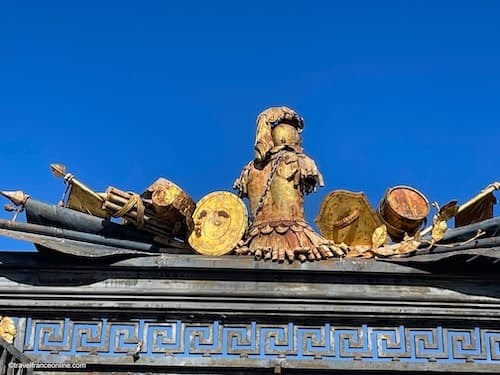
The eastern entrance is surmounted by a suit of armour, complete with a helmet and gilded shields. Much like the triumphal arch, these martial trophies pay tribute to Louis XIV’s military victories.
The park was also redesigned as a vast public garden featuring a symmetrical layout, divided into terraces lined with double rows of plane trees.

The promenade was surfaced with gravel to accommodate a steady stream of strollers. It runs around the esplanade and offers a panoramic 360-degree view of the city and the Cévennes mountains and, on a clear day, the Mediterranean Sea!
The Promenade du Peyrou, one of the city’s iconic landmarks, was designated a Historical Monument in 1954.
It is an ideal spot for relaxation. Locals gather there to stroll or play pétanque in the shade of the trees. And, if you visit on a Sunday, you’ll discover a lively flea and antique market.
Saint-Clément Aqueduct
Until the end of the 17thcentury, private wells and public fountains supplied the inhabitants of Montpellier with water. However, as the population grew, these sources became inadequate. This situation led to the decision to build an aqueduct to ensure reliable water supply to the city.

Yet nearly fifty years passed before the city council commissioned hydraulic engineer Henri Pitot to design and oversee its construction! The foundation stone was indeed laid on June 13, 1753, and the aqueduct was completed twelve years later.
For the urban section of the structure, known as Les Arceaux, which spans 800 metres and features a double tier of arches, Pitot drew inspiration from the Pont du Gard, considered a masterpiece of Roman engineering. He had previously adapted the latter for road traffic by constructing a new road bridge against the downstream side of the lowest tier, retaining the Roman bridge its aesthetics while reinforcing its foundations. Pitot was thus the quintessential specialist!
The Saint-Clément Aqueduct was inaugurated on December 7, 1765, and has supplied the city of Montpellier with fresh spring water ever since! It draws water from the Saint-Clément Spring, located in Saint-Clément-Rivière, some 14 kilometres north of Montpellier.
Cathédrale Saint-Pierre in Montpellier
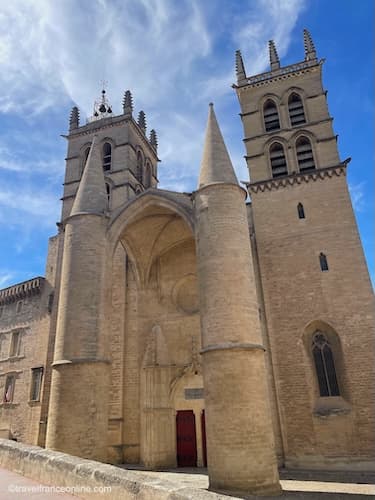
Finally, Montpellier is, of course, famous for its Cathédrale Saint-Pierre, which looks more like a fortress than a church!
The cathedral’s origins date to 1364, when Pope Urban V ordered the construction of the adjoining Saint-Benoît-Saint-Germain monastery. In 1356, the local bishop’s seat was transferred to Montpellier, thereby transforming the monastery church into a cathedral.
You can’t help but be impressed by the monumental porch, which is supported by massive pillars measuring 4.5 metres in diameter! Connected to the facade by a canopy, they were designed less for aesthetics than for defence.
And with good reason: their massive piles houses guardrooms and defensive staircases, as the monastery had been built outside the city walls and thus had to be self-defending.
These defensive features proved crucial during the Wars of Religion, when Montpellier became a Protestant stronghold. In 1561, the Huguenots indeed besiege the cathedral, where Catholic residents had taken refuge; the defenders used the systems built into the pillars to hold their ground.

However, the Protestants eventually captured the building, and for several days, worked relentlessly to undermine the foundations of the Saint-Benoît Tower, located behind the porch.
When it finally collapsed in 1567, it brought down the main facade, the vaults, and the original 14th-century nave. Yet the porch, supported by its colossal pillars, remained standing!
Sadly, the cathedral was left in ruins for 60 years years. After recapturing the city in 1622, King Louis XIII ordered its reconstruction to restore Catholic authority. The nave was rebuilt in Gothic style, less ornate that the original, yet equally spectacular.
A new Neo-Gothic chancel was added in the 19th century, creating a striking blend of architectural eras.
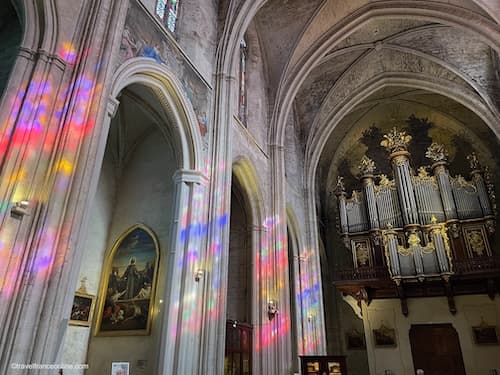
The cathedral boasts several remarkable features, including the grand organ. Built in the 18th century from dark wood and adorned with gilded angels, it has over 5,000 pipes and 70 distinct stops.
You’ll also find a large canvas, The Fall of Simon Magus, by Sébastien Bourdon, a Montpellier native and one of the greatest Baroque artists of his time.
Finally, one of the side chapels stands out: the Chapel of Saint-Roch, rediscovered by chance during electrical work in 2017. Hidden behind a plaster partition, it boasts a magnificent 17th-century trompe-l’oeil painting by Jean de Troyes.
As you walk beneath the stone vaults and arches of the vast nave, you cannot help but feel admiration, especially when the large stained-glass windows filter the sunlight and cast a spectrum of colours onto the soaring columns: a true feast for the eyes, yet also a sense of the sacred and the divine!

The cathedral apparently is still connected to the Faculty of Medicine by a side door located in the transept, a relic of the monastic era…
A final word:
Did you know that the city has implemented a policy offering free tram and bus travel around the historic centre for all residents, to discourage them from using their cars? However, sorry, this doesn’t apply to us tourists!
How to get there? Montpellier is served by the Montpellier-Méditerranée Airport, located just 11 kilometres from the city centre.