Monts d’Aubrac, an untamed country

The Monts d’Aubrac, a name that evokes a vast expanse of windy plateaus, covered with peat bogs and dense forests where wolves once roamed.
This untamed region extends across the departments of Aveyron, Cantal and Lozère.
The wild beauty and isolation of the region inspired many frightening legends, particularly among medieval pilgrims who travelled the Via Podensis on their way to Santiago de Compostela.
Aubrac is also the name of a village and a monastery-hospital located at an altitude of 1,300 metres.
La Dômerie d’Aubrac
Adalard, a Flemish pilgrim, founded La Dômerie after being attacked by bandits.
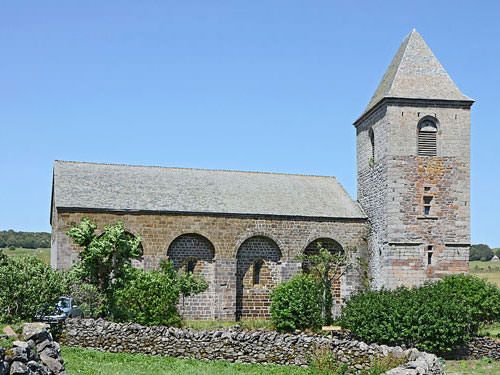
Since its creation, the Dômerie has offered refuge to hundreds of pilgrims, guided through the fog and bad weather by the sound of the monastery bell, the Cloche des Perdus (Bell of the Lost). They found shelter there for the night and resumed their journey at dawn after a traditional cheese-based meal.
The small village developed rapidly around the monastery. The Church of Notre-Dame-des-Pauvres was built in the 12th century, a bell tower was added in the 16th century, and the Tour des Anglais (English’s Tower) in the 14th century.
The church and the hospital are the only remaining vestiges of the original monastery. The Via Podiensis, a very popular hiking route, connects Le Puy-en-Velay to Santiago de Compostela. This 135 km stretch crosses the region, passing through superb fortified medieval towns such as Saint-Cosme-d’Olt, Conques and Espalion.
Hikers stopping in the village of Aubrac can visit the Maison de l’Aubrac, which offers an insight into the region’s rich history and traditions.
Aubrac means cows!
But don’t be afraid. The region is now safe!
The wolves that once haunted the dark forests and spread terror among men and animals have long since disappeared. In their place, you will find the magnificent cows, the undisputed “Queens of the Aubrac Mountains“.
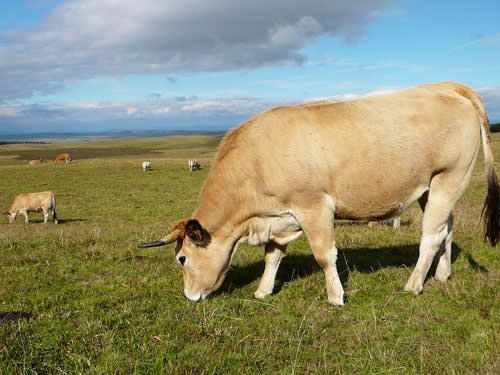
This ancient breed, with its fawn coat and gentle eyes rimmed in black, produces some of the best milk and meat in France. Their reputation is unrivalled, and the “Aubrac” quality label guarantees that they are fed exclusively on grass in summer and hay in winter.
Like the Lacaune ewes, these cows spend the summer in the alpine pastures. The transhumance, which takes place in May, is an occasion for joyous festivities, one of the highlights of the region’s pastoral life. Beautifully adorned with ribbons, flowers and colourful bells, the herds are led along the drove roads towards the plateaus.
Once there, the animals graze in vast enclosures surrounded by stone walls until Saint-Géraud’s Day, October 13th. Men and beasts form a joyful, lively crowd, gathered for the Transhumance Festival. This age-old tradition concludes with a feast of local beef, tender and tasty meat served with the famous Aligot.
Cows means cheese!
Unfortunately, very few huts or burons remain where shepherds produced their cheese. However, the Jeune-Montagne cheese cooperative in Laguiole has revived the local cheese-making tradition.

An audiovisual presentation at the cooperative details the making of Laguiole cheese, from the fresh Tome of Aubrac to the finished product (Laguiole AOC), ready for sale and tasting.
The ripening period varies from four months to one year, depending on the desired degree of maturity and aromatic intensity.
The cooperative produces various AOC cheeses, such as Laguiole, Grand Aubrac and AOC Vieux, as well as aligot. There is so much to discover and enjoy!
Aveyron department
Coordinates: Lat 44.621589 – Long 2.985022
Photos via Wikimedia Commons: Domerie by Pline CC BY-SA 3.0 – Laguiole Cheese by Jesmade CC BY-SA 3.0