Arles amphitheatre, a replica of the Colosseum in Rome
The Arles amphitheatre is one of the largest and best-preserved outside Italy; it’s also among the eight monuments, all in a remarkable state of preservation or restoration, that earned the city its place on the UNESCO World Heritage List.

Arles lies on the Via Tolosana, one of the four routes of the Way of St. James, and served as a starting point for my first Camino, a six-day hike. My friend and I dedicated a full day to exploring the city’s historical sites:
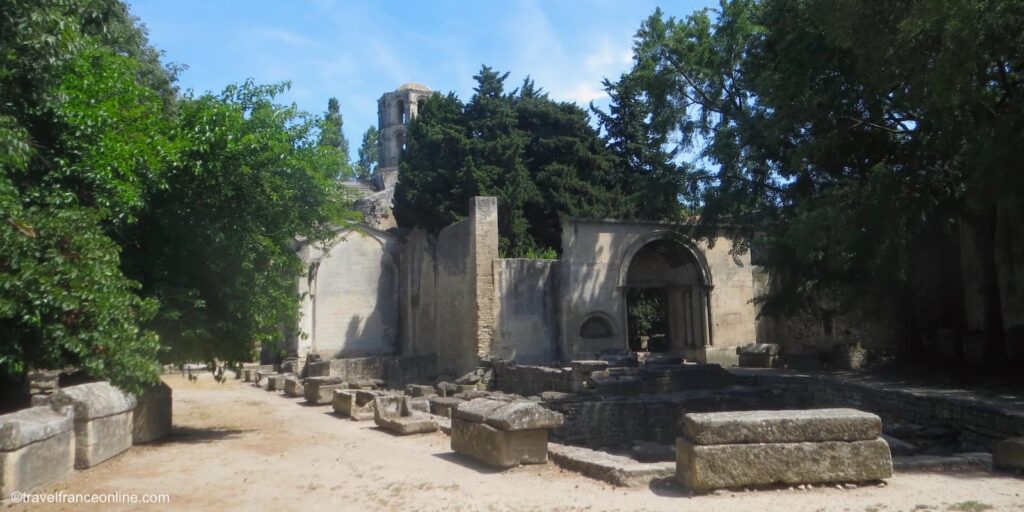
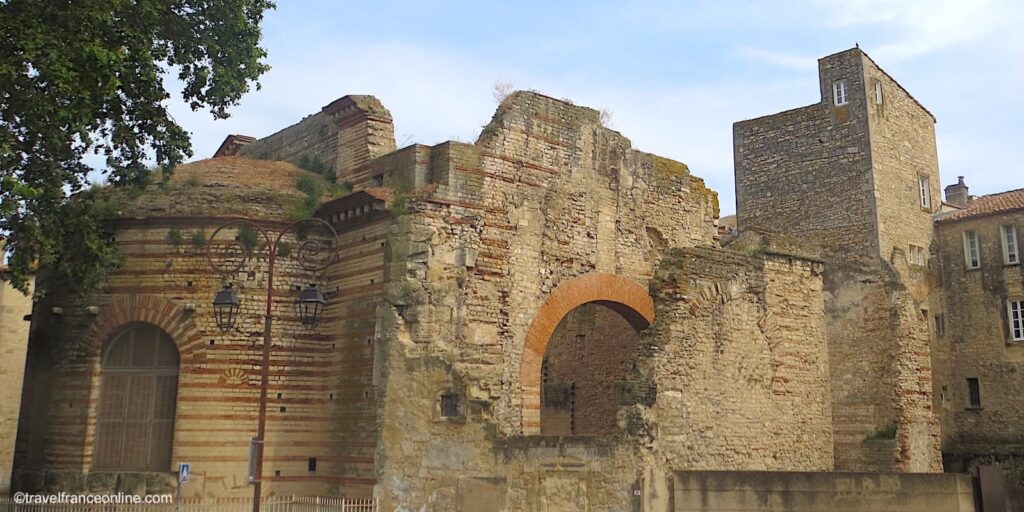
The Cathedral and Cloister Saint-Trophime, the Alyscamps necropolis and the Church of Saint-Honorat, the Théâtre Antique (Roman Theatre), the Forum Cryptoporticus, the Roman obelisk, the Baths of Constantine, and as our first stop, the spectacular amphiteatre or Arènes d’Arles in French.
Built in 90 AD, the Arles amphitheatre measures 136metres in length, and consists of two tiers surrounding an oval central arena , and it could accommodate 21,000 spectators.
Despite its massive size, crowds could enter and exit quickly thanks to a system of double galleries, an inner ring and an outer ring, alternatively connected by horizontal passageways and staircases.

At the time, Arles (then known as Arelate) was part of the Roman Province of Gallia Narbonensis, and the emperor was Domitian. The newly built amphitheatre was a replica of the Colosseum in Rome and the largest in the province, earning the city the nickname of “Little Rome“.
The Arles amphitheatre stands on a hill known as Colline de Hauture, which was partially levelled to make way for its construction. Like the Colosseum in Rome, it served multiple purposes, hosting gladiator combats (of course) as well as various games and festivities.
It remained in use until the fall of the Roman Empire in the late 5th century BC.
Arles amphitheatre, a fortified city
As the collapse of the Roman Empire coincided with waves of barbarian invasions, the inhabitants of Arles converted their amphitheatre into a fortress where they took refuge.

They indeed built an entire city within its enclosure: over 200 houses, two chapels, and four defensive towers! Naturally, thus caused significant damage to the building’s structure, as dwellings were erected not only on the area floor but also on the tiered seating and beneath the arches of the galleries, repurposing the original stonework. It’s nothing short of a miracle that the Arles amphiteatre has survived to the present day!
It was not until the late 18th century that these dwellings were expropriated, but the final houses were not demolished until 1840. That same year, the amphitheatre was designated a Historical Monument and secured the desperately needed funding for its restoration; there was a great deal of work to be done!
Arles amphitheatre, a gem of Roman architecture
Restoration efforts, launched in the early 2000s under the supervision of the Chief Architect of the Historical Monuments, were completed in 2013, and the amphitheatre reopened to the public.
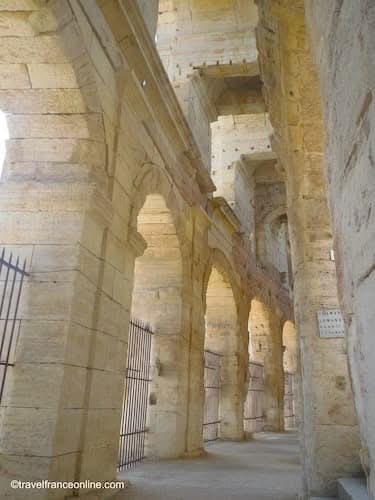
A true gem of Roman architecture and a source of pride for Arles, it has also reclaimed its role as an arena. The seating areas have been adapted to allow the public to attend various events, such as bullfighting or corridas (I know, this is not to everyone’s taste), Camargue-style bull games, theatre performances, and concerts.
As I wandered through the galleries arcades and tiered seating, I couldn’t help but feel transported back in time, imagining the scene as it must have been twenty centuries ago, the area packed with spectators. I pictured the crowds streaming through the arcades of the galleries that seem so spacious today, amidst an atmosphere alive with noise, anticipation and excitement. Street vendors clustered at the gates, calling out to customers, while children pressed eagerly against the entrances, hoping for a glimpse of the spectacle unfolding inside.
Today, the Arles amphitheatre is framed by elegant townhouses that accommodate various shops and restaurants.
My friend and I chose to spend our evening at a restaurant located right across from the amphitheatre’s main entrance; seated on the terrace, we savoured a local dish while enjoying the late-afternoon sun. We had an unobstructed view of this remarkable structure, and it was the perfect spot to soak in its grandeur. What a treat!
But let’s go back to the beginning of our days of discovery. The amphitheatre is just a stone’s throw from the Théâtre Antique (Roman Theatre), our next stop.
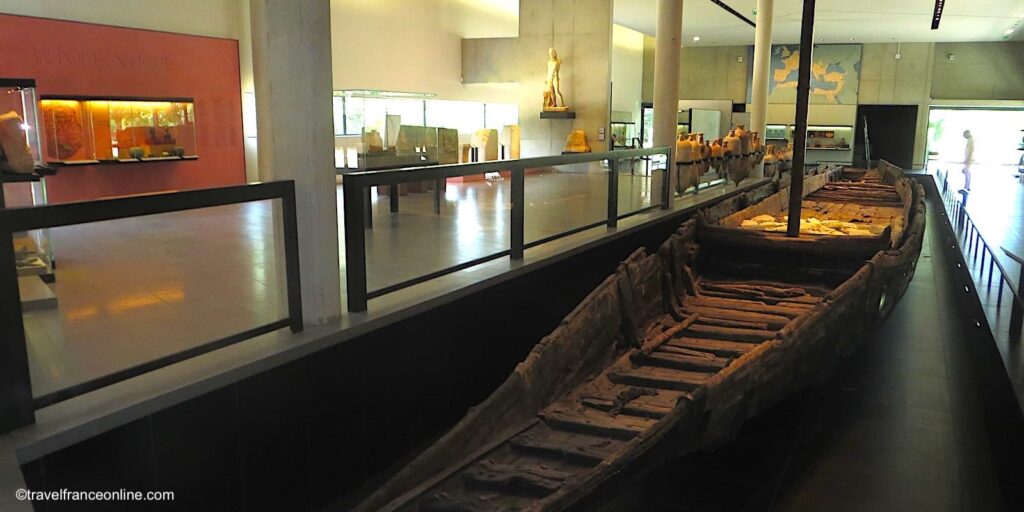
N.B. You can discover the exceptional artefacts excavated in the Arles ancient history museum, near the former Roman circus.
Wikimedia Commons: 18th-century engraving by J.B. (Jean Baptiste?) Guibert is Domaine public