The birth of Arles Ancient History Museum
In a series of eight articles, I introduced you to the UNESCO-listed monuments and sites in Arles: the Roman Amphitheatre, Ancient Theatre, Obelisk, Forum Cryptoporticus, Saint-Trophime Cathedral and cloister, Saint-Honorat Church, and the Alyscamps necropolis.
You can admire the countless artefacts unearthed when these monuments were excavated at the Arles ancient history museum (Musée Départemental Arles Antique). Located in the southern edge of the city, the museum houses the most comprehensive collection of archaeological finds in Provence! Arles was indeed one of the region’s most important Roman cities, known at the time as Little Rome.
However, following the fall of the Roman Empire an the late 5th century AD, the city fell into neglect. Its monuments were used as stone quarries and their ruins were gradually buried under layers of earth, fading into oblivion.
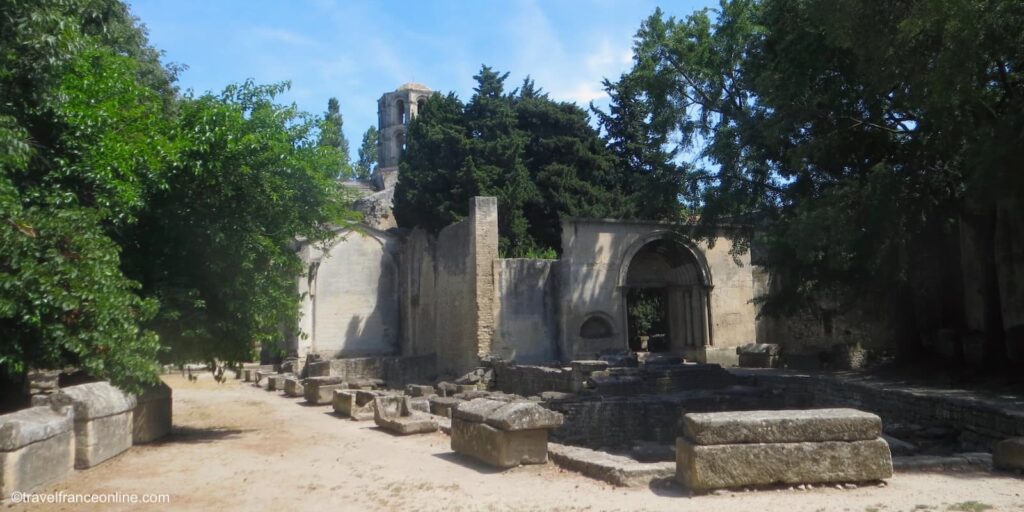
It was not until the late 16th century that a wealthy, enlightened art collector sparked a genuine passion for antiquity by publishing a book on the city’s origins. Soon, an initial collection of archaeological artefacts was assembled through donations and acquisitions. The Order of the Minims gathered the largest collection of carved stones and sarcophagi in the open-air courtyard of Saint-Honorat Church, located in the Alyscamps necropolis.
Unfortunately, many of these pieces were looted or destroyed during the French Revolution. In the early 19th century, the finest works were transferred to the Louvre and the Marseille History Museum.
This decision displeased Paul Véran, a respected local museum curator, who managed to secure an imperial decree in 1808 authorising the return of these collections Arles and their storage in Sainte-Anne Church on Place de la République.
In 1830, major excavations of the Amphitheatre began with the demolition of the 212 houses that had been built within it during the Middle Ages. Excavations of the Roman Theatre, located next to the Amphitheatre, took place three years later.
As for the Alyscamps necropolis, it was unfortunately truncated during the constructions of a major railway line. These various projects unearthed numerous objects that enriched the existing collections. However, storage space became inadequate; a lapidary museum was thus established in 1936 in the former Jesuit Saint-Vincent Church to house Christian artefacts. The remains from the Christian and Roman were thus separated and displayed in two distinct locations.
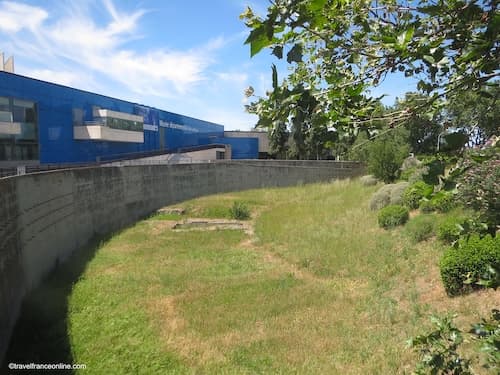
It was not until 1960 that the decision was made to built a large museum to bring all the collections together under one roof!
However, constructing this new facility within the city proved impossible due to the lack of space. A site at the western end of the former Roman circus was therefore chosen, a symbolic way of maintaining a historical link with antiquity.
In 1983, architect Henri Ciriani was selected to lead the project, and the museum’s foundation stone was laid in 1988. Ciriani chose to clad the facade of this ultra-modern building in blue enamelled glass panels, a tribute to the city’s perpetually blue sky!
Arles Roman circus
Before entering the Arles ancient history museum, look over the concrete barriers, and you’ll discover the southern tip of the ancient circus. The oval shape is clearly visible, and although the original track has vanished, its outline is recreated by the way the grass is trimmed.
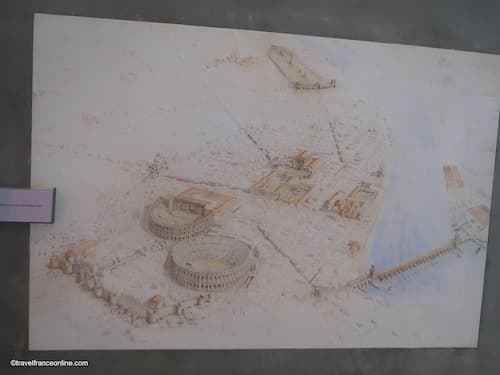
We are on a peninsula southwest of the city, jutting into the River Rhône, the only area where the Romans found enough space to built their circus in 149 AD. Roman architects and engineers thus faced the challenge of extremely marshy ground, mainly silt and clay.
They had to stabilise the site before building by driving thousands of oak wood pillars into the ground.This circus was indeed gigantic, measuring 450-m-long and 101-m-wide! The obelisk (today on Place de la République) stood on the median barrier that divided the track into two parallel lanes for chariots racing in opposite directions.
The circus could accommodate 20,000 spectators, who flocked to watch chariot races and cavalry displays. Excavations have revealed twelve starting gates, allowing the circus to hist high-level races with three chariots for each of the four traditional Roman teams. This was a privilege reserved for imperial cities, and Arles was one. Indeed, let’s not forget that Julius Caesar made Arles a Roman colony and that Emperor Constantine settled there in the 4th century!
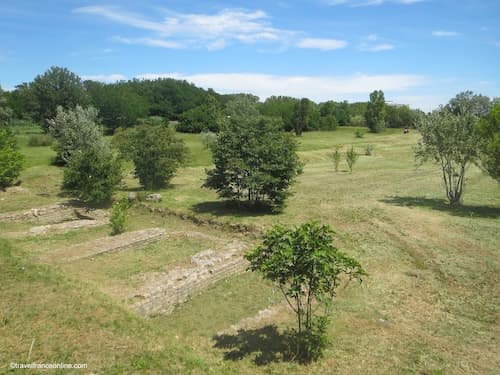
Like the city’s other Roman monuments, the circus was abandoned after the fall of the Roman Empire at the end of the 5th century. Without maintenance, it eventually subsided, and its stones were salvaged to erect new dwellings. Today, all that remains of this vast circus is its imprint in the ground, still easily visible as well as the tracks’ location, and numerous remnants of stands.
The site is now preserved as a vast green space, undeveloped but well maintained. Decorative artefacts, sculptures, and inscriptions unearthed during previous excavations have all been gathered in the museum.
A quick stroll in Arles Ancient History Museum
The Arles ancient history museum showcases artefacts spanning from the Neolithic era through the Roman and Christian periods, covering a timeline from 3000 BC to 476 AD. Every piece on display boasts remarkable archaeological and historical value.
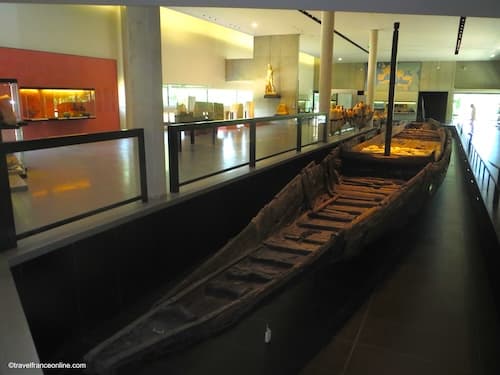
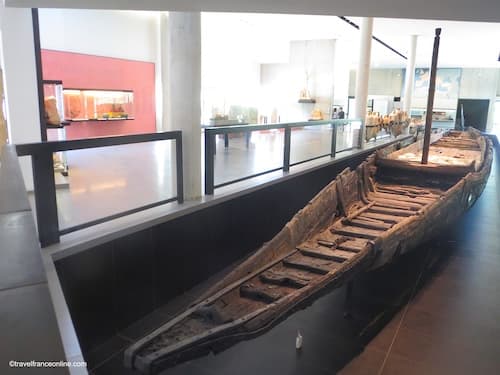
One of the museum’s masterpiece is the nearly complete wreck of a 31-m-long Gallo-Roman barge, discovered in 2003, buried in the silt not far from the museum. Known as Arles-Rhône 3, it provides extraordinary insight into river life and transport during antiquity.
The museum also features the oldest known representation of Julius Caesar: a marble bust sculpted during his lifetime in 46 BC and recovered from the silt of the Rhône in 2007.
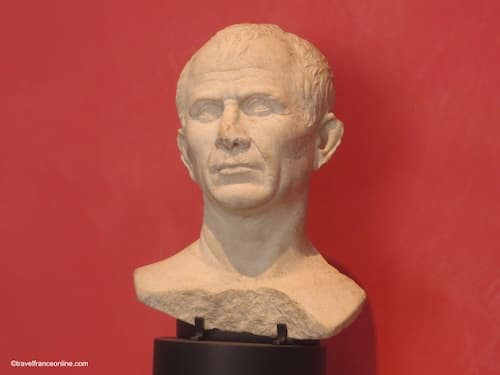
This bust is strikingly realistic, capturing every detail of Caesar’s face, from his wrinkle and receding hairline to his square jaw and the slight tension in his neck! The emperor was very fond of Arles, which had supported him in his conflict against his rival Pompey. In gratitude, he granted the city the status of Roman colony.
Another exceptional bust is that of the Greek goddess Aphrodite (known as the Head of Arles), and a replica of the statue of her Roman counterpart, Venus, the goddess of Love. The original Venus was discovered in 1651 among the ruins of the Ancient Theatre. In 1683, the city gifted it to King Louis XIV, who had it restored and placed in the Louvre, where you can still admire it today.
The museum also displays a gigantic statue of Augustus. Standing 3-metre tall, it originally stood on the back wall of the Ancient Theatre’s stage.
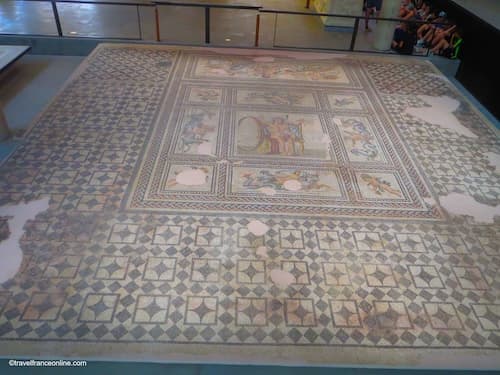
Many floor ceramics recovered from ancient Roman villas have been reassembled in the museum, where you can admire them in their entirety from an elevated wooden walkway.
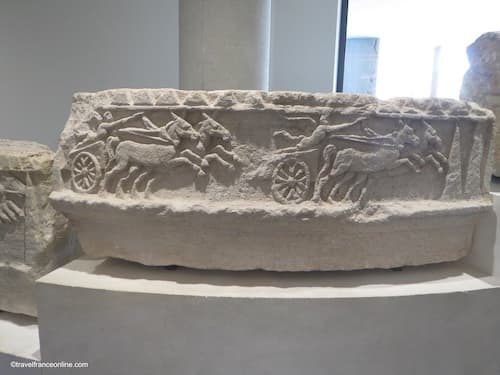
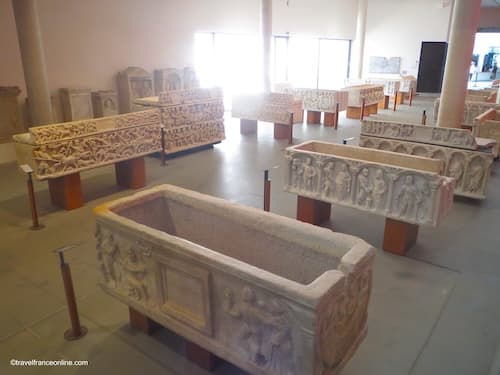
Finally, the Arles ancient history museum boasts one of the most complete collections of Roman and Christian sarcophagi.
The finest, carved in marble and depicting mythological and Christian scenes, were recovered from the Alyscamps necropolis.
This is only a glimpse of the wonders in display in the Arles ancient history museum. A visit can easily take two to three hours. The building is filled with natural light and offers plenty of space to explore the various exhibits at your own pace.
Hortus Garden, near the Arles Ancient History Museum
In 2010, a vast public park spanning 5,000 square metres, the Jardin Hortus, was landscaped next the museum.
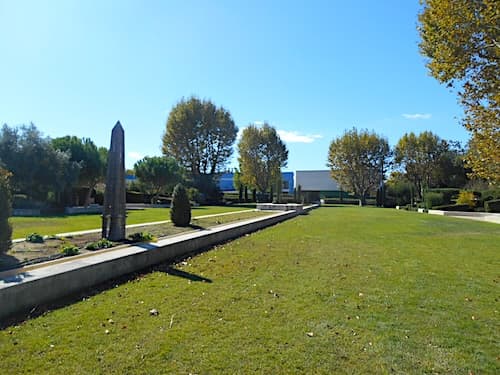
Its oval layout mirrors the shape of the ancient circus: the lawns represent the racetrack, laurel hedges mimic the stands, and a central cypress tree symbolically marks the place of the obelisk. The garden is designed for education and relaxation, and features planted areas, thematic gardens, and a series of interactive play zones inspired by ancient Roman games.
A 15-minute walk will take you from the city centre to the Arles ancient history museum. A pleasant, landscaped promenade along the Rhône River will lead you to the Presqu’Île du Cirque Romain, allowing you to enjoy the gentle river breeze.
The Arles ancient history museum marked the final stop on our day exploring Arles, just before we embarked on our six-day hike along a segment of the Via Tolosana, one of the four French routes on the Camino.
Wikimedia Commons: Jardin Hortus by xx is Sophiedidacressources — Travail personnel CC BY-SA 4.0