Baths of Constantine part of the imperial palace
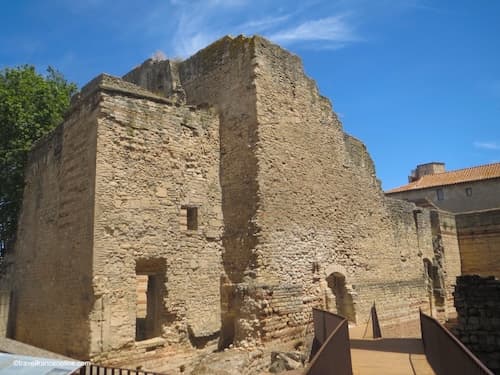
The Rhône River played a crucial role in the development of the port of Arles. It was thus along its bank that the Baths de Constantine were built in the early 4th century AD, during the reign of Emperor Constantine the Great.
These baths are among the city’s eight monuments inscribed on the UNESCO World Heritage List in 1981 alongside the Amphitheatre, the Theâtre Antique, the Roman Obelisk, the Forum Cryptoporticus, Saint-Trophime Cathedral and cloister, the Alyscamps necropolis and the Church of Saint-Honorat.
I spent a whole day with a friend exploring the remarkable city of Arles before setting out on our six-day hike along a section of the Via Tolosana, one of the four routes on the Camino.
Why did we choose Arles as our starting point? Simply because Arles was not only a vital river port and strategic crossroads, but an imperial city and one of the jewels of Roman Provence, then referred to as Little Rome.
The Romans indeed founded Arelate in the 1st century BC and equipped it with all the essential buildings today on the UNESCO List, including two long-gone bath complexes.
Four centuries later, Emperor Constantine commissioned the construction of a palace with baths on the banks of the river.
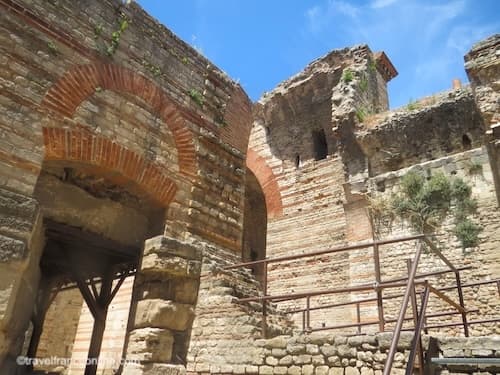
The Baths of Constantine remained in use until the fall of the Roman Empire in the late 5th century. Once abandoned, they gradually fell into ruin, not because the inhabitants of Arles dislike bathing, but because the aqueduct supplying water was no longer maintained and eventually partially collapsed.
For centuries, right up until the 16th century, their ruins were believed to be the emperor’s palace. However, the layout and specific characteristics of the rooms ultimately revealed that they were thermal baths, rather than residential quarters.
Who was Emperor Constantine?
Constantine was undoubtedly an enlightened ruler who left his mark on the history of the West an, naturally, that of France.
He put an end to the persecution of Christians and granted them freedom of worship throughout the vast Roman Empire by signing the Edict of Milan in 313 AD. He concluded this historic secular agreement with the Eastern emperor, Licinius. In 325 AD, Constantine convened the Council of Nicaea, the first religious council in the history of the Church. This assembly reaffirmed religious freedom and established the liturgical calendar.
Constantine’s primary goal was to prevent religious differences from jeopardising peace within his unified empire! After a series of military campaigns, he had indeed succeeded in reunifying the Roman Empire, which had been previously divided between East and West. In 330 AD, he founded Constantinopolis, modern-day Istanbul, to serve as his new capital. Bordered by three bodies of water, Constantinople was easier to defend. It was also situated on major trade routes linking West to East, safely away from Germanic hordes and a sufficient distance from Rome, a politically dangerous city!
But let’s return to Arles, between 308 and 312 AD, when Constantine built the palace from which he planned the conquest of the Eastern Roman Empire. Arles was a thriving port and a strategic commercial crossroads, controlling trade between the Mediterranean and Northern Europe. Its geographical location made it an ideal base for all his military campaigns.
In 313 AD, he established a imperial mint to directly pay and provision his troops at the front line; transporting bags of coins from Rome was indeed slow and fraught with risk. It was also a brilliant PR exercise, for having his face and military slogans stamped on the coins guaranteed him the total loyalty of his troops!
Needless to say, the presence of the imperial mint boosted the city’s prestige and prosperity. Constantine was so fond of Arles that he even renamed it Constantina, a name that endured for several decades.
Baths of Constantine in medieval Arles
Let’s jump to the Middle Ages; the Roman era had long since faded into history. Unsurprisingly, given hygiene standards that differed vastly from those of antiquity, the Baths of Constantine had lost their original function.
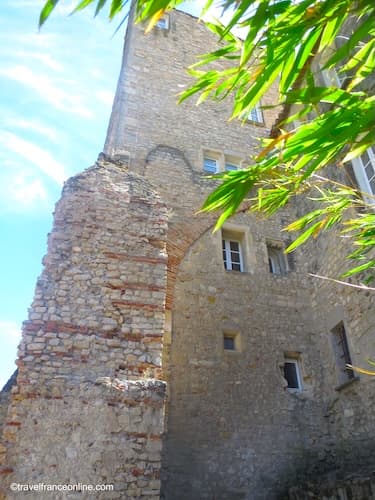
Locals began calling the ruined baths the Palais de la Trouille (Palace of Fear), a name likely derived from the Latin word trullum, an architectural term for semi-circular structures (such as that of the stunning Caldarium). Picture a landscape of ruins where hypocaust cellars and ancient foundations must have initially served as hideouts for criminals or vagrants, naturally causing fear among the locals!
However, as the city expanded, every available space was reclaimed. The Baths of Constantine’s massive, ruined walls served as foundations, supports, and buttresses for new dwellings.
Today, you can still see numerous remnants of the baths seamlessly integrated into the facades of surrounding houses. Ironically, this integration saved the baths from destruction or dismantling for building materials, though many of the stones were indeed reused in these houses. Thus, the Baths of Constantine came to form a sort of structural framework for the medieval district!
Baths of Constantine, a Historical Monument
Everything changed in the 19th century. The architectural and historical value of the Baths of Constantine didn’t go unnoticed by the French Historic Monuments authorities; they listed and protected part of the site during excavations carried out in the mid-1800s.
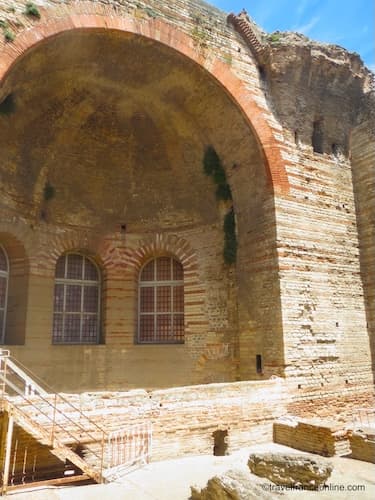
The cellars and walls, on the southern and western ends of the site, connecting the semi-circular curved apse of the Caldarium (hot baths) to the Tepidarium (warm baths) and the Laconicum (dry sauna), were excavated and listed in 1922. That said, the Baths of Constantine covered a much larger area, but the southern section was never excavated as it lies beneath existing houses.
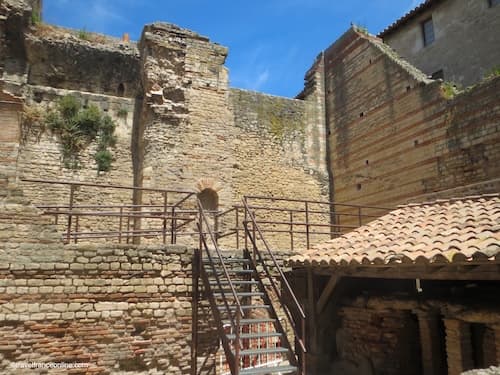
Despite centuries of neglect and disinterest, the Baths of Constantine are relatively well preserved, like most other Roman monuments in Arles!
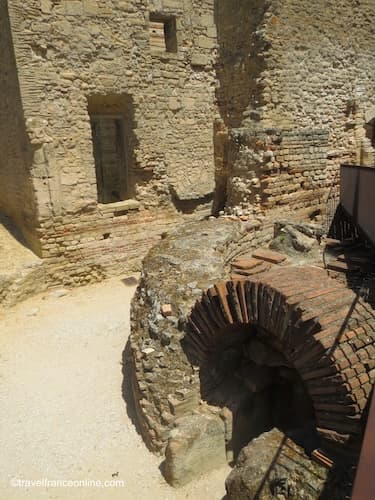
The Caldarium‘s exceptional state of preservation is more impressive given that it had been converted into dwellings during the Middle Ages! Their demolition revealed the semi-circular shape of the hot water pool, nestled within its curved wall, still open with three windows.
Walkways now overlook most of the ruins, making it easy to see the location of two other rectangular pools. They ran above the hypocaust and the brick pillars that once supported the pools’ heated floors. It’s easy to picture slaves toiling ceaselessly to stoke the furnaces and generate the hot air that circulated beneath the floors, a striking reminder of the gruelling conditions they endured!
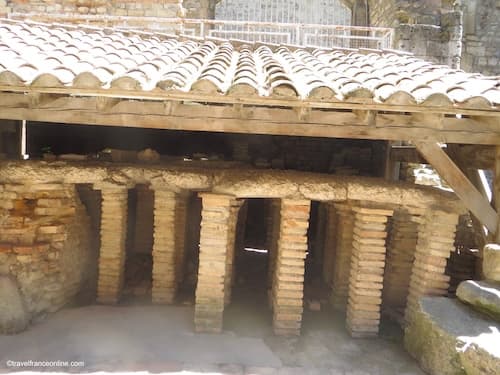
However, little remains of the Laconicum, and only a few vestiges of the Tepidarium survive, yet the visit is fascinating, as it transports you back 16 centuries!
The Baths of Constantine were not supplied by the Rhône, of course, but by the Caparon Aqueduct bringing spring water from the southern slopes of the Alpilles, some 20 kilometres from Arles. You’ll find extensive remains of this aqueduct in the neighbouring municipality of Fontvieille.
A visit to the Baths of Constantine takes about 30 minutes to an hour, and the admission fee is €5 (2026 rate). Wherever you are in Arles, try to get there by strolling along the Rhône’s riverbanks; you’ll enjoy the views and a pleasant river breeze, a real treat during the hot summer months.
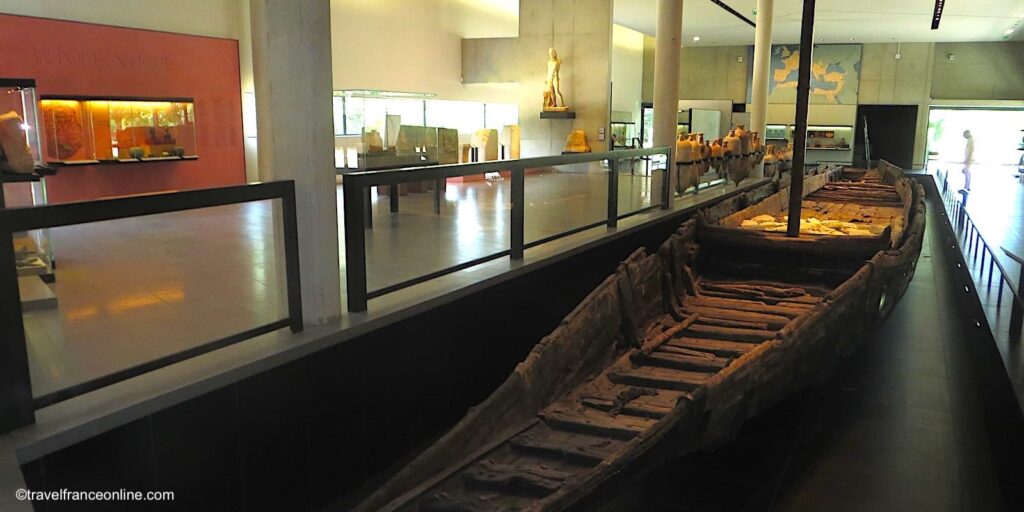
N.B. You can discover the exceptional artefacts excavated in the Arles ancient history museum, near the former Roman circus.