
Montarnaud, the village at the source of the Mosson River
After another 20 km leg of our six-day hike along the Via Tolosana, we arrived in Montarnaud, once again under threatening skies. Fortunately, the rain held off until we reached our guesthouse, which was nestled at the foot of the château and by the Tour de l’Horloge (public clock tower).
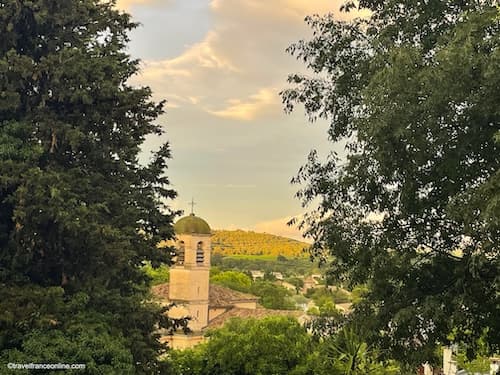
Montarnaud is another of those small towns with plenty of surprises! It lies about 3 km from the source of the Mosson River (known as the Font de la Mosson), which springs from the surrounding woods. A small stone hut, built in the late 19th century, marks the spot and houses a mechanism designed to regulate the river’s flow, which varies significantly with the seasons.
We are in the heart of a narrow valley carved by the river between the wooded hills of La Moure, the Rouvrière heights, and the Viols-le-Fort massifs, an area that offers an ideal setting for hiking and mountain biking.
Sheltered from sea winds and bathed in abundant sunshine, the plain enjoys a microclimate perfect for viticulture. This strategic location made it, since the earliest times, an ideal route for trade paths passing north of Montpellier.
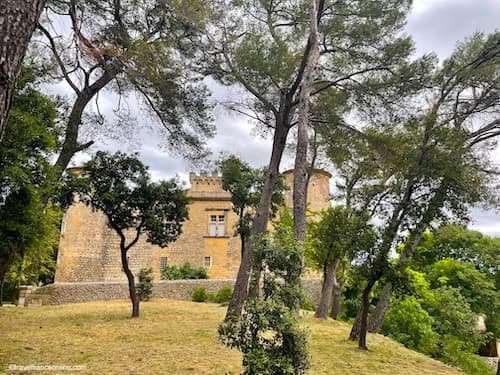
This is where the original village, Sestairanègues, developed during the Gallo-Roman era (1st century BC – 4th century AD) from a vast agricultural estate belonging to a Roman landowner named Sextilius or Sextarius.
Archaeological excavations have unearthed numerous remains of this estate, located on the grounds of the present-day Mas Dieu estate. Vestiges of building foundations, along with fragments of terracotta jars and various remnants of farming tools, bear witness to an activity already centred on viticulture and olive growing, with products transported via major Roman roads such as the Via Domitia.
The Chapel of Notre-Dame de Sestairanègues, no longer in existence, was built in the early Christian era, likely on the site of the temple associated with the Gallo-Roman villa and served as the parish church during the early Middle Ages.
Château de Montarnaud, Lower Languedoc’s oldest fortress
The village of Sestainarègues remained in the plain until the 12th century. In 1111, Arnaldus, a local lord and vassal of Guilhem V, Lord of Montpellier, built an outpost (the Mont of Arnaldus which evolved into Montarnaud) on a steep, rugged hill to monitor the borders of Guilhem V’s lands and ancient trade routes.
The Château de Montarnaud is thus one of the oldest castles in Lower Languedoc.
In 1122, Guilhem V divided his estates among his sons, assigning the lordship and castle of Montarnaud to his youngest son, Guilhem d’Aumelas.
These lands became the Vicomty of Aumelas in 1327 and were sold to the King of France in 1340. During the 14th century, the fortress suffered the ravages of the Hundred Years’ War, but it was rebuilt and its defences reinforced.
Montarnaud Fort and Chapel of Notre-Dame-du-Fort
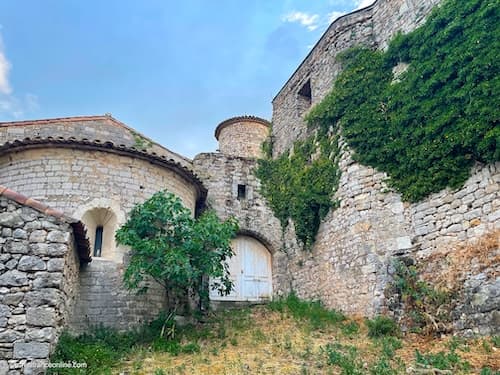
The fortifications, still known today simply as the ‘Fort’, once protected the Montarnaud fortress, the castle Chapel Notre-Dame-du-Fort, and the medieval village.
Originally dedicated to Saint-Etienne (St. Stephen), the chapel eventually replaced the old Church of Notre-Dame de Sestairanègues as the villagers settled by the fort.
Nestled within the fortified walls, the chapel became a symbol of safety for the villagers, who re-dedicated it to Notre-Dame (Our Lady).
Notre-Dame-du-Fort served as the official parish church of Montarnaud until 1850, when it became to small for the rapidly growing population.
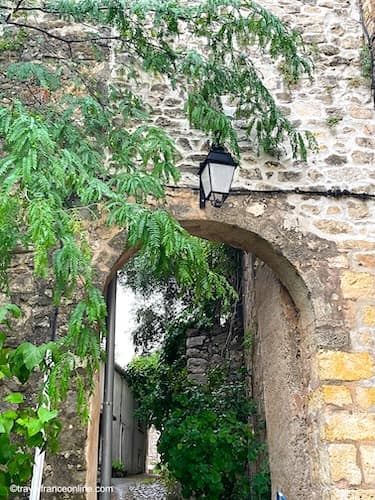
A new church, Notre-Dame du Bon Accueil, was built in the village that had expanded at the foot of the fort.
In the late 19th century, the municipality considered dismantling the disused Notre-Dame-du-Fort, to reuse its stones for other construction projects.
The Bishop of Montpellier opposed this and reached a compromise: only the massive bell tower was demolished to reclaim the stone, while the bells were melted down to create a new one for the new church.
The rest of the building was preserved and became the property of the municipality of Montarnaud in 1905, following the law separating Church and State.
This remarkable Romanesque castle chapel was finally designated a Historical Monument in 1922 and restored. Today, it is open to the public and hosts art exhibitions and concerts.
Montarnaud, from a fortress to Renaissance château

In 1521, Jean de Brignac acquired the Château de Montarnaud, which would remain in his family for over three centuries.
Brignac transformed this once-austere fortress into an elegant Renaissance residence and established the Barony of Montarnaud.
Unfortunately, the building suffered further severe damage at the hands of the Catholic king’s troops during the Wars of Religion in the 17th century, as Languedoc, a Protestant stronghold, became a major battleground.
Cardinal Richelieu, the kingdom’s prime minister, ordered the dismantling of local fortresses to suppress any rebellion against royal authority; thus, the imposing defensive structures and outer walls of the Château de Montarnaud were demolished.
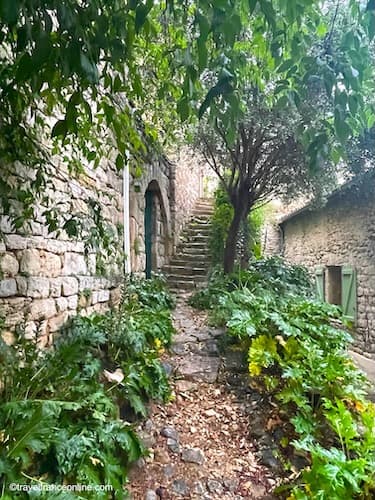
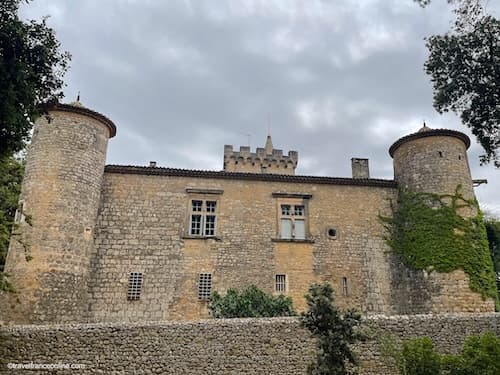
However, the Lords of Brignac rebuilt their château; the structure survives today as a rectangular main building flanked by four round corner towers, enclosing an inner courtyard.
In 1799, Claire de Brignac married Henri Amédée de Turenne d’Aynac, the future chancellor to Napoleon I, and the château thus passed into the hands of the House of Turenne. Their son, a diplomat who served as minister plenipotentiary to Japan, inherited the estate at the turn of the 20th century.
The Château de Montarnaud was designated a Historical Monument in 2015.
The current owners, two sisters from the Turenne family, founded the Association des Amis du Château de Montarnaud (Friends of the Château) to help restore the historic rooms, including the oldest, the Hall of Justice (Courtroom).
The château opens for guided tours during the summer season.
Tour de l’Horloge
The Tour de l’Horloge (Clock Tower), one of the town’s iconic landmarks, stands at the foot of Rue du Château, the steep lane leading to the hilltop where the imposing Château de Montarnaud sits.
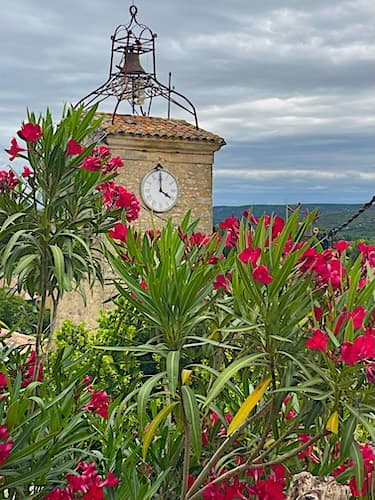
While the castle dates to the 12th century, the Tour de l’Horloge was built much later, in 1827, for practical rather than aesthetic reasons.
Its 260-kilogram bell marked the hours, allowing farm workers to keep track of time throughout the day.
The local bourgeoisie funded the construction of this public clock, seeking to break the Church’s monopoly on village life; indeed, until then, residents had relied solely on church bells, which rang only for Mass, to tell the time!
The clock mechanism is still in working order and requires winding every ten days. Foundations 1.5 metres deep stabilise the tower, as its height alone was insufficient to support the bell’s weight.
Today, the Tour de l’Horloge continues to chime the hours during the day, though the sound has been softened so as not to disturb residents.
Place de la Fontaine, the village square
The Place de la Fontaine takes its name from the fountain erected in its centre in 1851. This fountain was built to supply residents with fresh spring water after a series of waterborne disease outbreaks, caused by contaminated shallow wells, struck the village.
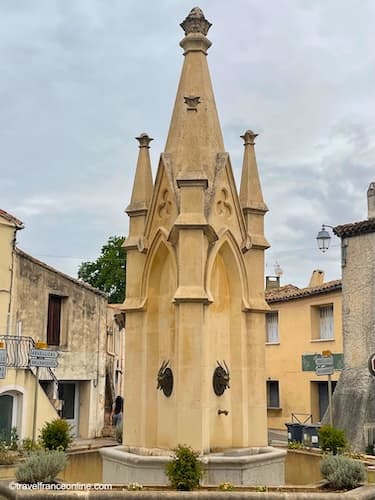
The fountain drew water from deeper, uncontaminated springs, thereby ensuring a safer supply for the community. It also served a a watering point for horses and livestock.
This distinctive fountain, triangular and reminiscent of a slender pyramid, was carved from a single block of local limestone. Water flows from the mouths of steel ibex heads, crafted by a local blacksmith and metalworker. The choicer of ibex symbolically pays tribute to the wildlife inhabiting the surrounding hills.
A Neo-Gothic spire flanked by three small pinnacles tops the fountain, as residents objected to installing a statue of the Virgin Mary. In the 19th century, the region was indeed still defined by a deeply rooted Protestant heritage!
So, as you can see, Montarnaud is a quintessential French village, modest in size, yet rich in history and cultural and architectural heritage. Nestled in the heart of a fertile plain sheltered by wooded hills, traversed by ancient trade routes, and inhabited for over two millennia, Montarnaud is a place of character, tradition, and peaceful charm that is well worth the detour.


