Père Fouettard and Father Christmas

Christmas wouldn’t be Christmas without Père Noël – Father Christmas – Santa Claus! But do you know his dark companion, Père Fouettard (the Whipping Father)? He’s a sinister and unsettling figure whose role is to punish disobedient children!
However, while Père Fouettard is a legendary figure, Santa Claus did indeed exist. Or rather, the man who inspired him: Saint Nicholas, Bishop of Myra (in present-day Turkey), who lived in the 4th century and was known for his kindness and generosity towards children, to whom he secretly left gifts during the night.
Père Fouettard, on the other hand, is his opposite. Instead of generosity, he embodies discipline, morality, and respect for rules. His presence reminds children that their actions have consequences. Thus, while Saint Nicholas rewards well-behaved children, Père Fouettard punishes the unruly, encouraging children toward wisdom and obedience.
That said, even though he frightens them, children eagerly await his arrival. He fascinates them and adds a touch of thrilling fantasy to the world of rules they are supposed to follow. They enjoy being a little scared: after all, the thrill of danger is always exciting, especially when you manage to escape unscathed.
Père Fouettard’s ancient roots
The story of this shadowy figure dates back to antiquity and is deeply rooted in European folklore.
According to some, his origins go back to Roman times. At that time, he was known as Felix (which is rather surprising, since Felix means happy or lucky). This Roman Felix’s mission was to punish disobedient children who caused trouble, or worse. Since France came under Roman rule more than 2,000 years ago, it makes sense that Roman traditions became intertwined with local customs.
Others believe that Befana may have partly inspired the French character. In Italian tradition, Befana is an old woman resembling a witch who, like Santa Claus or the Three Wise Men, brings gifts to children on the eve of Epiphany. Known by different names throughout Italy’s many regions, she belongs to a long line of mythical figures who travel the twelve days of Christmas to reward good children, punish disobedient ones, and distribute presents. However, this theory is more consistent with the origins of Santa Claus than with those of Père Fouettard, since the latter inflicts punishments, not gifts.
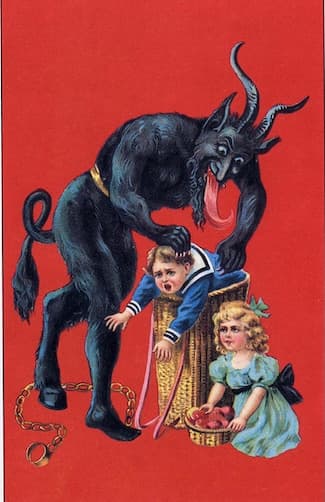
The most likely origin of Père Fouettard is a Christian adaptation of Krampus, a legendary horned creature from Germanic paganism, often described as half-goat, half-demon. While his exact origins are uncertain, he is thought to have come from the Alpine regions, and his name derives from Krampe, an Old High German word meaning “claw.”

At Christmas, he appears alongside Saint Nicholas: while the saint rewards good children with gifts, Krampus deals with the disobedient, issuing warnings and punishments. The Roman Catholic Church transformed this frightening figure to counter pagan beliefs and encourage conversion.
So, in reality, no one knows exactly where Père Fouettard comes from, except that he exists to frighten disobedient children!
It was in the Middle Ages that Saint Nicholas (Father Christmas) and Père Fouettard began to appear together, particularly during the processions of December 6th celebrating Saint Nicholas Day. Saint Nicholas rewarded good children with sweets and gifts, while Père Fouettard dealt with disobedient children, giving them only coal and sometimes pretending to whip the most unruly ones.
What does Père Fouettard look like?
It depends on the region of France. In most regions, he appears as a frightening and menacing figure, but his appearance varies.
In northern France, he is dressed in black and carries a whip.
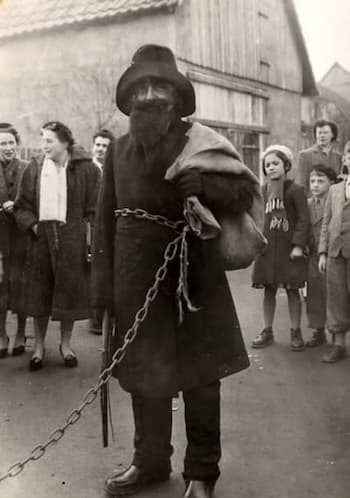
In Alsace, he is associated with Hans Trapp, often portrayed as a cruel and ruthless man, rich but miserly. According to legend, his misdeeds earned him excommunication and a sentence to wander the mountains and forests. As punishment, he was transformed into a terrifying creature, half-man, half-monster. In many chilling tales, Hans Trapp disguised himself as a scarecrow, dressed in rags stuffed with straw, to capture children. Those who disobeyed were taken into the woods and punished with blows from sticks or whips, thus reminding them of the importance of good behavior.
In Lorraine, he is portrayed as a sad and repentant man, burdened by his past sins.
In the Southwest, he is associated with Père La Fouine, a truly terrifying figure, dressed like a butcher, who lures children with candy only to kidnap and, it is said, devour them.
In Brittany, in western France, Père Fouettard simply does not exist! The Bretons, deeply attached to their Celtic traditions, resisted this imported legend despite Christianization.
Thus, whatever form he takes, the many faces of Père Fouettard testify to his cultural significance throughout the centuries.
Wikimedia Commons: Saint Nicholas and Krampaus 1896 by Unknown is Domaine public – Hans Trapp by Almanach de Wintzenheim is CC BY-SA 3.0 – Krampus punishing naughty children by Auteur inconnu is Domaine public – Saint Nicholas and Krampus 1900s by Unknown author is Public Domain