
Paris coat of arms and motto
Fluctuat nec mergitur – The waves buffet her, but she does not sink

Paris coat of arms depicts a silver-white sailboat navigating the choppy waters, against a bright red background topped with a royal blue band strewn with golden fleurs-de-lys.
This emblem symbolises the ancient city of Lutetia. Indeed, long before the Roman conquest, the Gallic tribe of the Parisii established their oppidum (fort) on the island we now call the Île de la Cité.
They did not choose this island at random, as it controlled river traffic and was located at the crossroads of ancient land routes. They connected Lutetia to the two banks of the Seine with two wooden bridges. Six more bridges were built over the centuries.
Thus, seen from the air, the almond-shaped silhouette of the Île de la Cité evokes the hull of a ship. At the same time, its bridges resemble unfurled oars, and its western tip a symbolic figurehead, guiding the city through the currents of history.
The powerful Guild of the Watermen of Paris
These distant inhabitants of Lutetia thus specialised in river trade. The Paris Boatmen’s Guild, or Nautes Parisiens, became the wealthiest and most influential in ancient Paris, eventually lending its coat of arms to the city.

Indeed, throughout history, this guild wielded considerable political and economic influence, playing a vital role in the city’s growth and development. Holding a monopoly on river traffic on the Seine, the Marne, the Oise, and the Yonne, its members regulated commerce, facilitated trade, and collected tolls.
Over time, they amassed considerable wealth and established themselves as prominent merchants and entrepreneurs.
By 1246, Paris was transforming into a dynamic metropolis, and required its own distinct administration! In 1260, King Louis IX (Saint Louis) thus granted Parisians the right to elect their aldermen (Echevins). Many of these elected officials came from the influential Guild of Boatmen.
The bearings on the coat of arms of Paris
The sailing ship already appeared in 1210 on the seal of the powerful Parisian Boatmen’s Guild, whose coat of arms was officially adopted as the Paris coat of arms.
In 1358, King Charles V added the Fleur de Lys, emblem of the kings of France, to symbolise royal protection and allegiance. The upper part of the coat of arms was thus adorned with gold fleurs-de-lys on a blue background.
However, the fleur-de-lys, or iris, was first adopted as a royal emblem by King Clovis in 507 AD after his victory over the Visigoths at the Battle of Vouillé, near Poitiers. According to legend, Clovis and his men discovered a ford marked by a large colony of yellow water irises. They crossed the river under the cover of night and launched a surprise attack against the Visigoths, thus winning a decisive victory.
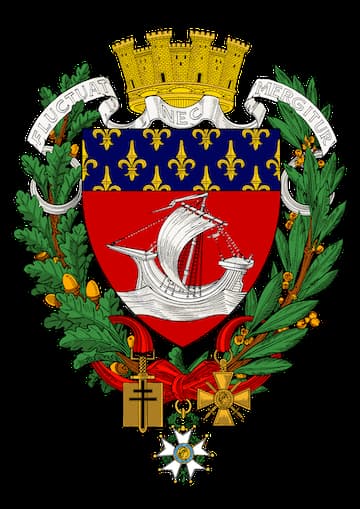
Red and blue have also been the official colours of the City of Paris since 1358. These were the colours of the hoods that the provost of Paris at the time, Etienne Marcel, then in conflict with the dauphin, the future Charles V, made his supporters wear.
The motto of Paris was added in the 16th century and remained in use until the French Revolution.
In 1853, the Prefect of Paris, Georges-Eugène Haussmann, officially reinstated and recognised the motto by a decree dated November 24.
The symbolism of the coat of arms evolved over the centuries.
President Vincent Auriol established the modern coat of arms of Paris by decree on August 20, 1949, after the Second World War.
The crenellated crown above it symbolises the ancient ramparts of the city and its independence from the central government. The oak branch with acorns on the left side of the coat of arms pays tribute to the acts of Bravery of French citizens. The laurel branch with berries on the right side symbolises Victory.
The complete coat of arms includes, at its base, three decorations awarded to the City of Paris throughout history: the Légion d’Honneur (1900), the Croix de Guerre (1919), and the Croix de la Libération (1945).
A few facts about Paris
The City of Paris is the capital of France, the Préfecture of the Ile-de-France Region and a département since 1975.

The Ile-de-France Region consists of eight départements:
Essonne (91), Hauts-de-Seine (92), Paris (75), Seine-et-Marne (77), Seine-St-Denis (93), Val-de-Marne (94), Val-d’Oise (95) and Yvelines (78).
Paris is divided into 20 arrondissements (administrative divisions). Their spiral layout resembles a snail’s shell.
The arrondissements are subdivided into 80 quartiers, which originated from the former parishes.
Paris and Greater Paris cover 2,000 km² and have nearly 10 million inhabitants, representing one-sixth of the French population.
Ancient Paris was known as Lutetia until 360AD.
Sainte-Geneviève became one of the three patron saint of Paris (along with Saint-Denis and Saint-Marcel) after rallying the Parisians to her cause to resist Attila and his Hun warriors in 451 AD.
In 508AD Clovis, the first King of France and the first convert to Christianity, made Paris the capital of the Frankish Kingdom.
Wikimedia Commons: Modern blason by RaphaëlMignon is CC BY 4.0


