The Parc André Citroën on the site of a former bleach factory
The Parc André Citroën was created on the historic site of the former Citroën factories, built on a vast sandy expanse bordering the left bank of the Seine.
This area was then largely uninhabited, with the exception of a charming fishing village called Javetz. Its picturesque location made it a popular destination for boaters as early as the 15th century. In the 17th century, the village took the name Javel, and its inhabitants turned to agriculture, taking advantage of the sandy soil, ideal for crops.
The region retained its pastoral charm until 1777, when the Count of Artois, the future King Charles X, recognized its industrial potential. He established a factory there to produce bleach, or Eau de Javel in France, which was sold throughout France, thanks to the Seine River, which facilitated transport. This marked the beginning of Javel’s transformation into a vast industrial area, attracting numerous other factories.
The Citroën factory at Javel
The village’s transformation took a decisive turn in 1915 when engineer André Citroën, a graduate of the École Polytechnique, established a factory there to produce 75mm artillery shells during the First World War. His industrial career had begun earlier, in 1900, when he discovered a process for manufacturing metal gears in Poland. He obtained the rights to produce chevron-shaped gears and founded his first factory the following year. This distinctive pattern inspired the iconic inverted double V logo that would later symbolize the Citroën automobile brand, launched in 1919.

After the war, Citroën turned his attention to the burgeoning automotive industry, whose potential he recognized during a trip to Detroit in 1913, where he met Henry Ford. His intuition proved correct!
In 1919, the Citroën factory produced the Type A, the first mass-produced car in Europe, propelling the brand onto the international stage. In 1924, production increased from 30 to 250 cars per day, making Citroën the fourth largest car manufacturer in the world. Citroën’s success was based on a spirit of innovation. In 1924, the company presented the first all-steel car body in Europe, a major advancement that solidified its reputation for cutting-edge technology and design. Since then, the Citroën brand has remained synonymous with innovation.
The global economic crisis of 1933 dealt a severe blow to the company. Despite declining production, André Citroën, ever ambitious, chose to expand, demolishing his original factory to build a vast 55,000-square-metre site. However, the launch of his revolutionary Traction Avant, the first front-wheel-drive car with a monocoque body, came at an exorbitant cost. The financial pressure became too great, and the company ultimately found itself on the brink of bankruptcy, unable to meet its financial obligations.

André Citroën died on July 3, 1933, before he could witness the full extent of his company’s difficulties. He is buried in the Petit Cimetière at Montparnasse Cemetery. The following year, the brand was placed under court administration and taken over by Michelin, its main creditor. Under Michelin’s leadership, the company survived, preserving 250,000 jobs and addressing the concerns of 1,500 creditors and thousands of small shareholders. André Citroën also missed out on the immense success of his revolutionary Traction Avant, which became one of the brand’s most profitable models!
The company continued to produce legendary vehicles over the decades. Among them were the much-loved 2CV in 1936 and the iconic DS in 1955, known for its aerodynamic design and front-wheel drive. In recognition of André Citroën’s influence, the City Council renamed the Quai de Javel Quai André Citroën in 1958.
A major turning point came in 1975 when the pressures of de-industrialization in Paris led to the closure of the Javel factories, which had produced 3.2 million vehicles, including the last DS model in April of that year. Production was transferred to a modern factory in Aulnay-sous-Bois (a northeastern suburb of Paris), built in 1973. That same year, Citroën merged with Peugeot to form the PSA Peugeot-Citroën group. For car enthusiasts, the Citroën showroom, the C42, on the Champs-Élysées Avenue is a must-see. Its facade, adorned with a chevron pattern, is a tribute to the brand’s heritage and a masterpiece of modern architecture.
The demolition of the Javel factories allowed for the development of the Parc André Citroën, created in the 1980s and 1990s, providing a vibrant green space that commemorates the industrial and innovative legacy of this iconic brand.
Parc André Citroën

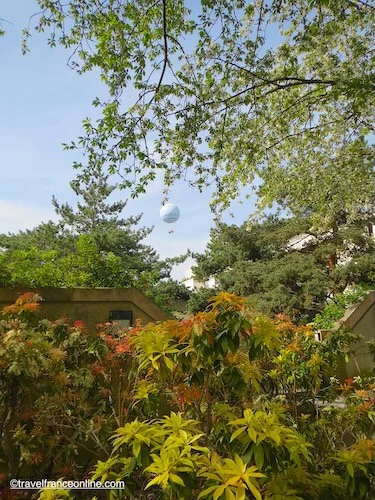
Welcome to this 14-hectare oasis, expanded by 10,100 square metres in 2013. The Parc André Citroën, sloping gently down to the Seine, is richly landscaped around water features, reflecting its connection to the river. Its design incorporates numerous fountains, water jets, canals, and a unique moored hot air balloon, creating a vibrant and interactive space.
Among its most captivating features are its themed gardens, which offer a harmonious blend of art and nature. Each garden possesses its own distinct character and symbolism related to water, the elements, colors, planets, and even the days of the week.
- The Jardin Blanc (White Garden – north side), renamed Caroline Aigle in 2015, and the Jardin Noir (Black Garden – south side), renamed Eugénie Djendi, pay tribute to two female soldiers who died in combat. In 2019, a war memorial was installed in the Jardin Noir, dedicated to the themes of the sea, lead, black, instinct, Saturn, and Saturday.
The other gardens include:
- Blue Garden: rain, copper, blue, smell, Venus, and Friday.
- Green Garden: the fountain, tin, green, hearing, Jupiter, and Thursday.
- Orange Garden: the stream, mercury, orange, touch, Mercury, and Wednesday.
- Red Garden: the waterfall, iron, red, taste, Mars, and Tuesday.
- Silver Garden: the river, silver, sight, the Moon, and Monday.
- Golden Garden: the sundial, gold, the sixth sense, the Sun, and Sunday.

Two immense greenhouses, located to the east of the park, are striking features bordering a wide esplanade adorned with fountains and water jets. Each greenhouse has its own botanical theme: one showcases exotic plants, while the other is dedicated to Mediterranean flora, offering a lush immersion into diverse ecosystems.
The vast central lawn, at the heart of Parc André Citroën, is a popular meeting place where the famous hot air balloon is moored. A long canal leads down to the Seine, where an artificial island is nestled within a peaceful bamboo grove. The highlight for many visitors is the Generali hot air balloon, installed in 1999, which provides an unforgettable experience. The 10-minute flights take passengers to an altitude of 150 metres, offering a spectacular 360-degree panoramic view of the city.
When to visit the Parc André Citroën? The park opens every day at 8:00 AM on weekdays and 9:00 AM on weekends. Closing times vary depending on the season, with the park closing at sunset so you can enjoy its beauty during the day.
Directions: 15th district – 2 rue de la Montagne de la Fage – Entrances to Parc André Citroën off Rue Balard and Rue Saint-Charles
Metro: Line 8 -Lourmel or Balard – Ligne 10 – Javel-Andre-Citroen – RER C: Gare du Pont du Garigliano and Gare de Javel