Bastille Fortress, a symbol of royal absolutism
The infamous Bastille fortress once stood on the west side of the Place de la Bastille.
Today, the square is a bustling hub, teeming with cafés, brasseries, and iconic cultural landmarks such as the Opéra Bastille. Despite this lively atmosphere, the roundabout is notorious for its daily traffic jams, making it one of the busiest spots in Paris.
Yet, for many French people, the Bastille holds a much deeper menaing: it indeed symbolises the spirit of the French Revolution. Bastille Day, celebrated on July 14th, is one of France’s most important holidays, second only to Christmas.
The fortress, originally called Castel Saint-Antoine, was commissioned in 1370 by Hugues Aubriot, Provost of Paris. Built opposite the Saint-Antoine Gate, one of the fortified gates of Charles V’s city walls, it was intended to protect the king’s residence, the nearby Hôtel Saint-Pol. With its eight imposing round towers and wide moats, the fortress was an impressive structure, a symbol of royal authority.
However, over time, the Bastille acquired a rather dark reputation. At the end of the 16th century, it was transformed into a prison, where one could be incarcerated simply by presenting a letter bearing the king’s seal. This arbitrary use of power thus made the Bastille a powerful symbol of royal absolutism in the eyes of the French people.
Bastille Fortress, the symbol of Revolution
The Bastille Fortress was not only a symbol of tyranny, but also a place of oppression where figures such as the philosopher Voltaire were repeatedly imprisoned due to the lack of freedom of expression. Even as social instability gained ground in France, the Bastille continued to hold prisoners; seven people were still locked up there on July 14, 1789.

Ironically, it was neither seasoned soldiers nor revolutionaries who stormed the Bastille that day, but a group of cabinetmakers from the nearby Saint-Antoine district. Even more surprisingly, most of these men were of German origin!
The fall of the Bastille marked a turning point in history, symbolising the overthrow of despotic power and the birth of a new era of liberty. The demolition of the fortress began on July 15, 1789, and was completed in 1792. The stones were reused, some notably in the construction of the Pont de la Concorde. The remaining stones were used to create 83 models of the fortress, each sent to a different French department to commemorate the end of the monarchy and the triumph of the people’s will.
The ghosts of the Bastille Fortress
The fortress is no more, but even today, traces of its location are visible.

Lighter-coloured paving stones, discernible at the intersection of Boulevard Henri IV and Rue Saint-Antoine, outline the footprints of two towers.
A commemorative plaque, unveiled at No. 3 Place de la Bastille on July 14, 1880, provides a visual representation of the fortress’s layout. An inscription at No. 5 Rue Saint-Antoine marks its former entrance , and upon closer inspection, you can see the location of the old drawbridge, at the pedestrian crossing at No. 46 Boulevard Henri IV. The ramparts to which the Bastille was once connected have long since disappeared, replaced by Boulevards Bourdon and Beaumarchais.
The Place de la Bastille was officially created in 1803, but Prefect Haussmann gave it its current appearance during his urban planning works in the mid-19th century.
Colonne de Juillet on Place de la Bastille
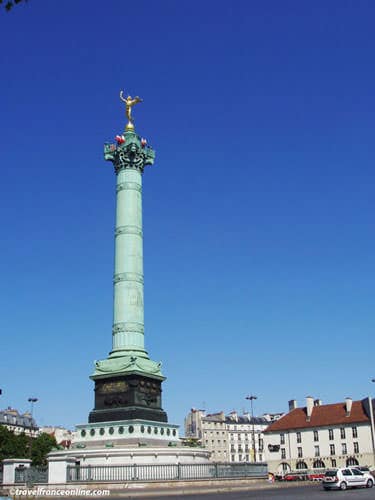
The July Column marks the centre of the Place de la Bastille.
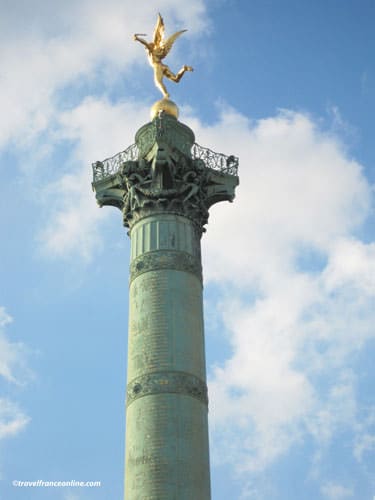
The imposing 52-m-high bronze column has a 4-m high and hollow shaft, and weighs 170,000 kilograms.
Two hundred and thirty-eight steps lead to the upper platform where the gilded bronze statue of the Genius of the Bastille stands. This allegorical figure represents Liberty taking flight, breaking her chains and spreading light.
It commemorates the Trois Glorieuses (Three Glorious Days), the uprisings of July 27, 28, and 29, 1830, which led to the abdication of King Charles X. A burial vault in the basement houses the remains of the 504 victims of the insurrection.
The names of 196 victims of the Revolution of February 23 and 24, 1848, were added in March 1848.
The July Column is open to the public.
Directions: 4th/12th District
Metro: Bastille on Lines 1, 5, 8
Coordinates: Lat 48.853183 – Long 2.369144
Photo via Wikimedia Commons: Fortress in 1420 by Theodor Josef Hubert Hoffbauer (1839–1922) Public Domain