
Toussaint – All Saints, Halloween or Samhain?
Halloween, originally known as All Hallows’ Eve, is the eve of All Hallows (All Saints’ Day), with”hallow” meaning “holy person.”
The French do not celebrate Halloween on October 31st, but the Toussaint, short for “Tous Saints” (All Saints) on November 1.
The origins of this festival date back to pagan times, when the Celts celebrated Samhain, their God of the Dead.
Samhain marked the end of summer and harvests, as well as the beginning of the Celtic New Year on October 31. It symbolised the transition from the light season to the dark season.
For the ancient Celts, whose survival was intimately linked to the cycle of the seasons, this period was a source of anguish. The arrival of winter meant long months of isolation and a dependence on provisions gathered during the summer and autumn.
Given the uncertainty and severity of winter, it is understandable why Samhain was the last major festival of the year, offering a final community gathering before winter isolation.
Celebrated on October 31, the festivities lasted for five days and incorporated various rituals and traditions to honour the Dead and prepare for winter.
During Samhain, the Celts believed that the boundary between the living and the dead was particularly thin, allowing spirits to wander the earth.
Samhain thus marked a rite of passage, symbolising the transition from one world to another, and was deeply linked to the cult of the Dead. On this eve, it was believed that Samhain returned to Earth, bringing with him the lost souls of the deceased, who could only wander among the living on this night.
These wandering spirits needed to be appeased through sacrifices. People would light bonfires to guide them in the dark and wear costumes and masks to disguise themselves. They would also leave offerings of food and drink to appease the spirits and ensure a safe and prosperous new year.
The druids went from house to house, demanding offerings. Those who refused were cursed; Thus, the choice was Offering or Curse – Trick or Treat!
With the spread of Christianity, the Church integrated and transformed pagan traditions. Pope Gregory IV tus moved All Saints’ Day to November 1st in 835 AD to replace the pagan festival of Samhain with a Christian celebration.
Despite this, many ancient customs persisted, blending with Christian traditions to give rise to the modern Halloween celebration, characterised by costumes, candy collecting, and various forms of festivities.
Toussaint – Halloween
From the 3rd century onward, Christian preachers began to convert the French population. However, deeply rooted pagan beliefs proved difficult for the Church of Rome to eradicate.
The solution was to superimpose Christian onto Pagan celebrations, keeping the original dates but changing their symbolism. Thus, the Roman Catholic Church associated Samhain with the celebration of all Christian martyrs, known as All Saints’ Day.
This celebration originally took place on May 13th. However, in 830 AD, Pope Gregory IV transformed it into a festival honouring all the saints recognised by the Church of Rome and moved it to November 1st to supplant Samhain.
Toussaint – Jour des Morts – Mois des Morts
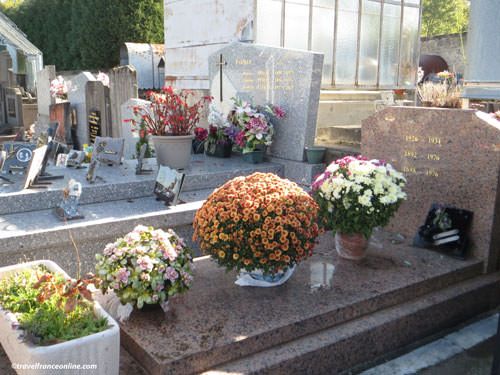
Toussaint is a public holiday in France, followed by Jour des Morts on November 2nd. Over time, these two celebrations have become intertwined.
During these two days, the French honour their deceased loved ones who have not yet reached the Gates of Paradise.
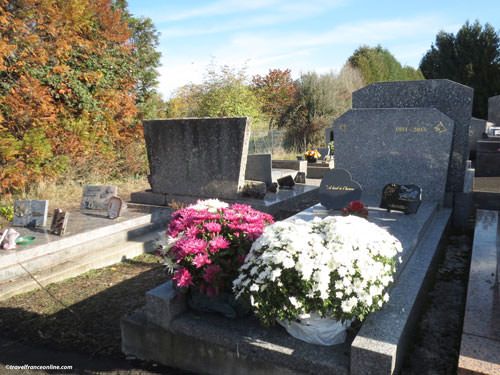
Although the French no longer practice sacrifices, the idea of making offerings has evolved into placing chrysanthemums on graves.
Historically, November was known as the Mois des Morts -Month of the Dead.
Chrysanthemums for Toussaint
The chrysanthemum, a magnificent golden perennial flower, occupies a special place in French and Japanese cultures.

Blooming from late October to early November, it is one of the few frost-resistant flowers, making it an ideal choice for this time of year.
Its affordable price during this season also contributes to its popularity.
In the language of flowers, the chrysanthemum symbolises Peace and Resurrection.
The tradition of placing chrysanthemums on graves is deeply rooted in French culture; It indeedconstitutes a powerful gesture symbolising the Resurrection of the Deceased.
Have you read about the Catacombes, Paris underground necropolis ?


