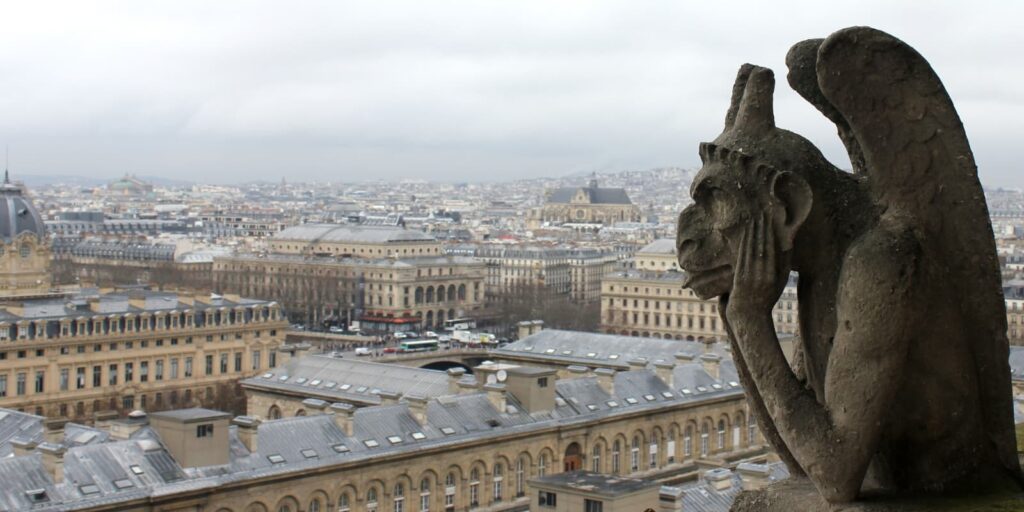
The foundation of Notre Dame Cathedral

Notre Dame Cathedral is a breathtaking masterpiece of Gothic architecture!
Spanning 130 metres in length and 35 metres in width, this majestic masterpiece could once accommodate nearly 9,000 people. For centuries, it has been not only a place of worship but also a symbol of Paris, where kings were crowned, where history was made, and where generations found spiritual refuge.
The story of Notre Dame begins long before the 12th century. Around 375 AD, a small chapel dedicated to St. Etienne indeed replaced the Roman Temple of Jupiter, which had occupied the site for over four hundred years.
In 528 AD, King Childebert (Merovingian dynasty) built another chapel, this time in honour of the Virgin Mary, on the spot where the cathedral’s sacristy now stands.
By the 12th century, both chapels had fallen into ruin. That was when Bishop Maurice de Sully envisioned something far greater. In 1163, he launched the ambitious project of building Notre Dame Cathedral, a work that would span generations. Construction began in earnest around 1165 and continued until 1230, though the high altar was consecrated in 1196.

The result was one of the finest examples of Early Gothic architecture in Europe. In the 14th century, flying buttresses were added (stone arches that brace the structure from the outside), both to strengthen the soaring walls and to allow for the addition of lateral chapels. Around the same time, the famous rose windows were installed.
By 1330, Notre Dame was complete. However, behind its towering beauty lay the toil of countless artisans, craftsmen, and labourers, their names mostly lost to history!
What we do know, though, is that master builders such as Jean de Chelles, Pierre de Montreuil, Jean Ravy, and Jean le Boutellier guided the work, ensuring the cathedral’s place among the greatest monuments of the Middle Ages.
Viollet-Le-Duc restores Notre-Dame
Sadly, Notre Dame did not escape the turmoil of the French Revolution. It was indeed plundered, its treasures stolen, and its bells melted down, except one. By the time Napoleon I was crowned emperor in 1804, the building was in such disrepair that great swaths of tapestry had to be hung to cover gaping cracks and holes.
The turning point came in 1831 with Victor Hugo’s The Hunchback of Notre Dame. His novel, intended as both a story and a plea, stirred the public’s imagination and awakened Parisians to the neglect of their beloved cathedral. The outcry was so strong that the government could no longer ignore it. Funds were released, and restoration began.
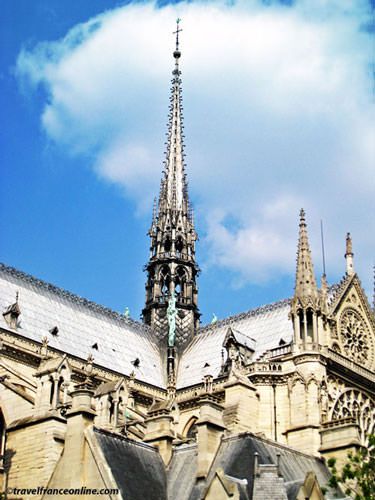
At first, architect Jean-Baptiste Lassus led the project, but Eugène Viollet-le-Duc took over after he died in 1857. For the next 25 years, the architect devoted himself to reviving Notre-Dame, carefully restoring its Gothic splendour while leaving his own mark by adding the iconic spire that would later define the Paris skyline.
Notre Dame’s survival was never guaranteed though, as it narrowly avoided destruction during the Paris Commune of 1871. And most recently, on April 15, 2019, a devastating fire consumed its roof and toppled Viollet-le-Duc’s spire, sending shock-waves around the world.
Yet Notre-Dame has always rose from devastation. Reconstruction is almost completed, and the cathedral has reopened its doors to the public!
Notre Dame Cathedral’s facade
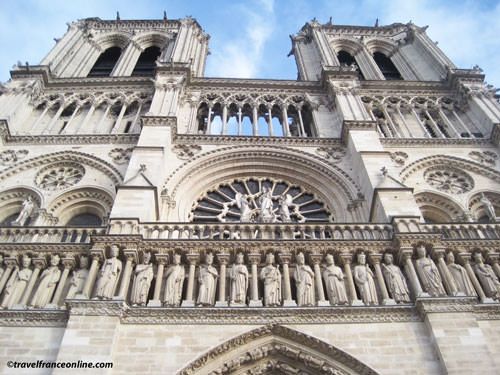
Work on Notre Dame’s magnificent facade began around 1200 and was completed in 1270. Its striking harmony comes from the careful balance of vertical and horizontal lines, culminating in two square towers that rise above four distinct levels: the grand portals, the Galerie des Rois, the rose window, and the upper gallery.
The north tower, slightly taller than its twin, was completed in 1240; the south tower, in 1250.
Notre Dame Cathedral – Portal of the Last Judgment

The Portal of the Last Judgment takes central place. Its tympanum depicts Christ enthroned in majesty, surrounded by angels, with the Virgin Mary seated at His side. To her right is the Bishop of Paris, and to her left, the King of France.
The upper relief portrays the weddings of Joachim and Mary, and of Mary and Joseph. The lower section tells the story of Christ’s arrival on earth, from the Annunciation through the Epiphany.
Arches teem with statues of prophets, martyrs, angels, and the Elders of the Apocalypse to frame the tympanum. Below them stand eight sculpted figures: the Queen of Sheba, Saint Peter, Saint Paul, King Solomon, King David, Bathsheba, and two unidentified kings. These statues are 19th-century creations by Viollet-le-Duc, and replace the originals destroyed during the Revolution.
The portal’s two massive wooden doors date from the 13th century, and are joined by a central column topped with a statue of Saint Marcel.
Notre Dame Cathedral – Portal of the Virgin
To the left, the Portal of the Virgin celebrates the Virgin Mary’s final moments, her ascension into Heaven, and her coronation as Queen beside Christ. In the tympanum, Mary is shown seated beside her son, who crowns her as Queen of Heaven.

The upper relief shows her on her deathbed, while the lower depicts prophets and kings of the Old Testament gathered around the Ark of the Covenant.
Nineteenth-century statues stand beneath the arches, including Emperor Constantine, two angels, Paris’s patron saints (Saint-Denis and Sainte-Geneviève), as well as Saint John the Baptist, Saint Etienne, and Pope Saint Sylvester. Lower reliefs depict the Resurrection of the Dead and the Archangel Michael weighing souls, with the righteous ascending to heaven and the damned led toward hell.
Above, the arches brim with angels, prophets, martyrs, and virgins, culminating in statues of the Twelve Apostles. Though heavily damaged during the French Revolution, the portal was painstakingly restored in the 19th century. The buttresses that flank it are adorned with figures of Saint Etienne, Saint Denis, the Church, and the Synagogue.
At the centre, a slender column bearing a statue of Saint Marcel unites the two original 13th-century wooden doors.
Notre dame Cathedral – Sainte Anne Portal

The Sainte-Anne Portal is the oldest of the three. Its tympanum, originally taken from the earlier Church of Saint-Étienne, depicts a Virgin and Child. Mary sits enthroned, flanked by two angels, with the Bishop of Paris standing at her right and the King of France at her left, a powerful pairing of church and monarchy.
The storytelling continues in the reliefs below. The upper scenes depict the weddings of Joachim and Mary, and later of Mary and Joseph. The lower relief traces Christ’s arrival on earth, from the Annunciation to the Epiphany.
The arches around the tympanum are sculpted with prophets, martyrs, angels, and the Elders of the Apocalypse. Beneath them stand eight statues: the Queen of Sheba, Saints Peter and Paul, Kings Solomon and David, Bathsheba, and two unidentified kings. The originals were destroyed during the Revolution, and what we see today are 19th-century restorations.
Bells of Notre Dame Cathedral
Before the French Revolution, Notre-Dame boasted 20 bells: two massive bourdons in the South Tower, eight bells in the North Tower, seven in the spire, and three more in the north transept. Most were melted!
It was not until 2013, on Notre-Dame’s 850th anniversary, that the full chorus of bells was restored. On February 2 of that year, Cardinal André Vingt-Trois, Archbishop of Paris, consecrated the new set. They rang together for the first time on March 23, 2013..
South Tower – The two bourdons
The great survivor of the Revolution was Emmanuel, Notre-Dame’s legendary bell. Cast in 1686, it weighs a staggering 13 tons and is considered one of the finest bells in Europe. It was replaced in the South Tower in 1802.
Legend says its warm, resonant tone owes something to the gold and silver jewellery donated by wealthy parishioners for its casting. Today, Emmanuel is listed as a historical monument.
Beside it hangs Marie, named after the Virgin Mary and in memory of an earlier bell cast in 1378. The current Marie was created at the Royal Eijsbouts foundry in the Netherlands and consecrated in 2013.
North Tower – The eight bells

The bells of the North Tower have had a more turbulent history. Four installed in 1856 were judged poor in tone, and were replaced in 2013 with a new harmonious set from the Cornille-Havard foundry in Villedieu-les-Poëles in Normandy. Each carries a name rich with meaning:
- Gabriel honours the Archangel Gabriel, who announced the birth of Jesus to Mary.
- Marcel is dedicated to Saint Marcel, ninth bishop of Paris and one of the city’s patron saints.
- Étienne is named in honour of Saint Stephen, the first Christian martyr.
- Benoît-Joseph is named after Joseph Ratzinger, Pope Benedict XVI.
- Maurice commemorates Bishop Maurice de Sully, who launched the construction of Notre-Dame in 1163.
- Jean-Marie pays tribute to Cardinal Jean-Marie Lustiger, Archbishop of Paris from 1981 to 2005.
- Anne-Geneviève honours Saint Anne, the mother of Mary, and Sainte Geneviève, patron saint of Paris.
- Denis is dedicated to Saint Denis, Paris’s first bishop and patron of the diocese.
Rose windows of Notre Dame Cathedral
Notre Dame’s three monumental stained-glass rose windows stand out as masterpieces of artistry!
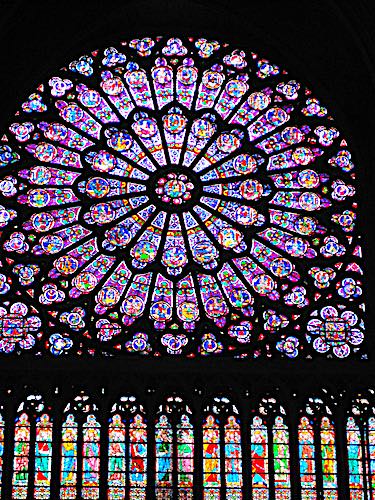
King Saint-Louis entrusted the creation of the south rose window to the cathedral’s first master builder, Jean de Chelles, then his successor Pierre de Montreuil. Jean de Chelles laid the foundation stone for the south transept’s facade in 1258, and by 1260, the rose window was complete, perfectly mirroring its northern counterpart.
Each of the transept roses measures an astonishing 12.90 metres in diameter and soars 19 metres above the ground, flooding the cathedral’s interior with colourful light.
The north rose window tells the story of the New Testament. At its centre, Christ reigns in glory, triumphant in Paradise. Around Him are prophets, apostles, saints, and heavenly figures, their jewel-toned images glowing as if suspended in divine light.
The design unfolds across 84 intricately crafted panels arranged in four concentric circles:
- The first circle holds 12 medallions.
- The second circle expands with 24 medallions.
- The third circle introduces graceful quatrefoil motifs.
- The fourth circle combines 24 medallions with additional quatrefoils, creating a dazzling frame of symmetry and meaning.
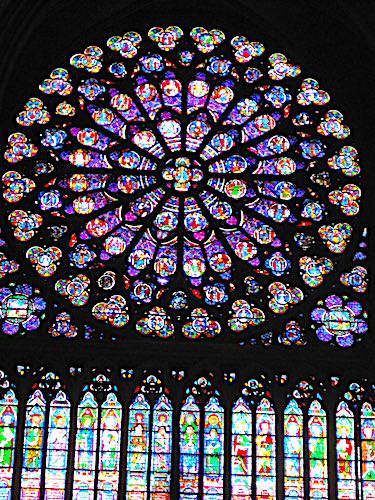
Notre-Dame’s rose windows have weathered centuries of strain, neglect, and upheaval, and with them, cycles of careful restoration.
The south rose window has required repeated intervention. It was rebuilt in 1543 after decades of neglect had left its stonework sagging. More repairs followed in 1723 and again in 1727. The Revolution of 1830 inflicted further damage, and by then, sections of the tracery had collapsed. To stabilise the structure, the window was reassembled with a 15-degree rotation, a detail still visible today. Missing medallions and motifs, such as those depicting prophets at the base, had to be recreated during the 19th-century.
The third great rose window, above the central portal on the main facade, is smaller than the transept roses but no less impressive. With a diameter of 9.60 metres, it was the largest 13th-century stained-glass window.
Notre Dame Cathedral’s Sacristy
Architect Eugène Viollet-le-Duc rebuilt the Neo-Gothic Sacristy during the great 19th-century restoration. It includes a charming cloister adorned with 18 stained-glass windows crafted by the glass-maker Gérente.
These windows recount the legend of Sainte Geneviève. At the heart of the main bay, a radiant medallion shows the Coronation of the Virgin, crowning the cycle with a vision of triumph and grace. Half of these windows can be admired during the visit to Notre Dame’s Treasure.
Notre Dame Cathedral’s Organ
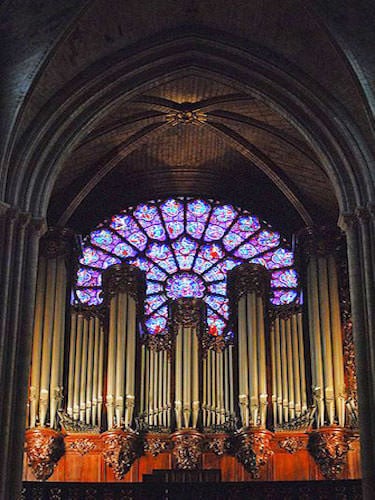
Notre-Dame’s Great Organ was built in the 15th century, and enlarged and restored in the 18th century before undergoing a masterful transformation in 1868 by the famed organ builder Aristide Cavaillé-Coll. His work elevated it into one of the greatest instruments of its time, blending power with remarkable tonal richness.
In 2012, the electronic transmission was updated in preparation for the Chemin du Jubilé celebrations. Just two years later, in 2014, the entire instrument was carefully disassembled so that mechanisms could be replaced and the facade pipes restored.
Today, the Great Organ is celebrated worldwide for its majestic sound.
For those drawn to sacred music, the cathedral has long offered a special treat: free organ concerts every Sunday during opening hours. This tradition allows visitors to experience both the grandeur of the instrument and the spiritual atmosphere it was built to serve.
Notre Dame Cathedral’s Porte Rouge and Porte du Cloître

The Porte Rouge (Red Door), on the northern wall of the chancel, once led to the cloister. Built in the 1250s, it reflects the refined sculptural style of Pierre de Montreuil, with a facade crowned with a delicate garland of hawthorn. The doorway’s single arch is adorned with carvings that tell the story of Saint-Marcel, while the tympanum depicts the Coronation of the Virgin Mary.
Sculptures of King Saint-Louis (who commissioned this remarkable portal) and his queen, Marguerite of Provence, once framed the entrance. The lower relief hints at Eastern artistic influences, likely introduced by Crusaders returning from the Holy Land.
The nearby Porte du Cloître was created a decade earlier by Jean de Chelles, the cathedral’s first master builder. This doorway once connected the cathedral to the Canons’ lodgings and is crowned by the magnificent north rose window.
Le Chemin du Jubilé in Notre Dame Cathedral
The Chemin du Jubilé marked Notre Dame Cathedral’s 850th anniversary, running from December 2012 to November 2013. Supported by national and civic leaders, the celebration transformed the Parvis Notre Dame into a vibrant space for ceremonies, exhibitions, and cultural events.
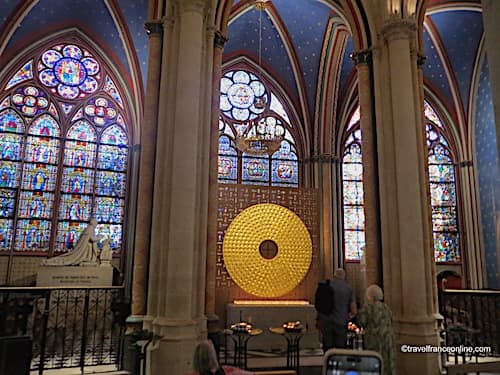
Major restorations were carried out beforehand: nine new bells were cast, the treasury enhanced, the Shrine of Sainte-Geneviève, the Porte Rouge, the Grand Organ, and cathedral lighting were restored.
The theme of pilgrimage was central to the festivities. Visitors were thus invited to walk Le Chemin des 850 ans, a symbolic journey that began beneath a soaring 13-metre portal, continued through the cathedral’s iconic sculpted facade, and led into its interior treasures.
Directions: 4th district
Metro station: Ile de la Cité on Line 4
Coordinates: Lat 48.853250 – Long 2.348886
Wikimedia Commons: Great organ by Ibex73 is CC BY 4.0