Place de la Nation, a major roundabout
Place de la Nation is located in the Faubourg Saint-Antoine.
This lively district, once renowned for its talented cabinetmakers, was the epicentre of several revolutions that shook France in the late 18th and 19th centuries. The inhabitants of the Faubourg Saint-Antoine were indeed the first to rise during the French Revolution in 1789 and storm the Bastille fortress.
Even today, the Faubourg remains imbued with a deep republican symbolism, as the Rue du Faubourg-Saint-Antoine, which connects it to Place de la Bastille, remains the official route for major political demonstrations.
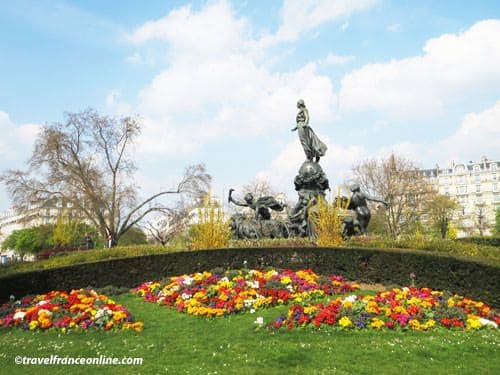
Place de la Nation is now a large roundabout with a central island adorned with a monumental sculpture representing the Triumph of the Republic. Avenue du Trône and Cours de Vincennes connect it to the town and castle of Vincennes.
Place du Trône

Although today one of the most vibrant squares in Paris, Place de la Nation had humble beginnings and remained largely uninhabited until the mid-19th century.
In the 10th century, it was little more than a wasteland, hosting the annual Gingerbread Festival of the Abbey of Saint-Antoine, a popular event that lasted until the French Revolution.
In 1660, the site was landscaped to commemorate the triumphant return of Louis XIV and his young wife, Marie-Thérèse of Spain, after his coronation in Reims. An imposing throne was erected in the centre of the makeshift square, providing the young royal couple with a platform from which to greet the Parisians.
This historic event gave the square its first name, Place du Trône (Throne Square). However, despite the popularity of this event, the aera remained sparsely populated, as it was too far from major roads and the Seine River.
Barrière du Trône on Mur des Fermiers Généraux

The Barrière du Trône, one of the massive gates of the tax enclosure known as the Mur des Fermiers Généraux – Wall of the Farmers General, was the first structure erected on the Place de la Nation in 1778.
The architect Ledoux designed two tollbooths, connected by a 60-metre-long railing, as well as two identical square pavilions to house the customs offices and staff quarters.
Ten years later, two 28-metre-high Doric columns were erected atop Ledoux’s tollbooths. In 1841, Antoine Étex and Auguste Dumont sculpted the statues of King Saint-Louis and King Philip-Augustus that crown them.
The Barrière du Trône, including its pavilions and tollbooths, was listed as a historical monument on April 24, 1907, and marks the southern edge of the square.
Place du Trône Renversé
Despite its aesthetic appeal, the Place de la Nation was the scene of tragic events.

The pavilions, columns, and tollbooths escaped demolition during the French Revolution. However, the revolutionaries renamed the square Place du Trône Renversé (Square of the Overturned Throne) and installed the guillotine there.
In the space of just over a month, from June 13 to July 28, 1794, more than 1,300 people were beheaded there in the name of Liberty, Equality, and Fraternity. The victims came from all walks of life, all generations, and all social classes.
The memory of these tragic events persisted, leaving its mark on the neighbourhood, which remained predominantly rural until its annexation to the City of Paris during the territorial reform of 1860.
The square was then completely redesigned and renamed Place de la Nation in time for the French National Day celebrations on July 14, 1880.
Le Triomphe de la République

Le Triomphe de la République (The Triumph of the Republic), Dalou‘s impressive bronze sculpture, was unveiled in 1899.
This work replaced an earlier plaster cast made in 1889 for the centennial celebrations of the French Revolution.
The French Republic has always been represented by a young woman named Marianne. Standing proudly on a chariot drawn by two majestic lions, Marianne radiates strength and resilience. The Spirit of Liberty guides the chariot, while a blacksmith, symbolising the dignity of Labour, pushes it. Statues representing Justice and Abundance, as well as a group of children symbolising the Future of the Republic, walk alongside Marianne.
The young woman’s gaze is fixed on the Rue du Faubourg-Saint-Antoine, the historic thoroughfare leading to the Place de la Bastille through the Faubourg Saint-Antoine. This deliberate orientation symbolises the square’s history and its unbreakable link with the revolutionary spirit that shaped the Nation.
Directions: 12th district
Metro: Nation on Lines 1, 2, 5, 6, 9 and RER A
Coordinates: Lat 48.848390 – Long 2.395921