Montmartre Cemetery – Cimetière du Nord
Montmartre Cemetery, officially called the Cimetière du Nord (Northern Cemetery), was established in 1825. It is one of the four main cemeteries laid out at the cardinal points of Paris in the early 19th century.
These cemeteries replaced the old parish cemeteries, which had been closed due to public health concerns. The remains of six million Parisians were thus transferred to the Catacombes, the Parisian underground necropolis located beneath Place Denfert-Rochereau.
Montmartre Cemetery was opened in the former limestone quarries at the foot of Montmartre Hill. It covers approximately 11 hectares, contains nearly 20,000 graves, and is the third-largest cemetery in Paris after the Père Lachaise and the Cimetière de Montparnasse.
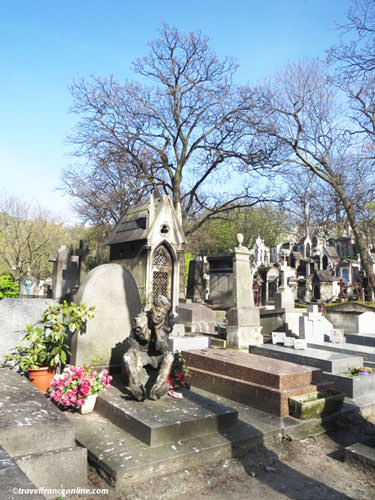
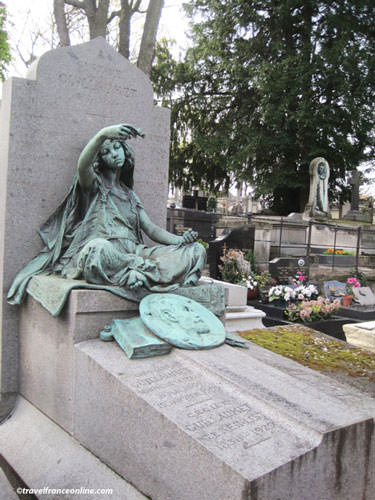
Montmartre Cemetery is renowned for the variety of its funerary art, mausoleums, vaults, and chapels, each reflecting a unique architectural style. Some buildings are indeed massive and extravagant, while others express simplicity and modesty. Over time, some monuments have deteriorated, while others have been reclaimed by nature, enveloped by tree roots.
Paved lanes lined with maples, chestnut trees, linden trees, and cedars crisscross the site and delineate its different sections.
Who was buried in Montmartre Cemetery?

Singers, dancers, and actors
Painters
Writers and poets
The name Rose Alphonsine Plessis, also known as Marie Duplessis, Countess of Perregaux, may not ring a bell at first. However, it will take on its full meaning when you learn that she was the courtesan who inspired Alexandre Dumas‘s iconic novel, La Dame aux Camelias – The Lady of the Camellias.” Both Marie and Alexandre are buried in Montmartre Cemetery.
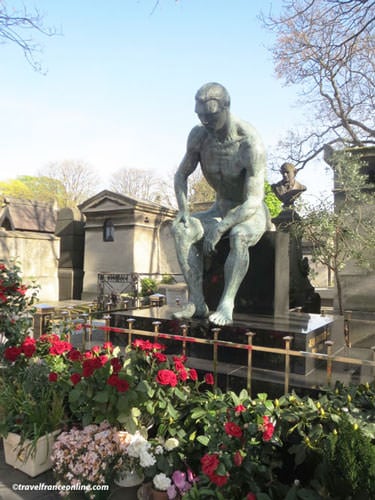
Théophile Gautier, one of the most renowned French Romantic poet of his time, is also buried there.
Don’t forget the grave of Marie-Henri Beyle, better known by his pen name, Stendhal.
You might be surprised to discover the modest grave of the poet and novelist Alfred de Vigny, discreetly nestled between several imposing chapels and the cemetery wall!
As for Emile Zola, he was initially buried in the family mausoleum. However, his remains were later transferred to the Pantheon, and a cenotaph now adorns the family grave.
Finally, the authors, publishers, and founders of the prestigious literary prize, Edmond and Jules de Goncourt, rest together in the same tomb.
Composers, creators, explorers
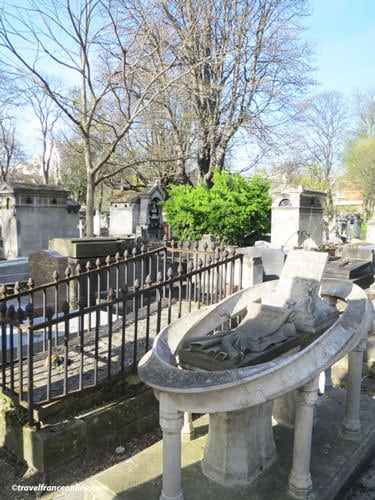
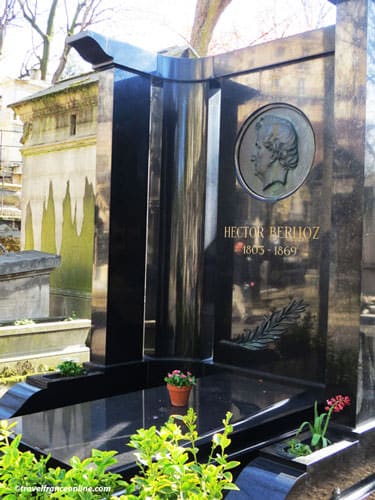
If you are a music lover, you will undoubtedly want to discover the tombs of the German-born composer Jacques Offenbach and the French composer Hector Berlioz.
The German-born architect Jacques Hittorf, known for designing numerous Parisian landmarks, including the Gare du Nord, the Cirque d’Hiver, the now-demolished rotundas of the Passage des Panaromas, and the prestigious buildings surrounding the Place de l’Étoile, and the Place de la Concorde, is also buried in Montmartre Cemetery.
You will also discover the tomb of the explorer Jean-Baptiste Charcot, as well as that of Jean Marie Joseph Farina, the perfumer to whom we owe the famous Eau de Cologne that bears his name.
This list only gives a glimpse of the many personalities who have left their mark on the history and culture of Paris, and you will need at least half a day to explore the Montmartre Cemetery in detail.
Opening hours: Every day from 8:30 a.m. to 5:30 p.m., 6:00 p.m., or 8:30 p.m., depending on the season (weather permitting). Access is free, but entry is prohibited 15 minutes before closing time.
Directions: 18th district – Entrance 20 avenue Rachel
Metro: Place de Clichy on Lines 2,13 then follow rue Caulaincourt
Coordinates: Lat 48.885404 – Long 2.331111
Discover more on Montmartre
Montmartre Village Place du Tertre – Petit Cimetiere du Calvaire – Saint–Pierre-de-Montmartre Church – Saint-Jean-de-Montmartre Church – Sacre-Coeur Basilica – Montmartre Abbey Sanctum Martyrium Crypt – Saint-Vincent Cemetery – Le Passe-Muraille sculpture – Le Mur des Je t’Aime – Abbesses Art Nouveau Metro station – Moulin Rouge – Bateau Lavoir – Montmartre grape harvest festival