
Emerald Coast, named after the colour of the sea
The Emerald Coast runs along the coasts of the Côtes-d’Armor department.

It extends from the fishing port of Cancale on the Baie du Mont Saint-Michel, to Cap d’Erquy, on the Bay of Saint-Brieuc.
The name Côte d’Emeraude – Emerald Coast is relatively recent; It was indeed coined by the local historian and socialite Eugène Herpin at the beginning of the 20th century.
Before then, this rugged coastline was known as Clos-Poulet, which literally means “chicken coop“.
But this particular name had nothing to do with chickens! It simply comes from the Latin Pagus Aleti ( the tribe of the Aleti’s tribe) which evolved into Pays d’Alet, then into Pou-Alet.
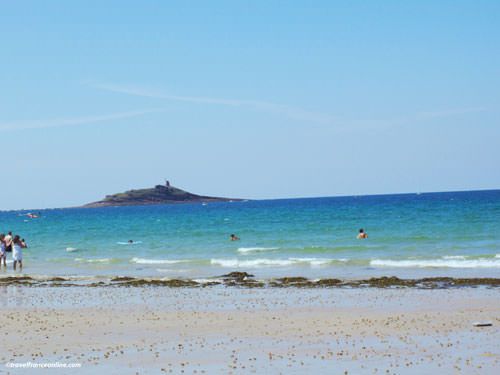
The name Emerald Coast perfectly describes this exceptional coastline, where the sea displays an exceptional palette of emerald green and turquoise hues evolving with the daylight.
Discovering the Emerald Coast
The Emerald Coast is an exceptional coastline, renowned for it succession of small coves, granite headlands, and cliffs plunging steeply into the sea. Over millennia, marine and wind erosion have sculpted this rugged coast; some sections are only accessible on foot.

Narrow, winding paths, once used by smugglers, meander between moors and rocks, leading to secluded coves with fine sandy beaches and promontories offering breathtaking views of the sea and coastal villages. Smuggling was once a common practice on this coast.
Today, each municipality is proud of its coastal paths, collectively called the Chemin des Douaniers (Customs Officers’ Path). Although the smugglers have long since disappeared, old guard posts still dot the landscape.
Finally, the Rance estuary, as well as the Frémur and Arguenon rivers, cut into the coastline and are sheltered havens for small ports and marinas, protected from sea spray.
Cancale – Rotheneuf – Saint-Malo
The scenic coastal road runs along the coastline, linking towns and villages, coves and headlands.

Starting from Cancale, a picturesque fishing village renowned for its oysters, you can admire the famous Rocher de Cancale, a rocky islet off the coast.
Farther on, the La Pointe du Grouin, one of the region’s most picturesque promontories, offers breathtaking panoramas that extend from the Bay of Mont-Saint-Michel in the east to Cap Fréhel in the west.
The village of Rotheneuf, once a haven for smugglers, welcomes holidaymakers to its two magnificent beaches. It is also known for the sculpted rocks, which Abbé Fouré, a priest, sculpted at the end of the 19th century.
A short distance from Rotheneuf stands Saint-Malo. This imposing fortress and former corsair city proudly watches over the north bank of the Rance estuary.
Dinard – Le Guildo
Dinard, renowned for being the most English of French seaside resorts, commands the southern bank of the Rance estuary. Following the scenic route, the next seaside resort is Lancieux, famous for its long sandy beach, a surfer’s paradise.

The picturesque fishing village of Saint-Jacut-de-la-Mer stretches along a long rocky peninsula. The village’s main street leads to Rougeret beach and Pointe du Chevet, both offering stunning views of the island of Ébihens and the surrounding coastal villages.
The fishing village of Le Guildo commands the mouth of the Arguenon. Pen Guen, with its fine sandy beach, is an ideal place for a break.
Next comes the old fishing village of Saint-Cast-le-Guildo and its magnificent marina. The seaside resort extends over three districts: Le Bourg, L’Isle and Les Mielles. At the tip of the peninsula, Pointe de Saint-Cast, stands the Monument aux Evadés (Monument to the Escapees), offering a breathtaking view of the Emerald Coast. You’ll find another monument, dedicated to the crew of the frigate Laplace, which sank in 1950, along the path leading to this viewpoint. Saint-Cast boasts a long, fine sandy beach, Plage de la Mare, ideal for a stroll or a day in the sun.
To the west of Saint-Cast stands the fort of La Latte. The current structures are the remains of the 14th-century fortress of the Goyon-Matignon family. The fortress was remodelled and restored in the 17th century, and again in the early 20th century.
Cap Fréhel – Les Sables d’Or
Cap Fréhel is a remarkable site on the Emerald Coast and serves as a bird sanctuary.
Paths wind through the heath-land, leading to the two lighthouses located at the tip of the peninsula. This promontory juts out into the sea, offering breathtaking views of the coastal villages, including Les Sables d’Or les Pins.
Originally developed in the 1920s, Les Sables-d’Or-les-Pins declined after the 1930s economic crisis. However, its superb beaches of fine, golden sand, from which it takes its name, as well as its casino, have since been revitalised. Today, the seaside resort attracts many French and international holidaymakers during the summer.
The journey along the Emerald Coast ends at Cap d’Erquy, a promontory nestled in the Bay of Saint-Brieuc. An excursion along this beautiful Emerald Coast offers a day of discovery, blending history, nature and relaxation.


