
Aubusson, a site inhabited since the Iron Age
The legend surrounding the origins of Aubusson recounts that the Saracens settled on the banks of the Creuse River after being defeated by Charles Martel at the Battle of Poitiers in 732 AD. True or false, who knows?
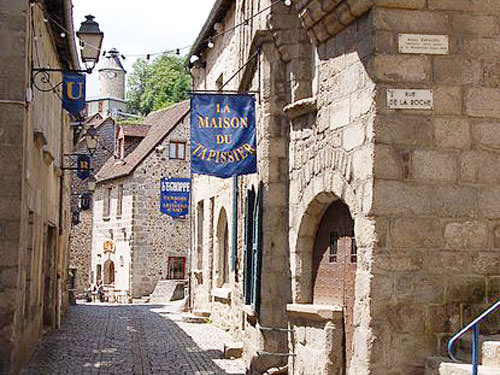
What we do know for certain, however, is that the region was inhabited during the Iron Age, as evidenced by archaeological excavations at the Camp de Châtres site.
Gallo-Roman architectural remains also indicate that Aubusson was a flourishing city around 2,000 years ago.
Then historical documents from 936 mention the town of Albuciensis, which became Albuconis at the end of the 11th century.
The exact origin of this name, however, remains obscure; it could be derived from a Celtic term meaning “rocky” or be a variant of the given name Albucius.
The origins of the Aubusson Tapestry
Aubusson has been renowned worldwide since the 14th century for its exceptionally high-quality tapestries, but once again, we don’t known exactly how the town began to specialise in tapestry.
This brings us back to the Saracens, as some suggest that they introduced weaving in the 8th century, but there is no documentation to support this theory. However, this could be plausible given the tradition of high-quality tapestries and carpets among Berber communities. Another hypothesis proposes that Flemish weavers settled in the town in the 14th century, when Louis I of Bourbon, the town’s patron, married Marie of Hainaut, and developed the local weaving industry.
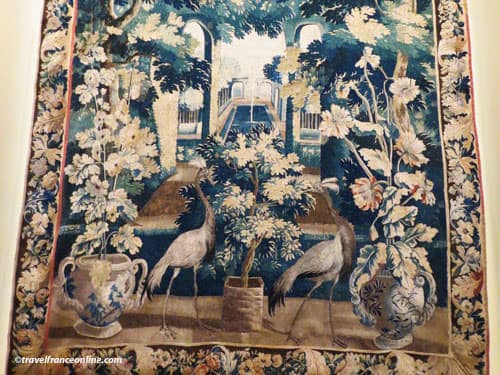
In any case, Aubusson was an ideal location for weaving workshops. The acidity of the Creuse River’s waters indeed facilitated the degreasing of wool and the fixing of dyes. The city’s flourishing weaving industry also had a beneficial impact on local sheep farming due to the high demand for wool.
Aubusson tapestries are renowned for their traditional motifs, particularly the iconic Verdures designs. These tapestries showcase plant motifs such as trees and foliage, themes that have remained popular throughout the centuries. Hunting scenes, another emblematic motif, enjoyed great popularity from the 16th century onward. Many tapestries depicted hunting scenes, including the hunt for the unicorn, boar, wolf, and lion. However, religious themes were also common, and featured mythological scenes, stories from the lives of saints, and narratives from the Old Testament.
Aubusson and the great painters of the 17th and 18th centuries
The Aubusson workshops also collaborated with renowned painters to create new designs. This association began in 1665 when the first minister Colbert granted the Aubusson tapestry workshops the status of Royal Manufactory. Thus, Isaac Moillon, the King’s painter, was among the first painters to collaborate with the newly founded manufactory.
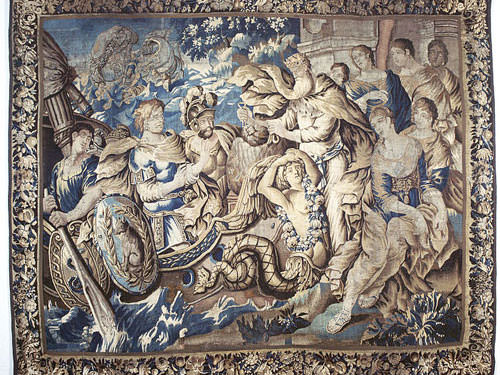
Jean-Joseph Dumons and Jean-Baptiste Oudry followed. The latter later became artistic director of the Royal Manufactories of Beauvais and the Gobelins in 1734.
François Boucher, known for his mythological and pastoral scenes, also contributed, as did Jean-Antoine Watteau, Jean-Baptiste Huet, Charles Le Brun, and Jacques-Nicolas Julliard, a student of Boucher whose innovative spirit raised the manufactory’s work to new heights. François Finet, an expert in character portraits in the 18th century, was renowned for his unparalleled technique in reproducing flesh tones.
Finally, Jacques Barraband was one of the last renowned painters to contribute to the creation of Aubusson tapestries before the French Revolution.
Aubusson workshops after the Revolution
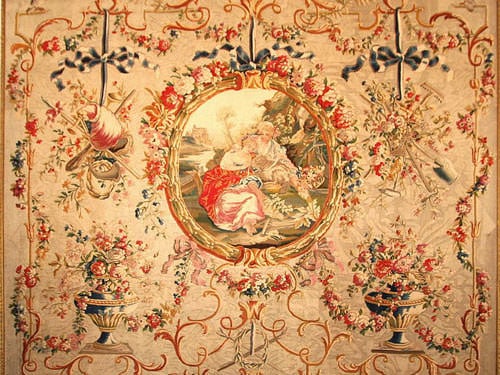
The Aubusson tapestry factory and its magnificent creations were looted and burned during the French Revolution.
Fortunately, the weaving workshops reopened a few years later under the Napoleonic Empire. However, the quality of the production declined.
The creation of large wall tapestries was indeed abandoned, and the focus shifted to producing smaller rugs.
While these more “ordinary” creations helped revive the tapestry industry and prevent its collapse, they lacked the creativity and innovation that characterised earlier works, leading to a gradual decline in the artistic quality of Aubusson tapestries throughout the 19th century.
Revival of the Aubusson tapestry
The French state founded the National School of Decorative Arts to revitalise the tapestry industry.
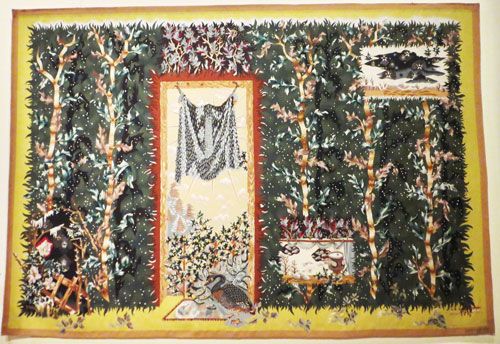
However, it was only in 1917, when the painter and engraver Antoine-Marius Martin took over its direction, that the institution experienced a true renaissance.
This revival was celebrated at the 1925 International Exhibition of Modern Decorative and Industrial Arts. Aubusson indeed presented works based on designs by renowned painters and promising young artists of the time.
But the decisive turning point came at the 1937 International Exposition of Arts and Techniques in Modern Life, where Élie Maingonnat, who succeeded Martin, met Jean Lurçat, the brilliant painter and ceramicist who revolutionised and revitalised the art of contemporary tapestry.
Aubusson tapestry today
The consecration took place in 2009 when UNESCO inscribed the Aubusson Tapestry on the Representative List of the Intangible Cultural Heritage of Humanity.
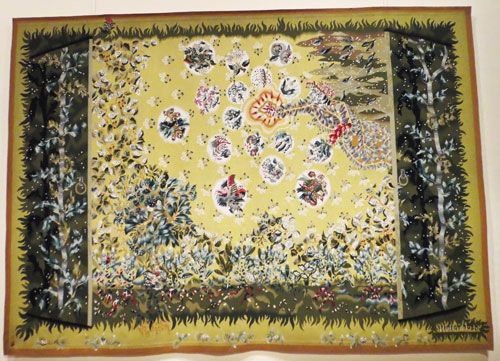
Today, Aubusson is a generic term, as these magnificent tapestries are created in several accredited workshops.
From the 16th to the 18th centuries, each Aubusson tapestry bore the name of its original workshop, often accompanied by the artist’s name or initials woven into the fabric. Contemporary tapestries display the workshop’s logo, the artist’s signature, and a weaving reference number.
Here are exceptional museums where you can admire these tapestries:
- The Cité Internationale de la Tapisserie (International Tapestry Centre) traces the evolution of tapestry from its origins.
- The Maison du Tapissier (Tapestry House) houses an authentic tapestry workshop.
- Finally, the Galerie de la Manufacture des Gobelins (Gobelins Manufactory Gallery) in Paris.
Department of Creuse – Limousin region
Coordinates: Lat 45.954090 – Long 2.168938
Photos via Wikimedia Commons: Maison du Tapissier by Dietrich CC BY-SA 3.0 – Drawing by Huet by Robert Valette CC BY-SA 4.0 – Eole from a drawing by Moillon by Cité Tapisserie CC BY-SA 3.0


