Place des Victoires, a royal square
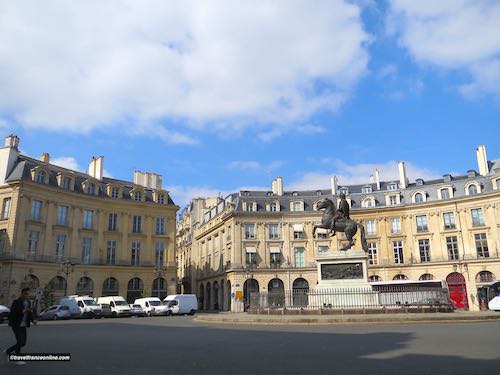
Place des Victoires is a prestigious square built to commemorate the victories of Louis XIV, known as the Sun King. It is one of the five “royal squares” of the city, in other words squares built either by a king or in his honour.
The other royal squares are Place des Vosges in the historic Marais district, Place Dauphine on Ile de la Cité, Place Vendôme and Place de la Concorde near the Louvre, Tuileries and Champs-Elysées.
Located in the heart of Paris, Place des Victoires also marks the boundary between the 1st and 2nd arrondissements. Its strategic location makes it easily accessible from iconic sites such as the Palais-Royal, Galerie Vivienne, La Bourse (Paris (Stock Exchange) and Les Halles.
A square framed with elegant mansions
So, who initiated its creation? In 1685, Marshal de La Feuillade had the old Hôtel de La Ferté-Senneterre and its gardens demolished. He commissioned Hardouin-Mansart for the creation of the square.
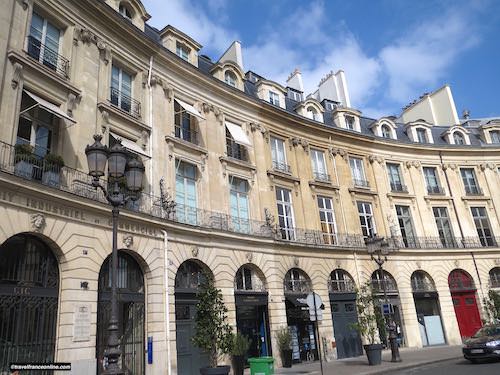
The renowned architect gave the Place des Victoires its characteristic circular shape, 80 meters in diameter. He also designed the superb private mansions that surround it, but as their construction was not yet complete for the inauguration day, they were depicted on large canvases!
The upper floors of these buildings, linked by elegant Ionic pilasters, once offered luxurious apartments. Elegant Mansard-style dormer windows adorn the attics, which formerly served as servants’ quarters.
The ground-floor arcades now house high-end fashion boutiques. Six streets were opened in 1692, starting from the Place des Victoires.
Equestrian statue of Louis XIV
François Bosio created the imposing equestrian statue of Louis XIV that stands in the centre of the square, and was inaugurated on August 25, 1822.
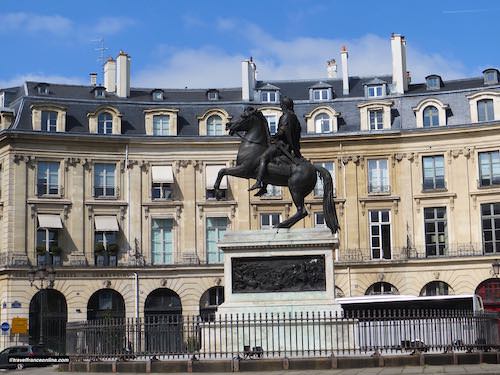
Bosio drew inspiration from the bronze equestrian statue of Peter the Great of Russia, a work by Falconet, housed in Saint Petersburg.
The statue of Louis XIV that originally adorned the square was destroyed during the French Revolution and melted down, like most of the statues and artefacts then associated with the monarchy. After the Revolution, the empty space was temporarily filled by a wooden pyramid. A statue of a general of the Empire then occupied the spot until 1822, when Bosio’s masterpiece was installed.
It is a pity that Place des Victoires is less well-known than other prestigious Parisian squares; it indeed boasts superb architecture, and the plethora of refined boutiques open under its elegant arcades turn it into a hub for luxury commerce.
Directions: 1st–2nd district
Metro stations: Bourse or Sentier on Line 3
Coordinates: Lat 48.865999 – Long 2.341102