Before Les Halles

The writer Émile Zola famously immortalised Les Halles as the “Belly of Paris,” capturing its very essence as the city’s commercial heart!
Les Halles district wasn’t always the bustling hub it is today.
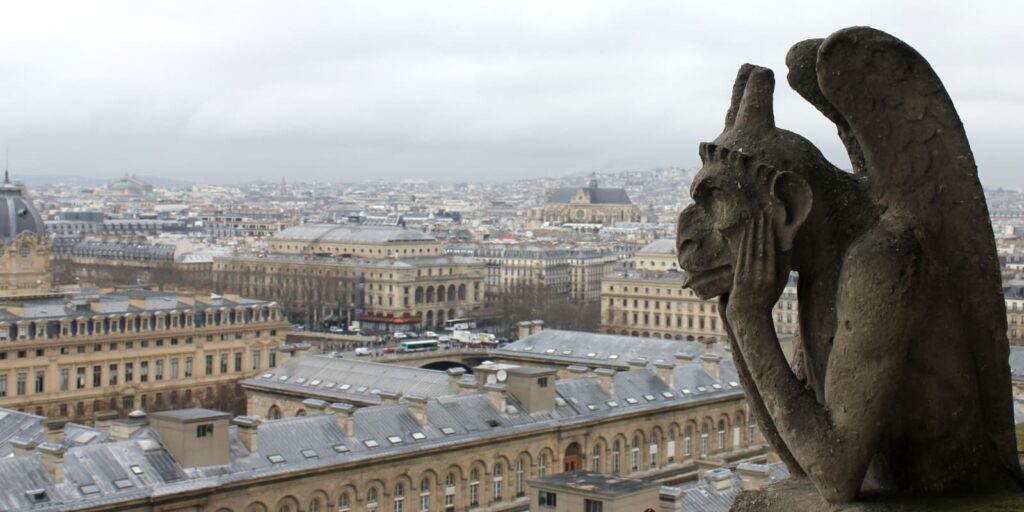
Until the 12th century, the Right Bank was indeed primarily a vast marshy area, left behind by an ancient meander of the Seine after its course was reversed.
Sparsely populated, it housed only two large monasteries: the Enclos du Temple, the Knights Templar fortified monastery, and the Abbey of Saint-Martin-des-Champs, as well as a small community that had developed on a hillock near the Pont-Notre-Dame (bridge).
The birth of Les Halles
At the beginning of the 12th century, the market at Place de Grève (Hôtel-de-Ville) struggled to meet the demand of the rapidly growing Parisian population.
Thus, in 1135, King Louis the Fat had a public market, or Halle, built on the Right Bank at a place called Campelli (fields), a name that evolved into Les Champeaux.
In 1183, King Philip-Augustus expanded the market by adding two buildings to house cloth merchants, shoemakers, weavers, and tinsmiths. The king also incorporated the Halle within the rampart he had erected in the 1190s before departing for the Third Crusade.
The first food stalls appeared in 1269, and King Louis IX ordered the construction of three new buildings. Two of these buildings were dedicated to the sale of fish, which arrived from Norman ports via the Chemin des Poissonniers (Fishmongers’ Road). The present-day Rue Poissonnière, Rue des Petits-Carreaux, and Rue Montorgueil follow the route of this ancient road.
Finally, in 1284, shoemakers and leather-workers had their own dedicated building.
Les Halles – Rive Droite
The presence of Les Halles stimulated the development of the Right Bank and gave rise to a vibrant neighbourhood.
The Sainte-Agnès chapel was thus built in 1213 to serve the rapidly growing population.
Open three days a week, on Wednesdays, Fridays, and Saturdays, Les Halles became a central hub of commerce and activity.
However, by 1553, the considerable expansion of Paris had rendered them obsolete!
New buildings, specifically dedicated to stalls selling bread and dairy products, were thus erected around a central square, known as the Carreau.
The wine and leather markets were transferred in the 1810s to a specially constructed hall located in the 13th arrondissement, and the flower market to Place Lépine on the Ile de la Cité.
Halles de Baltard
The penultimate transformation of Les Halles occurred in the mid-19th century when Baltard, a pioneer of metal architecture, built the famous covered market halls that bear his name.

However, Baltard did not simply remodel and enlarge Les Halles; he completely redesigned its layout, and oversaw the demolition of the Cemetery of the Innocents (now Place Joachim du Bellay), whose remains were transferred to the Catacombes at Place Denfert-Rochereau on the Left Bank. He redesigned the site to accommodate the herb and vegetable market.
Despite significant controversy during their construction, the Halles de Baltard pavilions became a Parisian icon.
But as all things must come to an end, these magnificent covered market halls gradually became obsolete as the population increased. They were demolished in the 1970s, and the market was relocated to Rungis, located in the southern suburbs of Paris.
Despite the efforts of various heritage preservation groups, the demolition occurred over just a few months, resulting in the disappearance of 800 years of history.
Forum des Halles
The Forum des Halles replaced the market in 1979.

However, the glass and metal architecture of this 4,000 m² complex sparked further controversy! The project was completed despite opposition from numerous residents’ associations, who claimed it was destroying the historic heart of Paris.
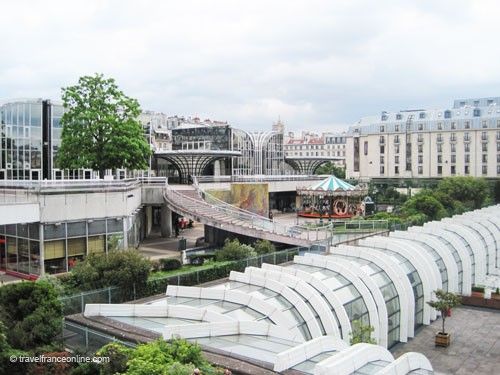
The Forum des Halles comprised four underground levels dedicated to fashion boutiques, cinemas, restaurants, banks, and a museum. Large arched glass roofs allowed natural light to flood the lower levels. The complex was connected to the metro and the RER (Regional Express Network).
However, the Forum was not only deemed unattractive but it quickly became a gathering place for young delinquents. Thus, few people dared venture there late at night, and the Forum soon acquired a reputation as an area to avoid. A real failure!
La Canopée
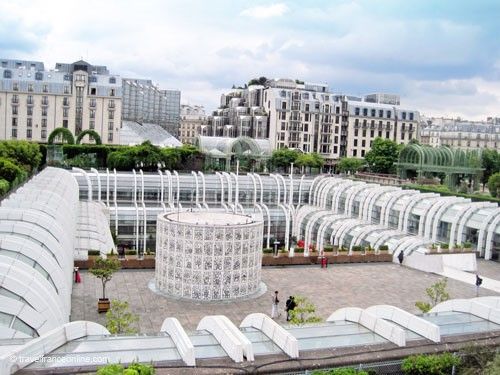
Thus, once again, the City of Paris embarked on an ambitious redevelopment program to revitalise the district and commissioned architects Patrick Berger and Jacques Anziutti to create La Canopée.

This vast, undulating roof houses theatres, banks, museums, restaurants, and shops spread across five floors arranged around a central courtyard.
However, their architectural vision sparked even more controversy than the Forum and Baltard’s Les Halles combined!
Despite the opposition, and unsurprisingly, construction continued, though not without some delays that impacted the project schedule! Thus, Les Halles district remained a vast construction site for several years.
La Canopée was finally completed in 2016.
Directions: 1st District
Metro station: Châtelet-Les Halles on Line4 and RER A,B, D
Coordinates: Lat 48.862480 – Long 2.346381
Photo via Wikimedia Commons: Halles de Baltard is in Public domain usage