Parmentier Metro station’s decorative theme: the potato
Yes, you read that right: the Parmentier Metro station celebrates the potato with a unique design! The reason is that it is one of Paris’s cultural Metro stations!

Located on Avenue Parmentier, the station it pays homage to Antoine Parmentier, a 18th-century figure who popularised the potato cultivation in France. Antoine Parmentier discovered the potato while a prisoner of the Prussians during the Seven Years’ War, as potatoes were a staple food for prisoners. It was in this context that Parmentier fervently defended the nutritional value of the potato upon his release.
Green latticework, reminiscent of the mesh of the traditional potato sack (the iconic French sac à patates), adorns the vaulted ceiling and walls of the station, creating a unique nod to the history of this tuber.
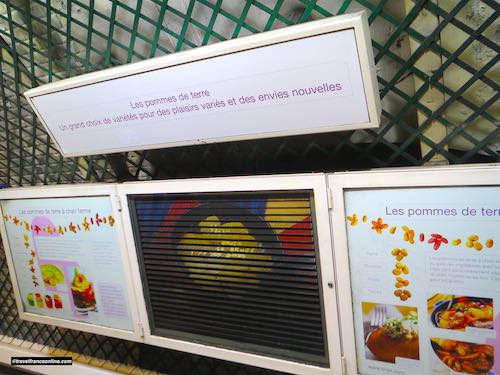
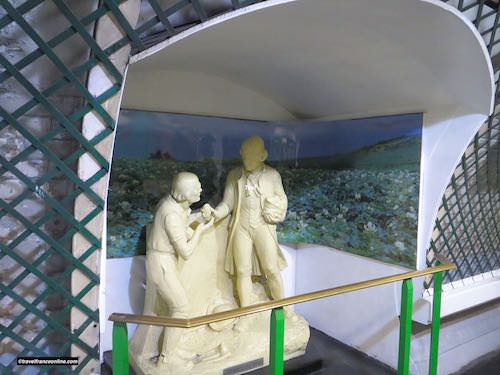
Display cases placed on each platform showcase photos and documents recounting the discovery of the potato by Spanish conquistadors in Peru. Information panels lining the walls provide an overview of the potato’s evolution, its various varieties, and its culinary uses, from fries to mashed potatoes and more. Finally, a replica of a statue of Antoine Parmentier seems to watch over the area.
Parmentier introduced the potato in France
Let’s return to Parmentier’s crucial role in introducing potato cultivation in 1787, just two years before the start of the French Revolution!
Parmentier experimented in the Plaine des Sablons (today the town of Neuilly-sur-Seine), a region that was once arid and sandy (sableuse – sablons), where Queen Marie Antoinette had a racecourse built in 1776.
Parmentier believed that the quality of the sandy soil and the size of this area provided ideal conditions for growing potatoes.
The timing of Parmentier’s launch was significant. France had indeed just experienced several consecutive harsh winters that had devastated a large portion of the wheat harvest, the staple food of the time.
The shortage of this essential commodity led to recurring famines and increased social unrest, highlighting the urgent need to find alternative food sources.
By introducing potato cultivation, Parmentier not only addressed immediate food shortages but also laid the foundations for a sustainable agricultural solution that would help alleviate hunger and ease rising social tensions in France.
Parmentier had also recognised the potato’s resistance to cold and its nutritional value, convinced that it therefore held the key to resolving the food crisis.
Thus, with the support of King Louis XVI, genuinely concerned about the well-being of his subjects, Parmentier launched a campaign to promote the consumption of potatoes.
The king ordered his cooks to serve potato dishes daily, a practice quickly adopted by his court. However, despite royal approval, the people remained sceptical of this new tuber, considering the potato unfit for human consumption and only good for feeding livestock.
Parmentier then employed an ingenious and cunning strategy to overcome this resistance. He had the potato fields guarded at night, secretly ordering the guards to turn a blind eye to the thieves who stole the plants under the cover of darkness. This clever trick exceeded all expectations! Soon, most Parisians began growing potatoes in their gardens, followed by the rest of France.

The name of Antoine Parmentier lives on through numerous potato-based dishes, one of the most popular being hachis Parmentier, which consists of minced meat mixed with mashed potatoes. Also discover Aligot d’Aubrac from Aveyron, a delicious regional mashed potato recipe with a twist.
Let’s return to the Parmentier metro station on Line 3. It was opened in 1904, and today connects Galliéni in eastern Paris to Pont de Levallois-Bécon in the west. As you enter the station at the corner of Avenue Parmentier and Avenue de la République, don’t forget to admire its original Art Nouveau entrance, designed by Hector Guimard!
From there, a 10-minute walk will take you to to Place de la République and Cimetière du Père Lachaise.
Directions: 11th district
Coordinates: Lat 48.865444 – Long 2.374557