
Place de la République, a once busy roundabout
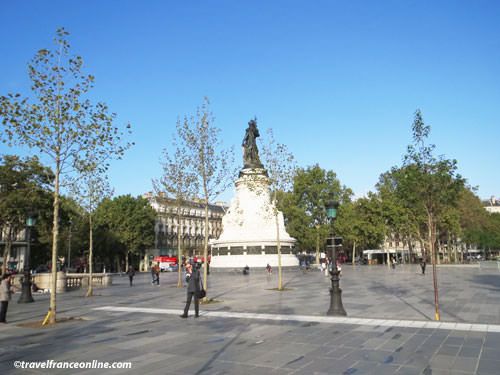
The Place de la République holds profound symbolic value, as it has served as a rallying point for expressing grief and solidarity since the tragic attack on the satirical magazine Charlie Hebdo on January 11, 2015.
Formerly a bustling roundabout at the junction of the 3rd, 10th, and 11th arrondissements of Paris, at the intersection of eight major streets and avenues, and served by five metro lines, making it an important interchange hub.
The square underwent a radical transformation in 2012-2013. The City of Paris indeed commissioned the architects and urban architects Trévelo and Viger-Kholer to divert car traffic around its perimeter, and transform it into an exclusively pedestrian space that consequently improved its functionality.
The long gone Place du Château
That said, the Place de la République wasn’t always a huge roundabout and wasn’t in its current location. A first square was created at the end of the 17th century when Louis XIV commissioned the demolition of the 14th-century Charles V’s Wall and its replacement with a Nouveau Cours, a series of wide avenues which have become our current Grands Boulevards.

This small square replaced the Temple Bastion, then located at the level of the current Rue René-Boulanger, at the beginning of the Boulevard Saint-Martin. In 1811, this square was named Place du Château d’Eau after the Fontaine du Château d’Eau, created by Girard.
Fifty years later, Prefect Haussmann had new avenues opened and a rectangular 280-m-long and 120-m-wide square created slightly further east. These extensive works necessitated the demolition of part of the Boulevard du Temple, known as the Boulevard du Crime, due to the numerous theatres that lined it.
In 1866, Gabriel Davioud, architect for the City of Paris, had the Château d’Eau Fountain dismantled, as it was then considered too small for the new square, and reassembled it in front of the Grande Halle of the La Villette slaughterhouse (present-day Place de la Fontaine-aux-Lions) to serve as a watering trough for livestock.
In its place, he had a monumental fountain installed, adorned with eight bronze lions. The Place du Château d’Eau was renamed Place de la République in 1879 to commemorate the proclamation of the Third Republic.
Statue of the Republic
The Morice Brothers sculpted the monumental allegorical group symbolising the French Republic, which stands in the centre of the square and was unveiled on Bastille Day 1885. The main statue represents Marianne, a young woman who traditionally embodies our Republic.
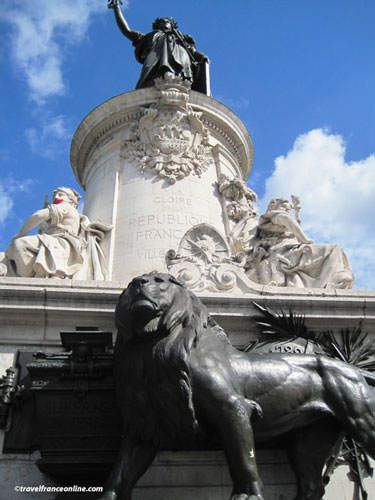
Marianne wears her Phrygian cap, the symbol of Liberty, holds an olive branch in her right hand to represent Peace, and in her left hand a tablet inscribed with “Rights of Man.” A sword hangs from a belt resting on her shoulder.
She stands on a pedestal surrounded by statues of Liberty, Equality, and Fraternity, the three fundamental values of the French Republic.
This pedestal, adorned with a bronze garland, also features two medallions bearing the inscriptions “Labour” and “Pax,” the coat of arms of the city of Paris, and the following inscription:
A la gloire de la République Française – La Ville de Paris – 1883 (To the Glory of the French Republic – The City of Paris – 1883).
A lion holding the Ballot Box of Universal Suffrage, surrounded by twelve bronze bas-reliefs illustrating significant events in the history of the Republic, stands at the base of the pedestal.
Directions: 11th District
Metro: République on Lines 3, 5, 8, 9, 11
Coordinates: Lat 48.867158 – Long 2.363663


