Aligot of Aubrac, the legend
Aligot, a generous and flavourful regional dish emblematic of the Aubrac region, is a mashed potato dish enriched with Laguiole cheese, crème fraîche, and garlic. Laguiole cheese, similar to Cantal cheese, is made primarily from the milk of Aubrac cows, giving this dish a unique regional flavour.
Aligot may be a potato puree, but not just any puree!
The legend tells that the recipe for Aligot was invented in 590 AD! It began when Eulale, the king of Auvergne, the beautiful region of volcanoes, had a bitter argument with his fiery wife, Trétédia.
Seeking a solution, King Eulale turned to the bishops of Saint Flour, Rodez and Mende for mediation. The dignitaries decided to meet on the high plateaus of Aubrac, where the territories of their respective dioceses met.
However, their discussions dragged on without any solution in sight. But after several hours of fruitless deliberations, they began to feel hungry. Thinking that this hardship would only last a short time, they had brought only meagre snacks.
The Bishop of Saint-Flour had indeed brought donated potatoes, the Bishop of Rodez fresh cheese, milk, and butter, and the Bishop of Mende salt and garlic cloves, a recently discovered plant imported from distant lands.
With these disparate ingredients at hand, the bishops sought advice from Raginwald, one of their cooks, on how to prepare an appetising dish. Raginwald, lacking inspiration, mixed all the ingredients in a large pot.
The result? Mashed potatoes with garlic and cheese! And so this curious concoction, born of necessity, was served to the three bishops.
And the three men, invoking their patron saints… “By Saint Flour,” said the first bishop, “it’s not so bad!”
“By Saint Hilary,” said the second, “with a touch of garlic, it’s even renowned!”
“By Saint Felix,” said the third, “it’s rather good!”
“I’ll take a bite to inspire my cook on this meatless day!” said the first bishop.
“Excuse me,” said the second, “this unusual mash will allow my monks to sell the large quantity of cheese they produce.”
“Pardon me,” said the third bishop, “I’m thinking of my pilgrims, and such a mash would restore their strength!”
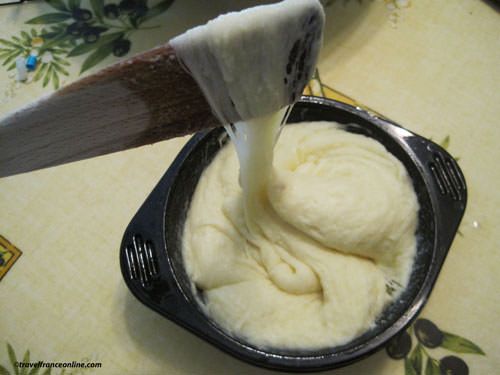
The Bishops tried to divide the remaining mash with a spoon, but the more they cut, the more the mash stretched and stuck to the bottom of the pot! From this curious phenomenon, the bishops discerned a message. They collectively deduced that this concoction belonged in the high plateaus of the Aubrac region.
However, what to call this strange creation? They christened it Ailligot, a name derived from its garlic flavour and its binding properties, a combination of “ail” (garlic) and “ligoter” (to tie).
Is this story true or simply a legend? It doesn’t matter, because it’s a beautiful one.
Croix des Trois Evêques
The monks of La Dômerie erected the Cross of the Three Bishops on the spot where the bishops gathered to commemorate their council. This cross is located 5 km from the village of Aubrac, on the Puy de Guidette (along the D15 towards Laguiole), at the confluence of the present-day departments of Lozère, Aveyron, and Cantal. However, it is now only a replica; the original 300 kg cross was stolen in 1990!
Aligot of Aubrac – Recipe
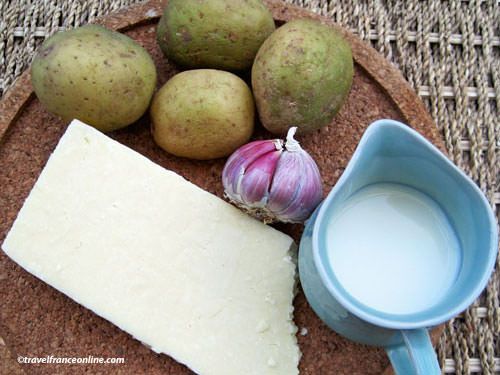
Ingredients:
- 1 kg potatoes (preferably old)
- 150 g butter
- 200 g dairy cream
- 350 g Tome of Laguiole (or substitute with mild Cantal cheese)
- Garlic (to taste)
- Salt and pepper
Method:
- Cook the Potatoes: Peel and cut the potatoes into uniform pieces. Boil them in salted water until tender.
- Mash the Potatoes: Drain the cooked potatoes and mash them until smooth.
- Add Butter and Cream: While the mashed potatoes are still hot, add the butter and cream. Mix thoroughly with a wooden spatula until smooth.
- Incorporate the Cheese: Gradually stir in the grated Laguiole cheese or mild Cantal cheese. Continue stirring until the cheese is melted and the mixture is elastic.
- Season: Add crushed garlic to taste. Season with salt and pepper.
- Final Cooking: Place the mixture over high heat and continue stirring vigorously. Continue cooking, stirring constantly, until the aligot is smooth, elastic, and glossy.
Serving: Serve hot as an accompaniment to meat or enjoy on its own.
Tip: For optimal texture, continue stirring until the Aligot reaches its characteristic elastic consistency.
Bon appetit!
Have you tried this delicious sucré-salé dish from Auvergne: Le Pounti