
Loire Valley, a World Heritage Site
The Loire Valley is one of the country’s most popular tourist destinations.

UNESCO inscribed part of the valley on the World Heritage List on December 4, 2000, for its outstanding cultural and natural significance. This section is 260 kilometres long and approximately 3 kilometers wide, and is bordered by Sully-sur-Loire upstream and Chalonnes-sur-Loire (west of Angers) downstream.
It encompasses 159 municipalities spread across four departments, Loiret, Loir-et-Cher, Indre-et-Loire, and Maine-et-Loire, as it overlaps the Centre – Val de Loire and Pays de la Loire regions.
The Parc Naturel Loire-Anjou-Touraine – Loire-Anjou-Touraine Regional Natural Park, headquartered in Montsoreau, was established in 1996 to preserve the region’s rich biodiversity. This protected enclave, encompassing 136 municipalities in the Maine-et-Loire and Indre-et-Loire departments, indeed provides a refuge for the diverse flora and fauna along the riverbanks.
Loire Valley, a limestone valley

The Loire Valley was already inhabited around 40,000 BC, as evidenced by the dolmens that still stand today.
These dolmens, known as Dolmens Angevins, have a distinctive structure consisting of a burial chamber preceded by a long entrance.
The descendants of these early inhabitants found refuge in the natural shelters carved by the Loire River into the soft limestone, or tufa, remnants of a vast sea, the Falun Sea, which covered northwestern France during the Mesozoic Era.
Tufa, renowned for its softness, was easily cut and shaped, making it ideal for construction. Generations of inhabitants exploited the tufa quarries to build churches, chapels, houses, and castles. However, the depletion of the limestone quarries made tufa bricks increasingly rare and expensive. As a result, they are now mainly reserved for the restoration of historical monuments and listed castles.
Loire Valley, Vallée des Rois
Indeed, tufa, a multifaceted limestone, served as the building material for the magnificent châteaux that adorn the Loire Valley, earning it the nickname Vallée Royale – Royal Valley.
In the 16th century, the kings of France imported a “new culture,” the Renaissance, from their military campaigns in Italy, and transformed the Loire Valley into a realm of a thousand châteaux.

In 1884, the playwright Jules Lemaître wrote:
“La Loire est une reine : les rois l’ont aimée et l’ont coiffée d’une couronne de châteaux” – “The Loire is a Queen loved by Kings, a Queen they adorned with a crown of chateaux.”
The only question is: which of these enchanting châteaux will be your favourite?
As you explore the picturesque Loire Valley, you might be captivated by the elegance and imposing Château de Chambord, the fairytale charm of the Château d’Ussé, or the Château de Chaumont, or the splendour of the moated Chateau d’Azay-le-Rideau. Or perhaps you will be captivated by the graceful arches of the Château de Chenonceau, spanning the shimmering waters of the River Cher.
Each château boasts a unique charm that has inspired royal wives and mistresses to vie for its ownership, a testament to their timeless allure and fascination.
Loire Valley, Douce France
King Henry IV affectionately nicknamed the Loire Valley La Douce France- Sweet France for its micro-climate and gentle light, thanks to its proximity to the ocean.
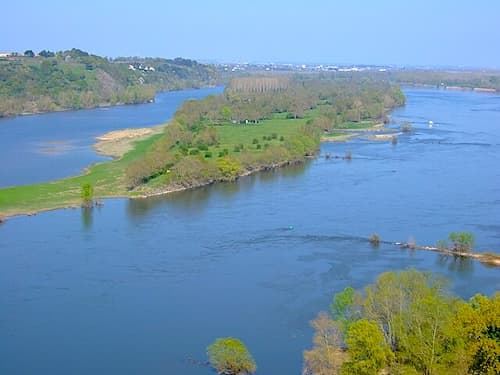
The fertility of the alluvial soils and the mild climate provide optimal conditions for the extensive cultivation of vegetables, fruits, and flowers, transforming the valley into a vibrant mosaic of colourful orchards and cultivated fields. The Loire River meanders through gentle limestone hills covered in vineyards that produce some of France’s finest AOC wines.
The unique charm of the Loire Valley is further enhanced by the diversity of its natural features: the creamy white tufa, the blue-grey slate, the deep brown sand of the beaches and islets, the lush vegetation along its banks, and the reflection of the blue sky in its shallow waters.
With such beauty, it’s no wonder the Loire Valley is among the most visited regions in France!
Photos via Wikimedia Commons: Gabare by Cjp24 CC BY-SA 3.0 – Islet by Touriste Public Domain


