Who is Raymond Isidore, the creator of the ceramic house?
Just like the Palais Ideal du Facteur Cheval, the Maison Picassiette challenges preconceived notions and proves that mastery of art and innovation can be innate, regardless of one’s social or cultural background.

Raymond Isidore’s childhood was indeed marked by poverty and hardship. Born in Chartres in 1900, the seventh of eight children, he became blind in his childhood but was cured at the age of 10 “by ‘kissing a pillar of Chartres Cathedral.” He left school at the age of 10, with only rudimentary knowledge, and grew into a fragile, sensitive, yet quick-tempered adult.
In 1924, his life took a decisive turn when he married a widow.
By 1929, he had saved enough money to buy a small plot of land in the Saint-Chéron district of Chartres, where he built a modest house with the help of his two stepsons.
Maison Picassiette, Raymond Isidore’s dream house

Raymond’s artistic journey began in 1938 when he noticed fragments of sparkling, colourful glass and earthenware filling the surrounding potholes.
He started by collecting them and piling them up in a corner of his garden without knowing exactly what he would do with them, until he realised that he had amassed enough material to create a mosaic to adorn his house.
During the day, he continued to collect fragments of glassware, and in the evening, after his day job, he would begin his mosaic by the light of his kerosene lamp. He often recounted that celestial figures visited him at night and inspired his creations.
He embellished not only the walls and ceilings of his Maison Picassiette, but also his furniture with intricate mosaics and frescoes depicting scenes of Chartres and its surroundings, as well as the iconic Mont-Saint-Michel. His garden did not escape his creative spirit: he lavishly decorated the paths and the perimeter wall.
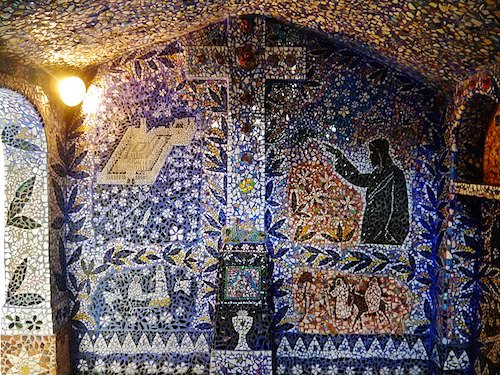
But, like Ferdinand Cheval, he was often the target of ridicule and mockery, as many considered him eccentric, even simple-minded.
The hardships of the Second World War only exacerbated the rejection he faced. Assigned to a coal depot and subjected to the contempt and criticism of his co-workers, he fell into a nervous breakdown that led to his confinement in a psychiatric hospital.
Upon his release, he remained withdrawn, resuming the creation of his mosaics without fully realising the growing attention he was attracting, and completed the decoration of his Maison Picassiette in 1952.
At that time, people’s attitudes began to change. Many curious onlookers, as well as lovers of naive art, come to admire the decoration of his Maison Picassiette, which quickly becomes a major local attraction.
He soon realised that the public’s interest was genuine and began to offer tours of his remarkable work.
Maison Picassiette’s success and notoriety
And so, this self-taught artistic genius achieved recognition during his lifetime!
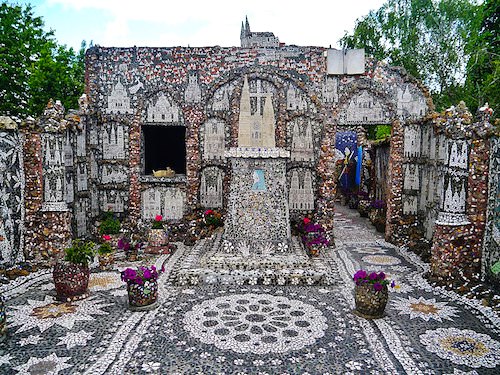
As early as 1954, his fame extended beyond the borders of Chartres. Picasso indeed paid him a visit, and in 1956, Robert Doisneau immortalised him in a photograph.
That same year, Raymond undertook the construction and decoration of a chapel and a summer house behind his Maison Picassiette. He also acquired an adjacent plot of land to create a garden, which he embellished with new mosaics and frescoes.
However, in 1958, suffering from illness, he abandoned his other activities and devoted himself entirely to his art. But as his physical health gradually declined in the following years, he abandoned mosaics for frescoes, perhaps sensing the need for a less physically demanding artistic medium.
Unfortunately, his inspiration also began to wane as his health deteriorated.
In 1960, he suffered a major setback when the city expropriated part of his property to build social housing. He indeed lost his kitchen garden but managed to keep his house and orchard, narrowly escaping eviction.

Unfortunately, the stress and upheaval likely contributed to the resurgence and worsening of his psychiatric problems in 1962. The lack of new projects after 24 years of intense creative activity may have aggravated his condition. He relapsed in 1964 and was once again hospitalised in a psychiatric ward.
Tragically, he ran away on September 5, 1965, during a violent storm, in the throes of madness; he was found dead in a ditch early the next morning. He was 64 years old. His wife outlived him, but she eventually moved into a retirement home in 1979, where she died in 1986.
The Maison Picassiette, also known as the Maison aux Millions de Pièces (House of a Million Rooms), became the property of the City of Chartres in 1981.
I’m sure Raymond Isidore would have been amazed to know that his Maison Picassiette was listed as a historical monument in 1983 and registered as a 20th-century heritage site in 2016.
Department of Eure-et-Loir – Address Maison Picassiette – 22 rue du Repos
Photos via Wikimedia Commons: House-Header and Living room and courtyard and Chapel and bedroom and garden by Zairon CC BY-SA 4.0