
Château de Chambord, the dream chateau of François I
Chambord Castle… imposing, magnificent, grandiose, exceptional… Words fail to describe this gigantic castle!

With its 440 rooms, 335 fireplaces, 12 staircases, and 70 main staircases, spread over an area of 18,580 square meters, Chambord indeed defies description.
This magnificent castle, renowned for its splendid northwest facade, resembles a fortress, with a central keep and four towers. Its construction began in 1518 under the patronage of Francis I, on the site of a former hunting lodge belonging to the Counts of Anjou.
Many claim that Leonardo da Vinci was behind the architectural plans.
The construction, which spanned several years, swallowed up a colossal fortune, as Francis I spared no expense to create his “dream castle.”

He even considered diverting the Loire River at the foot of the château! However, this ambitious project proved too costly and complex, leading to its abandonment. Francis, I then settled for the smaller Cosson River to supply water for the château.
Construction of the château was interrupted in 1524-1525 when Francis I was captured after his defeat at the Battle of Pavia in Italy. Despite these setbacks, the exterior of the Château de Chambord was completed in 1537.
Emperor Charles V, one the first guests to stay at Chambord in 1539, was deeply impressed by its luxury and splendour. Throughout his reign, Francis I continually refined the plans for his “dream château,” a passion that sustained him until he died in 1547.
A journey in the French Renaissance
Entering the royal apartments of the Château de Chambord is like stepping into the world of Francis I, at the height of the French Renaissance.

Every corner is adorned with the king’s emblem, the salamander, and his initials, meticulously integrated into the sumptuous decorations that adorn the ceilings and walls. These symbols appear more than 700 times within the château!
His dressing room, with its magnificent barrel vault, was transformed into a chapel in the 18th century.
However, Francis I was known not only as a visionary architect, but also as a great romantic, as evidenced by the melancholic inscription he had engraved on a windowpane in his bedroom following a romantic disappointment:
“Souvent femme varie, bien fol est qui s’y fie” – “woman often changes, he who trusts her is a fool”.
Leonardo da Vinci’s double helix staircase
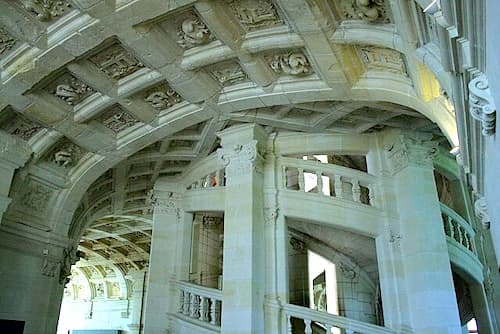
The double helix staircase, designed by Leonardo da Vinci, is a marvel of architecture and aesthetics that ranks among the Château de Chambord’s most iconic marvels. Its ingenious design indeed allows those ascending to remain invisible to those descending.
It staircase leads to the vast rooftop terrace, which boasts an exceptional view of the surrounding area.
This terrace is a veritable labyrinth of chimneys, spires, staircases, lanterns, dormer windows, sculpted gables, and hidden alcoves, all dominated by a soaring 32-metre-high lantern.
In the past, the royal court gathered there to celebrate festivities or lavishly welcome ambassadors and distinguished guests.
Château de Chambord after Francois I
The Château de Chambord changed hands several times over the centuries, each owner leaving their mark.

Henry II, son of Francis I, commissioned the west wing, the chapel and the completion of the curtain wall. However, the château remained unfinished at his death in 1559.
Seventy years later, Louis XIII bequeathed Chambord to his brother, Gaston d’Orléans.
Louis XIV undertook significant restoration and expansion work, which he then interrupted to focus on the construction of Versailles.
Louis XV temporarily entrusted the use of the château to his father-in-law, Stanislas Leszczynski, the former King of Poland. After Stanislas’s deposition, the king transferred ownership of Chambord to the son of Augustus of Poland, who installed two cavalry regiments in the stables and the park. Unfortunately, Chambord fell into ruin after Auguste died in 1733. Its furnishings were then looted during the French Revolution!
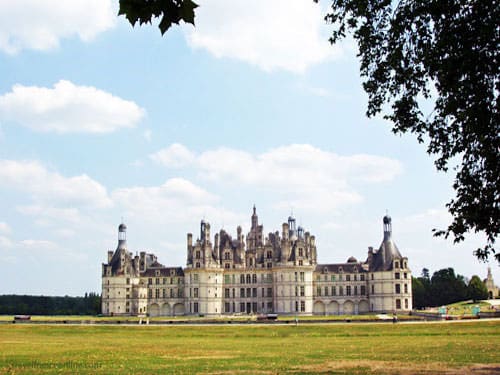
In 1809, Emperor Napoleon bequeathed the château to Marshal Berthier, who sadly sold the estate’s woodwork before ceding ownership to the Duke of Bordeaux in 1821. Finally, the Duke of Parma inherited it at the end of the 19th century.
In 1932, the French state acquired and restored it, also acquiring an exceptional collection of furniture, tapestries, and paintings to recreate the opulence of court life.
The vast 5,500-hectare estate was transformed into a private hunting reserve in 1948, where deer hunts were occasionally organised for official guests. As for the stables, they have been transformed into a venue for equestrian shows and exhibitions.
Surprisingly, the Château de Chambord was only inhabited for twenty years!
Department of Loir-et-Cher
Coordinates: Lat 47.616055 – Long 1.517222
Photos via Wikimedia Commons: Double helix staircase ceiling CC BY-SA 3.0 and Coupole grand staircase by Hélène Rival Public domain


