The Brie family, first owners of the Château de Serrant
The Château de Serrant is one of the finest French Renaissance châteaux in the Loire Valley.

Built in the 13th century, it was significantly embellished by the de Brie family, who acquired it in the 14th century. In 1539, Pean de Brie returned from the military campaigns in Italy, where he discovered and fell for the sophistication of the Italian Renaissance, a style favoured by the kings of France.
Pean embarked on the ambitious project of transforming his ancestral medieval fortress into an elegant Renaissance château. His vision likely included grand features such as richly decorated facades, spacious and refined interiors, and landscaped gardens reflecting the principles of Renaissance aesthetics.
However, the high cost of such renovations meant that he never manage to transform the Château de Serrant into a true Renaissance residence. Only certain parts of the building were completed (the staircase, the north tower, and part of the main building) before work was halted for financial reasons.
Guillaume de Bautru transformed the Château de Serrant
Guillaume de Bautru acquired the estate in the 17th century. The building had remained unfinished for over a century!

He resumed reconstruction work, respecting Pean de Brie’s original plans and layout. He also used the same materials, notably red schist and white tufa (tuffeau), the latter a local stone quarried in the Loire Valley.
Under his direction, the main building was completed, and the south tower was added, thus giving the château a certain architectural coherence. His son took over the transformations, adding two perpendicular wings, two corner pavilions, and the monumental gateway.
At the end of the 17th century, architect Jules Hardouin-Mansart built the chapel by extending the south wing of the château to house the mausoleum of the Marquis de Vaubrun, sculpted by Coysevox and commissioned by the Marquise, née Madeleine de Bautru.
The Bautru family also expanded the château by adding stables, a dovecote, and a magnificent orangery.
The Walsh family acquired Serrant
The Bautru family sold the Château de Serrant to the Irishman Francis Walsh, whose family had been exiled to France following the 1715 Jacobite Rebellion of Bonnie Prince Charlie’s grandfather, King James II. A crucial financial backer of the prince, the Walsh provided him with two ships in June 1745 to sail to Scotland. In 1754, in recognition of his family’s support for the Stuarts, Francis Walsh became Earl of Serrant.

He and his descendants spared no expense in renovating and embellishing Serrant. They furnished and decorated it with exceptional furniture and woodwork that can still be admired today, and they also created an English-style park.
The Walsh family managed to preserve the castle from destruction during the tumultuous years of the French Revolution! From the restoration of the monarchy in 1815, they organised sumptuous receptions for leading personalities, including Marie-Christine of Austria, sister of Queen Marie Antoinette, as well as Napoleon Bonaparte and Josephine, and later Louis-Napoleon Bonaparte, the future Napoleon III.
The Duc de la Trémoïlle restored the Château de Serrant
In 1830, Eugénie Joséphine Walsh de Serrant married a member of the Duke of La Trémoïlle’s family, marking a turning point in the history of the Château de Serrant.
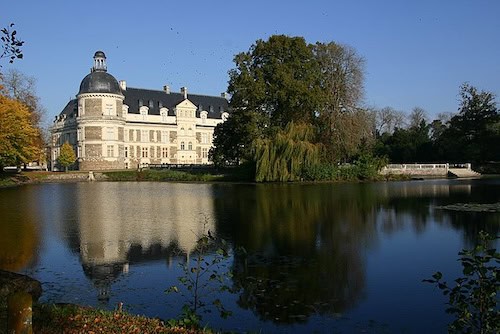
Their son, Louis-Charles, and his wife undertook a complete restoration and interior decoration of the château, preserving the original furnishings and mementoes accumulated over the years by previous owners.
This restoration also provided an opportunity to adapt the château to contemporary standards, making it more comfortable and pleasant to live in. They indeed installed elevators, central heating, electricity, running water, bathrooms, and toilets.
They also enriched the collections of tapestries, paintings, and furniture. However, the Duke of La Trémoïlle’s most remarkable addition was undoubtedly the creation of an exceptional library, housing an impressive collection of some 12,000 volumes, which is now a listed historical monument. Among the other exceptional collections at the Château de Serrant are the 300-year-old Ebony Cabinet, considered a masterpiece of cabinetmaking, and the Empire Room, where Napoleon and Josephine stayed during their visit.
The Château de Serrant is now open to the public.
Maine-et-Loire – Saint-Georges-sur-Loire
Photos via Wikimedia Commons: Photo1 and Header and Chapel by Manfred Heyde CC BY-SA 3.0 – Photo2 by Calips CC BY-SA 3.0 – Photo4 by Gerd Eichmann CC BY-SA 4.0