Pont Notre-Dame – Historical facts
The Pont Notre-Dame connects the Ile de la Cité to the Rue Saint-Martin on the Rive Droite – Right Bank.
Along with the Petit Pont, on the south of the island, it is one of the oldest bridges in Paris. The Celtic tribe of the Parisii indeed built two wooden bridges in the 3rd century BC to connect their fortress of Lutetia (Ile de la Cité) to the two banks of the Seine. The Pont Notre-Dame was initially called the Grand Pont (Large Bridge) and spanned the wider branch of the river, while the Petit Pont crossed the narrower one.
When the Romans conquered northern Gaul in 52 BC, they established Lutetia as the administrative centre of the region. They improved the old fortifications and rebuilt the existing footbridges with more robust wooden structures. These two bridges opened onto their Cardo, the essential north-south axis, which today corresponds to the Rue Saint-Martin and Rue Saint-Jacques, and crossed the island via the current Rue de la Cité.
The Vikings burned these two wooden bridges when they besieged the city in 885.
Planches de Milbray
Once the Normans had left, the Parisians improvised a crossing over the wider, marshy branch of the Seine using a makeshift structure of wooden planks. This temporary bridge was christened “Planches de mi-bray,” derived from “emmi le brai,” meaning “in the middle of the marsh.” Over time, it became known as “Planches de Milbray.”
Tragically, the floods of 1406 swept away the Planches de Milbray, and the Pont Notre-Dame was built in 1419. However, this new wooden bridge collapsed on October 25, 1499, under the weight of its two rows of houses.

Thus, in 1507, a stone bridge was built in its place, with two rows of 30 stone houses, each with shops on the ground floor. Amazingly, these houses were the first in Paris to have street numbers!
The bridge led directly onto Rue Saint-Martin, a major thoroughfare connecting Paris to northern France via the prestigious abbeys of St-Martin-des-Champs and Saint-Denis.
The Pont Notre-Dame became one of the most fashionable spots in Paris in 1660 when Rue Saint-Martin was embellished to welcome Marie-Thérèse of Spain, the future wife of Louis XIV.
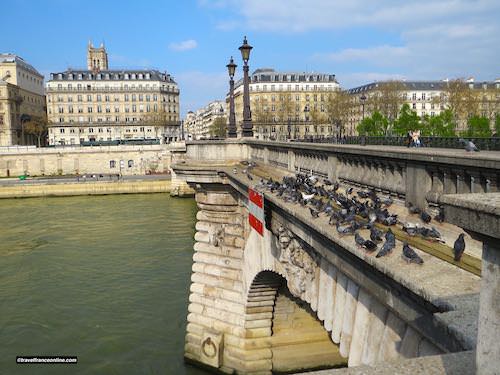
The bridge was rebuilt on the same foundations in the 18th century, but this time without houses so as not to compromise the structure’s integrity. However, this five-arched bridge was eventually demolished due to numerous river accidents. Engineer Jean Résal oversaw the construction of the current 105-m-long and 20-m-wide bridge, which was inaugurated by President Raymond Poincaré in 1919. This bridge has a central metal arch flanked by two smaller stone arches. Each stone arch is decorated with a sculpted head of Dionysus, and each of its pillars with a ram’s head.
Metro: Cité on Line 4
Coordinates: Lat 48.855876 – Long 2.348553