Aveyron, historic Rouergue
The Aveyron département has encompassed the former province of Rouergue since the French Revolution (at the end of the 18th century).
It is now part of Occitanie, one of the 13 regions created by the territorial reform of January 1, 2016.
Aveyron is a region renowned for its diverse and untamed landscapes, characterized by striking contrasts that never cease to amaze.
From rugged mountains to rolling hills, from verdant valleys to picturesque villages, the region indeed boasts exceptionally rich natural beauty just waiting to be explored.
Aveyron, a land of rock
This unique landscape was shaped by millennia of geological activity.
The Grands Causses, located east of Millau within the Grands Causses Regional Natural Park, are a region of arid and semi-desert plateaus. These vast limestone plateaus absorb rainwater like a sponge, which explains the scarcity of surface water. In this harsh environment, the vegetation has adapted to withstand dry summers and winter frosts. Despite these difficult conditions, the region is renowned for its Lacaune ewes, whose milk is used to produce the famous AOC Roquefort cheese.

The rugged terrain of the Grands Causses is punctuated by the Tarn Gorges, a spectacular canyon carved by the raging river. Along its course, in the heart of the impressive Raspes du Tarn, west of Millau, the river creates verdant oases where castles and medieval villages nestle.
Millennia of erosion by water and rain have also sculpted the dolomitic rock formations into fantastical shapes, locally known as chaos. These surreal landscapes evoke fairy tales, with their pillars, arches, and formations resembling ancient ruins, human faces, and mythical creatures.
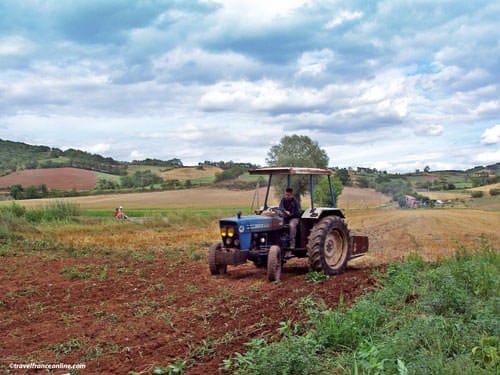
However, southern Aveyron is characterised by its distinctive red soil. The Rougiers plateaus in Camarès are indeed saturated with iron oxide, giving them a vibrant purple hue, similar to the colour of blood, the colour of life!
Green Aveyron
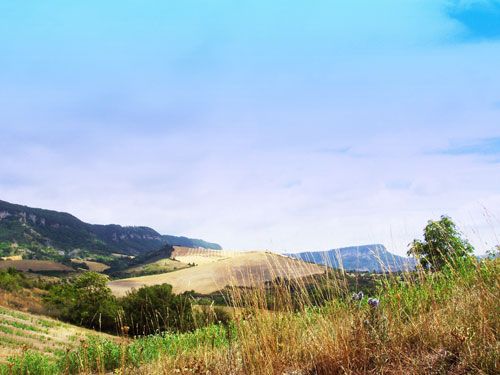
Northern Aveyron, on the other hand, is a verdant region with lush vegetation.
The crystalline rock formations of the Auvergne foothills have created a unique hydrological environment, giving rise to the picturesque Lévezou Lakes.
These vast bodies of water are true havens of peace, attracting visitors for their natural beauty and the leisure activities they offer.
Farther north, the vast plateaus of Aubrac stretch as far as the eye can see, offering a wild expanse. Located between 1,200 and 1,400 metres in altitude, their rolling hills and open meadows are primarily dedicated to cattle farming.
Bastides and towns

The rolling hills of the Ségala plateau, in northwestern Aveyron, are the land of bastides.
These fortified towns, built in the Middle Ages and carefully restored, are very popular tourist destinations, as are the dozen or so villages that were awarded the prestigious Most beautiful villages in France“label.
You will discover the picturesque bastide of Villefranche de Rouergue, Laguiole, famous for its cutlery, and the enigmatic Templar cities, and Rodez, the main city of Aveyron and former capital of the historic Rouergue, all testaments to Aveyron’s fascinating past.
And let’s not forget the magnificent viaduct of Millau, a true feast of engineering!
Area: 8,735 km2
Population: 277,048