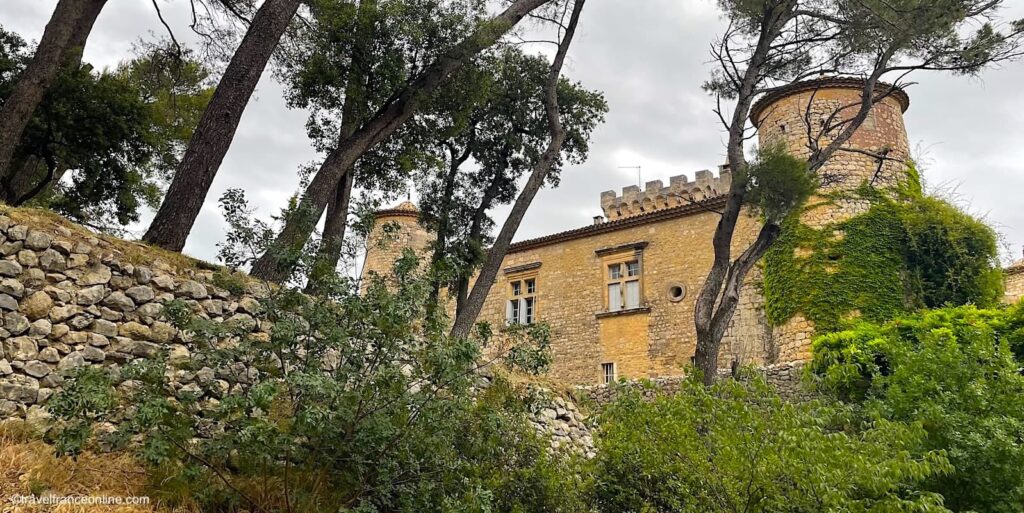
Villefranche de Rouergue, a listed bastide
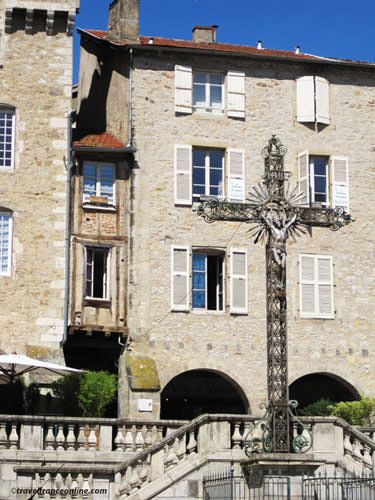
Villefranche de Rouergue is a former bastide town at the confluence of the Aveyron and Alzou rivers, in the heart of the plateaus and rugged valleys of western Aveyron.
Renowned for its cultural and historical heritage, Villefranche de Rouergue holds several prestigious designations, such as Grand Site of Midi-Pyrénées, City of Art and History, and Bastide du Rouergue.
This region is also known as the Land of Bastides.
It is indeed dotted with numerous picturesque fortified towns that sprang up along the pilgrimage road to Santiago de Compostela (Way of St. James – Camino de Santiago) to offer rest and shopping opportunities to weary travellers and pilgrims on the route.
The bastides indeed benefited from exemptions from customs duties and taxes, and were thriving centres of commerce and cultural exchange.
Villefranche de Rouergue – Birth of the bastide
Raymond IV of Saint-Gilles, Count of Toulouse, founded Villefranche de Rouergue in the 11th century on the left bank of the Aveyron River. However, this town had no church, and the inhabitants had to attend services at the church of Saint-Jean-d’Aigremont on the right bank.

In the 13th century, the town came under the authority of the French crown.
Under the impetus of Alphonse of Poitiers, brother of King Saint-Louis and heir to the County of Toulouse through his marriage to Jeanne of Toulouse, the town experienced significant demographic and economic growth.
Indeed, in the 1250s, Alphonse of Poitiers founded the new bastide of Villefranche de Rouergue on the right bank of the Aveyron, with the ambition of centralising the administration of the County of Rouergue and thus consolidating its authority.
The numerous privileges, charters, concessions, and exemptions from customs duties played a vital role in stimulating trade and the economic growth of Villefranche de Rouergue.
The bastide’s geographical location was also ideal! Situated at the crossroads of ancient routes and on the Way of St. James, and in the heart of fertile lands and near limestone plateaus suitable for mining, it indeed attracted many settlers and merchants.
Villefranche de Rouergue’s decline
Despite its commercial success in the 15th century, cemented by the right to mint coins granted by King Charles V, Villefranche de Rouergue experienced several setbacks that hampered its growth and prosperity in the following centuries.

The plague epidemic of 1628 was truly devastating, with a third of the population succumbing to the disease.
Then followed the peasant revolt known as the Jacquerie des Croquants (Croquant rebellions) which erupted fifteen years later, the Wars of Religion in the 16th century, and finally the earthquake of 1775, which destroyed a large part of the town!
Villefranche de Rouergue struggled to regain its former prosperity despite being designated the capital of the new province of Haute-Guyenne in 1779. The positive effects of this elevation in status were indeed short-lived, and the town continued to face economic difficulties in the years that followed.
The restructuring of territorial administration during the French Revolution had a profound impact on the city. Rodez was designated as the prefecture of the newly created department of Aveyron. Villefranche de Rouergue lost its status as a bastide town and became a sub-prefecture. Once a thriving commercial and economic center, it lost its regional influence and gradually faded into obscurity.
Champ des Martyrs Croates
The tragic events of September 17, 1943, during the German occupation, brought Villefranche-de-Rouergue back into the spotlight, but alas, for the wrong reason.

Indeed, Croatian soldiers, forcibly conscripted into a pioneer battalion of the 13th SS Division, rose. They seized control of the town by capturing and executing the German officers who commanded it.
However, despite their initial success, the rebellion was short-lived. In less than 24 hours, the Germans regained control of the town after fierce street fighting.
Many Croatian insurgents were captured and then executed, their bodies buried in a place now known as the Champ des Martyrs Croates – Field of Croatian Martyrs.
Only two alleged leaders, Eduard Matutinović and Božo Jelinek, managed to escape capture. Jelinek was promoted to officer and awarded the Legion of Honour for his acts of bravery.
Villefrance de Rouergue, a historic walled city
The ramparts and fortified gates that once protected Villefranche-de-Rouergue were gradually demolished during the 18th and 19th centuries. Today, Les Promenades, a network of shaded paths, stand in their place. Despite the disappearance of its defences, the old bastide town has managed to preserve much of its medieval architectural heritage.
Pont des Consuls and Fontaine du Griffoul
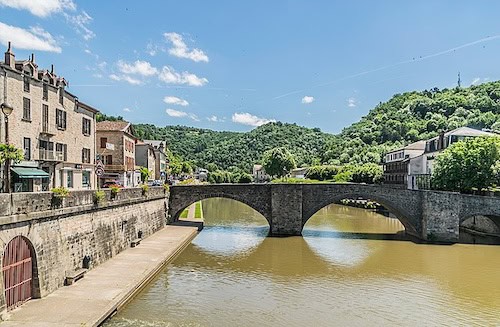
The Pont des Consuls (Consuls’ Bridge), also known as the Vieux Pont (Old Bridge), was built around 1331 to replace a ford that once crossed the river.
In 1336, the Consuls (mayors) of Villefranche de Rouergue commissioned the construction of the Fontaine du Griffoul, a magnificent fountain that has since been listed as a historical monument.
Place Notre-Dame
The houses surrounding Place Notre-Dame, the market square and heart of the town, were mostly rebuilt after a devastating fire in 1497.
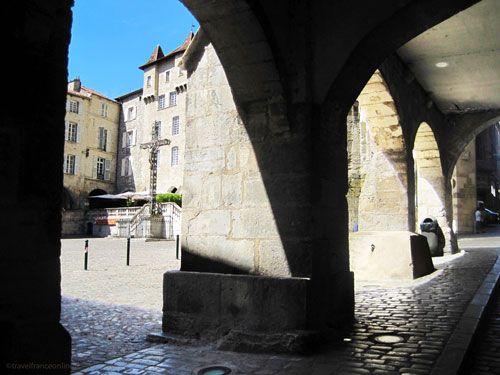
Their vaulted stone galleries have obviously withstood the flames and provide covered space on market days.
You will find several exceptional Flamboyant and Renaissance-style former mansions that boast adorned facades, mullioned windows and finely sculpted doorways.
They are all listed as historical monuments.
You will recognise the Maison du Président Raynal for its remarkable facade, as well as the courtyard of the Maison Dardennes, which houses a magnificent Renaissance stair tower adorned with sculpted figures.
Notre-Dame Collegiate church
Construction of the collegiate church began in 1252 and spanned three centuries.
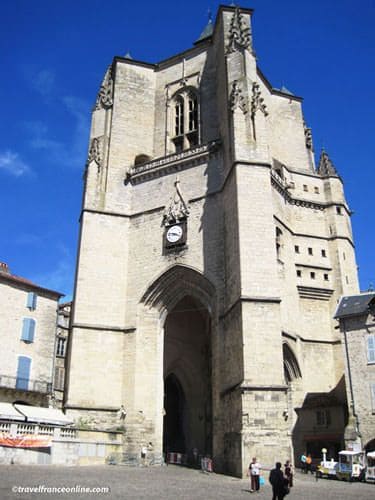
The 58-metre-high bell tower was completed in 1589. This tower has a unique design, as its vaulted porch is open on four sides, thus spanning the street.
The church’s history is closely linked to the rivalry between Rodez and Villefranche de Rouergue during the Middle Ages.
Each city aspired to build the most prestigious cathedral; however, conflicts such as the Hundred Years’ War and financial difficulties forced the town to settle for a more modest structure. The size of the church’s foundations indeed suggests that the initial plans were far more ambitious!
While the Church of Notre-Dame’s proportions are modest compared to its original plans, its architectural beauty remains undeniable. The spectacular portal with its openwork gable, as well as the dimensions and architectural details of its interior, make it a remarkable monument, rightly classified as a historical monument.
Chapelle des Pénitents Noirs
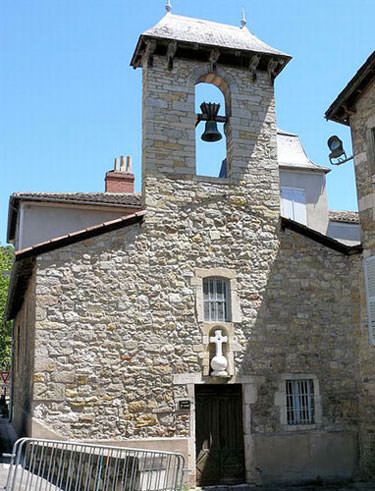
The Chapelle des Pénitents Noirs (Black Penitents) was built in the early 17th century.
It stands along the Promenade du Languedoc, a walkway built on the old city walls.
Halle au Gras and Chapelle Sainte-Barbe
The Halle au Gras was built in 1888 at the rear of the church, on the site of the old cemetery.
The cemetery was indeed decommissioned, and a new one was created outside the town limits in the mid-19th century. The building now serves as a covered market and also hosts fairs and local events.
Chapelle Sainte Emilie de Rodat
The neo-Gothic Chapelle Sainte-Émilie-de-Rodat was built in the 1950s on the site of a former Franciscan convent.
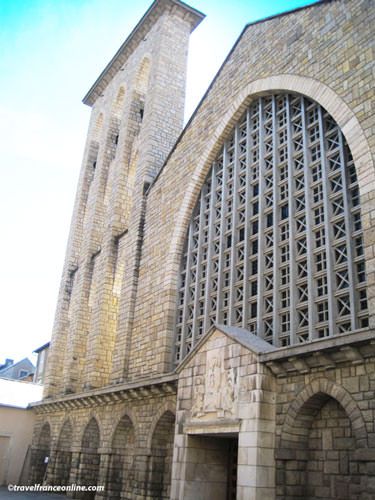
This convent, built in the 13th century, was unfortunately destroyed during the French Revolution.
Only the chapter house was spared and was converted into a crypt for the chapel of the new church.
Dom Odilo Hitier commissioned the chapel to the architect Bosser and dedicated it to the work of Emilie de Rodat.
In 1816, Émilie de Rodat indeed founded the Institut de la Sainte Famille (Institute of the Holy Family), a charitable organisation primarily dedicated to the education of young orphans.
Department of Aveyron
Coordinates: Lat 44.349746 – Long 2.035381
Photos via Wikimedia Commons: Pont des Consuls by Krzysztof Golik CC BY-SA 4.0 – Chapelle des Penitents Noirs and Chapelle Sainte-Barbe by MOSSOT CC BY-SA 3.0