Roquefort-sur-Soulzon
Roquefort-sur-Soulzon is nestled in the heart of the Grands Causses Regional Natural Park in Aveyron.
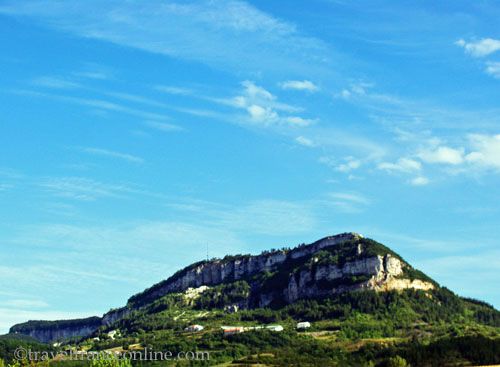
This small village, perched on the slopes of the imposing Combalou Rock, is renowned not only for the exceptional beauty of its landscapes but also for being the birthplace of one of the world’s most prestigious cheeses.
It is indeed the production site of Roquefort, an iconic cheese made primarily with the milk of Lacaune yews, which has earned it the “Remarkable Site of Taste” label.
Roquefort-sur-Soulzon invites you to explore its underground cellars where the cheese matures. Guided tours take you into these underground cellars where the complex Roquefort cheese-making process takes place. You witness each stage, from the initial fermentation to the meticulous ageing process. And of course, no visit is complete without a tasting, allowing you to savour this renowned cheese in its place of origin.
Legend of Roquefort
The creation of such a remarkable cheese certainly deserves a legend!
Long ago, a young shepherd tended his flock near the majestic Combalou cliff. One day, while seeking refuge in a nearby cave to enjoy his humble meal of rye bread and sheep’s milk curd, he saw a young girl gliding through the morning mist. Captivated by her presence, he decided to follow her, abandoning his lunch in his haste. For days, he roamed the rugged terrain in search of the mysterious apparition, but alas, she remained elusive.

Discouraged and exhausted, he finally returned to the cave, hoping to find his forgotten meal. To his great surprise, upon his return, he found his bread and cheese covered in a delicate blue-green mould. Despite the strange appearance and strong aroma, the shepherd, driven by curiosity, dared to taste this transformed food.
At that precise moment, a revelation occurred: the blending of flavours, the harmony of textures, a unique sensation that exploded in the mouth.
For hidden within this seemingly spoiled meal lay an unsuspected treasure: a cheese unlike any other, possessing a singular and irresistible flavour.
Thus, from the chance encounter between a shepherd and his forgotten meal, the legendary Roquefort was born.
Roquefort and the Rocher du Combalou
Roquefort is a name that evokes one of the world’s most renowned and luxurious cheeses. Yet, beyond its reputation for excellence lies a rich tradition, deeply rooted in a history spanning millennia.

The story begins approximately two million years ago, at the dawn of the Quaternary period, when the imposing Combalou mountain suffered a cataclysmic collapse, leaving behind a sheer cliff now known as the Rocher du Combalou.
Over millennia, erosion and underground rivers have sculpted a labyrinth of fissures in the limestone. These natural conduits, called fleurines or blowholes, serve as vital passages connecting the depths of the mountain to the outside world. This is the secret to Roquefort’s unique environment: perfect natural ventilation.
Throughout the day, the temperature variations between the outside and inside of the mountain create a constant air flow within the caves. This sophisticated ventilation system, optimised by the Combalou’s northern exposure, maintains a constant humidity of 95% and an average temperature fluctuating between 8 and 10°C year-round. These natural conditions thus provide an ideal environment for producing Roquefort cheese!
The origins of the Roquefort cheese
Two thousand years ago, Pliny the Elder was already praising the incomparable flavour of this cheese!
However, long before the arrival of the Romans in the region, the shepherds of Aveyron were already making cheese from sheep’s milk. Unfortunately, we don’t know which name they gave to their cheese.
The name Roquefort appeared only during the barbarian invasions of the 4th century, when the shepherds fortified their village at the foot of the Combalou mountain. This “strong fortress“, or “Roca Forta” in Occitan, evolved into “Roque Fort” in French.
Over the centuries, Roquefort attracted the favour of a prestigious clientele. Indeed, legend has it that in the 9th century, Emperor Charlemagne ordered Roquefort to be delivered to his residence in Aachen twice a year. In 1411, Roquefort’s reputation was such that King Charles VI issued a decree granting it a protected designation of origin (AOC). This decree was subsequently approved by the Parliament of Toulouse in 1666.
AOC Roquefort
Roquefort’s AOC (Appellation d’Origine Contrôlée) was confirmed in 1925, and in 1996 it obtained the prestigious AOP (Appellation d’Origine Protégée) designation from the European Economic Community (EEC), thus placing it among exceptional cheeses.

The specifications for the Roquefort AOC are rigorous and precise.
Firstly, it must be made exclusively from the milk of Lacaune ewes, renowned for their abundant milk production and their adaptation to the grass of the rugged Causses region. During the lactation period, from December to July, each Lacaune ewe indeed produces between 2 and 3 litres of milk per day.
Secondly, the milk must come from approved farms located within the Roquefort appellation area, which covers the departments of Aveyron, Aude, Gard, Hérault, Lozère, and Tarn.
Manufacturing stages
After collection, the milk undergoes a meticulous transformation.
It is first poured into large vats and heated precisely to 32°C. Next, it is inoculated with spores of Penicillium Roqueforti, the blue-green mould responsible for the cheese’s distinctive flavour and appearance, as well as with rennet, an enzyme of animal origin.

The curd is then cut into portions and placed in draining moulds, where it begins to take on its characteristic shape. Once drained, the cheeses are carefully transferred to the Combalou caves, where the slow and precise ripening process takes place under the supervision of a master cheese-maker. These natural caves were expanded and renovated in the 17th century to create ideal ripening.
Each cave has its own micro-climate, guaranteeing optimal conditions at every stage of the ripening process. Penicillium Roqueforti develops gradually from the inside out of the cheese, necessitating piercing the wheels to facilitate aeration.
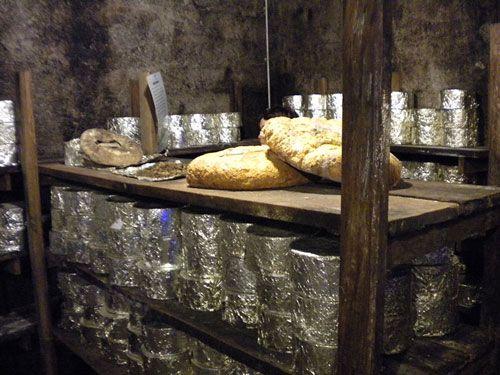
Cheeses are then placed on wooden shelves, sprinkled with coarse salt to protect them from external bacterial contamination. The spacing and arrangement of the wheels are carefully considered to optimise ventilation through the “fleurines,” the natural openings in the caves. The master cheese-makers constantly monitor and adjust the opening of the fleurines according to the outside temperature, thus maintaining an ideal balance of humidity and temperature inside the cellars.
This meticulous attention to detail guarantees optimal conditions for the cheese’s maturation and the development of its characteristic flavour and texture.
The Cabanières
When the cheese wheels reach the desired level of maturity, they are carefully wrapped in special aluminium foil, a task performed exclusively by women known as Cabanières. These skilled artisans wrap an average of 100 cheeses per hour by hand. The name “Cabanières” refers to their historical role in the small huts (cabanes) located at the entrance to the cellars. This wrapping process slows down and controls the development of Penicillium roqueforti, thus guaranteeing the cheese its desired flavour and texture.
After maturing for at least three months in the cellars, the Roquefort cheeses are finally ready for packaging and for you!
Aveyron department
Coordinates:Lat 43.974566 – Long 2.992022
Photos via Wikimedia Commons: Cave 1 – Cheeses in tin foil and Cave 2 all images by Fantafluflu CC BY-SA 3.0