Brousse le Château along the Raspes du Tarn
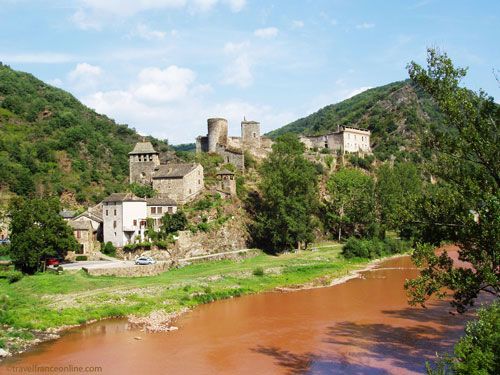
Brousse le Château overlooks a stretch of the Tarn known as the Raspes du Tarn.
Over millennia, the river’s tumultuous waters have carved deep canyons in the black shale typical of the region.
Extending for about forty kilometres downstream from Millau, the Raspes du Tarn offer dramatic landscapes.
Cliffs overlook the gorges where the tumultuous Tarn sometimes cascades onto peaceful pebble beaches below ancient perched villages and castles built from the region’s ochre stone.
Brousse le Château, ranked among the Plus beaux villages de France
Brousse-le-Château is truly enchanting!
The picturesque D902 road winds its way to the village, following the banks of the Alrance through verdant groves.The mill and the dam are nestled amidst this lush vegetation, at the foot of the imposing castle.
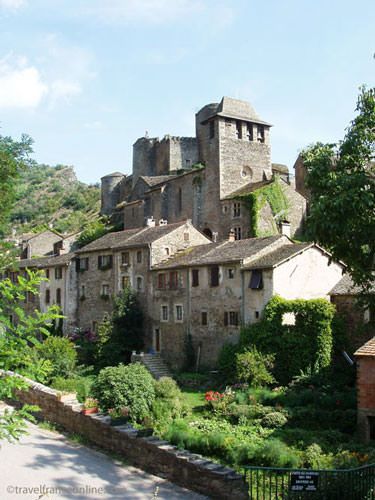
Farther on, the bridge spanning the Tarn offers an unobstructed view of Brousse le Château. Majestically perched on the steep slopes below the castle, the medieval village lies at the confluence of the Tarn and the peaceful Alrance rivers.
With its authentic charm and unique character, Brousse le Château is ranked among the most beautiful villages in France.
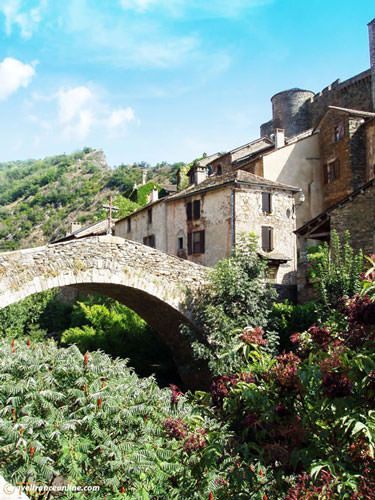
You will need to park your vehicle in the designated parking areas along the riverbanks, as the village is only accessible on foot. The picturesque Gothic stone bridge, the Vieux Pont, spanning the Alrance is the only access to this enchanting hilltop village.
Brousse le Château, a medieval village
Locals affectionately nicknamed the bridge, Pont Crouput, as it resembles a circumflex accent.
It offers an exceptional viewpoint over the lush vegetation of the gardens below, where willows, hydrangeas and aquatic plants flourish along the banks of the Alrance.
While strolling through the village, the lush green vegetation gradually gives way to terraced gardens.
Closer to the castle, these gardens give way to charming inner courtyards.
Each courtyard, section of wall, staircase, porch, balustrade and window frame is adorned with a profusion of flowers, which showcase the warm colour of the ancient stones.
Medieval stone houses with roofed with lauze (limestone slabs) lined the picturesque cobbled alleyways that wind their way up to the church and the castle.
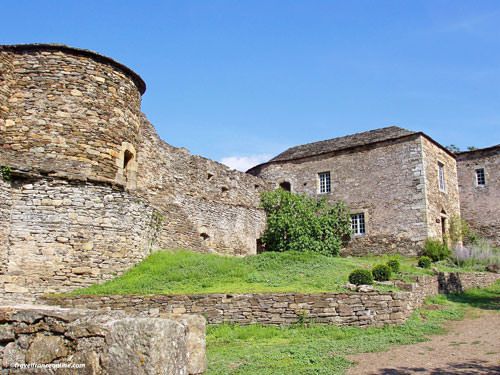
Jean II d’Arpajon, lord of Brousse-le-Château, had the church and its bell tower fortified n the 15th century (Hundred Year’s War).
Located on the Santiago de Compostela, the village once served as a stopover for pilgrims.
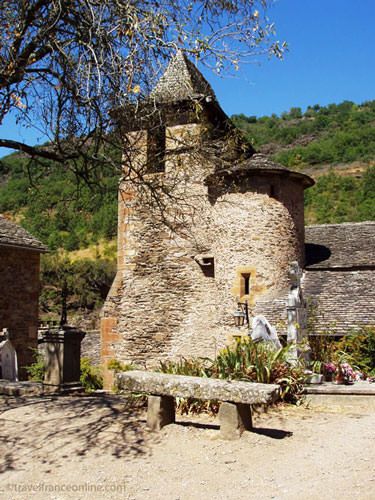
The small cemetery, overlooking the river, offers a haven of peace conducive to contemplation.
Here, a stone bench invites you to pause, offering a moment of respite to soak in the wild beauty of the village.
Brousse le Château – The castle
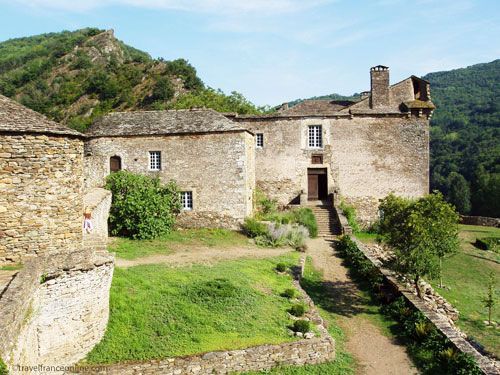
Perched on its oval promontory, the Château de Brousse le Château offers an unobstructed view of the tumultuous Tarn below.
It was built in the 9th century, and was expanded and modified throughout the centuries until the 17th century. Initially, the residence of the Counts of Rouergue, it was later associated with the Arpajon family.
Behind its sturdy ramparts, the castle appears as a vestige of the Middle Ages. The formidable fortifications, remarkably well preserved, allows you to walk along its walkway, offering glimpses of the surrounding landscape. Five of the six original imposing defensive towers still stand, reinforcing the fortress’s commanding presence.
Although the inner courtyard has transformed over time, one can easily imagine it bustling with the comings and goings of servants, knights and ladies of the nobility on their daily routine. Entering the castle is indeed like stepping back in time, where echoes of bygone eras still resonate.
The main platform and the old courtyard have been transformed into a peaceful garden. Dominating the highest point of the enclosure, t
The castle stand son the highest point of the enclosure. Its French Renaissance architecture exudes an elegant simplicity, in contrast to the opulent Loire Valley Châteaux.
The rooms are spacious and bathed in natural light, and are also devoid of the opulent ornamentation characteristic of Renaissance architecture.
The castlenow houses a museum offering permanent and temporary exhibitions on the village’s history.
Brousse le Château is a listed historical monument, and is managed by the Foyer Rural de Brousse le Château.