Rougier de Camarès, a region of red soil

The Rougier de Camarès stretches across an impressive 170,000 hectares, making it one of the largest red clay plains in France.
This vast expanse of red earth nestled in southern Aveyron owes its name to the distinctive hue of its soil: a rich mixture of red clay saturated with iron oxide. This remarkable landscape indeed boasts a breathtaking palette of colours, ranging from royal purples to vibrant crimson, evoking a natural mosaic spread across the land.
The origins of this red landscape date back approximately around 250 million years ago,when the region enjoyed a tropical climate and was submerged by a shallow sea, where the skeletons of ancient corals and marine creatures were deposited and solidified over time, forming a sedimentary layer.

With the retreat of the sea, the land underwent cycles of drought and flooding, catalysing the oxidation of iron-rich clay sediments that gave the soil its distinctive colour and its name, Le Rougier (Red).
Water erosion then sculpted the terrain, shaping the landscape into a multitude of small canyons, valleys, hills, and small mountains that rise between 300 and 600 metres in altitude.
At the heart of this rugged terrain, the Dourdou River carved its course, creating a vast, fertile alluvial plain that still sustains life today.
Yet, amidst the gentler curves of the landscape, rise imposing promontories of red sandstone, localle called puechs, where fortresses and fortified towns were built during the Middle Ages.

While we are drawn today to the enchanting landscapes of the Rougier region, the fertility of its land did not escape the notice of the ancient civilisations that settled there as early as the Neolithic period.
They erected the enigmatic statues-menhirs near Camarès, some of which are preserved at theFenaille Museum in Rodez.
Over the centuries, the Rougier region has yielded valuable copper and lead mines, which sustained communities until the end of the Middle Ages.
Today, parts of this diverse region are dedicated to sheep farming, particularly the breeding of Lacaune ewes, whose milk is essential to the production of AOC Roquefort cheese, while the arable land produces abundant harvests of cereals.
Camarès
Camarès, capital of the Rougier region, formerly known as Camberès, is a fortified town dating from the 11th century.
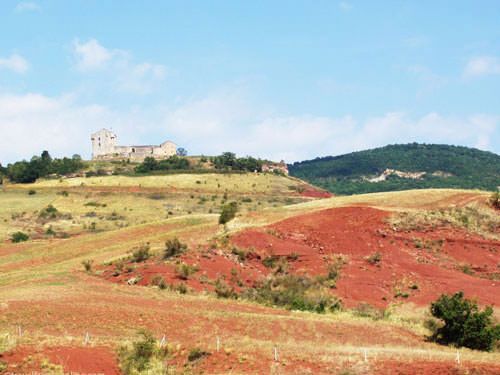
Strategically built on one of the region’s most important puechs or hills, it stands a stone’s throw from the prestigious Château de Montaigut. From its medieval past, the town has preserved numerous vestiges, such as the emblematic Pont Vieux (Old Bridge), a 11th-century Romanesque bridge that spans the Dourdou River and still in use today.
Camarès played a major role during the Wars of Religion in the 16th century, establishing itself as a bastion of Protestant resistance in Aveyron, although its ramparts have long since disappeared. Textile spinning was the town’s main economic activity until the end of the 19th century, but the town has since adapted to modern needs and is now a centre for leather garment production.
Department of Aveyron
Coordinates: Lat 43.885998 – Long 2.880135