
Bastides in France

Franco-English rivalry
Bastides served not only as economic and defensive centres, but also played a crucial role in defining and defending the border between the County of Toulouse to the east and the Duchy of Aquitaine to the west.

This region of southwestern France found itself at the heart of the Franco-English conflict that erupted after Eleanor of Aquitaine married Henry II of England. Eleanor’s dowry, which included the entirety of the Duchy of Aquitaine, considerably strengthened the English crown, effectively granting it control over a significant portion of the Kingdom of France.
This geopolitical upheaval exacerbated the rivalry between the two powers. In 1259, Louis IX, known as Saint-Louis, negotiated the Treaty of Paris, which aimed to resolve these territorial disputes. Under the terms of this treaty, Henry III of England received territories such as Perigord, Quercy, Limousin, , and Agen, on the condition that he become a vassal of the King of France.
Following this agreement, the English embarked on a building frenzy, erecting bastides such as Lalinde, Beaumont, Molières, Roquepine, and Monpazier within their newly acquired territories in Périgord. These bastides, of course, strengthened their control over the region.
Bastides – Ville Nouvelles and Villes Franches
The inhabitants of the bastides enjoyed numerous privileges and liberties, meticulously defined in charters that legally guaranteed their rights. These privileges included exemption from forced labour and military service, the right to inherit, and freedom from feudal obligations.

Some bastides even retained the title of their privileges in their names, such as Ville Neuve (New Town) or Ville Franche (Free Town) such as Villefranche-du-Périgord, symbolising the freedoms granted to their inhabitants. These fortified towns also enjoyed significant local economic and political autonomy, along with the right to self-government.
This autonomy facilitated the establishment of militias for defence, consulates for administration, standardised weights and measures for trade, and regular markets and fairs to stimulate economic activity.
Remarkably, these privileges persisted throughout the Middle Ages.
Bastides’ grid plan
The planning of bastides followed precise and uniform rules, resulting in towns organised according to a grid plan.
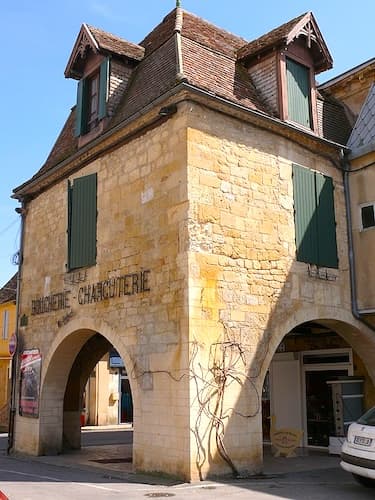
The land was divided into equal-sized plots, allocated free of charge to the new inhabitants. Straight streets intersected at right angles, radiating from a central square that served as a focal point for markets and fairs held under the covered market hall.
Houses with vaulted galleries or arcades, known as cornières, framed this central market square. The church and cemetery were set back, while narrow passageways running between the houses helped to limit the risk of fire, a common scourge in the Middle Ages.
A heavily fortified rampart, punctuated by gates and watchtowers, surrounded the town, protecting it from external threats.
While many bastides have withstood the test of time and undergone meticulous restoration, such as Domme, Eymet, and Monpazier, they have long since lost their defensive function. Today, these bastides have become picturesque and lively market towns, attracting crowds of tourists during the tourist season.
Photos via Wikimedia Commons: House with arcades and Maison Laphiteby MOSSOT CC BY-SA 3.0 – Porte de Luzier by Michel Chanaud CC BY-SA 4.0


