
The Merderet crossing, a major strategic position
La Fière Memorial Park pays tribute to the American airborne divisions that bravely landed on D-Day.
Located 4 km west of Sainte-Mère l’Eglise, along the D15 road and near the La Fière bridge spanning the Merderet River, this site holds considerable strategic importance. The causeway, of vital historical importance, was the only passage across the river, marshes and plains of the Merderet.

In the early Middle Ages, a wooden defensive tower stood on top of the hill where the memorial park is located today, and commanded the causeway and the river crossing. Over time, the road, now known as D15, has undergone improvements, while remaining the main route through the marshes.
During World War II, La Fière and Chef-du-Pont became strategically crucial, as they were the only bridges that could support the armoured vehicles’ weight. The 500m long road connected to the village of Cauquigny.
The marshes and alluvial plains extended 3 km inland along the Merderet and Douve rivers and replicated the configuration of Utah Beach. The area was thus of strategic importance during the Normandy campaign.

Four secondary causeways crossed the marshes, linking the beaches to Carentan and Sainte-Mère-l’Église, the two main crossroads of the region.
The capture of Cauquigny, La Fière and the roads would block any potential German reinforcements coming from the south.
It would also secure the Utah Beach bridgehead and facilitate the advance of troops who landed through the marshes.
The bridges at La Fière and Chef-du-Pont were thus of vital strategic importance to both the Germans and the Allies. As a result, the Battle of La Fière was one of the most intense engagements of the Normandy campaign. Tragically, it took the Allies four days of fierce fighting to seize and secure the causeway, resulting in heavy losses on both sides.
Merderet marshes and lowlands

- Three of the four secondary causeways provided direct access to Tare Green and Uncle Red, forming a natural defensive line which the Germans exploited to their advantage. They fiercely defended these access routes using coastal batteries located at Saint-Marcouf and Azzeville.
- The US 4th Infantry Division was tasked with landing on Utah Beach, divided into three sectors: Tare Green, Uncle Red and Victor (from west to east). The main objective of the landing was Tare Green and Uncle Red, particularly the Vareville dunes area. However, these sectors encountered strong resistance from German forces stationed near the marshes and plains of Merderet, fortified by the coastal batteries of Saint-Marcouf and Azzeville.
- In addition, the Germans controlled La Barquette, located at the mouth of the Douve, which housed a lock controlling water level regulation in the marshes. Field General Erwin Rommel ordered the sluice gates to be manipulated, opened at high tide and closed at low tide to flood the entire area, thus creating new obstacles for the Allied forces.
Battle de La Fière – 82nd Airborne Division
The capture of the bridge spanning the Merderet at La Fière was a key objective of the Boston Mission, an airborne operation entrusted to the US 82nd Airborne Division.
The objectives
The 82nd Airborne Division was organised into three assault forces:

- The Parachute Infantry Regiments, commanded by General Gavin.
- The Glider Infantry Regiment, under the command of General Ridgway.
- Seaborne support troops and armoured regiments landing on Utah Beach.
The objectives were clear:
- The 505th Parachute Infantry Regiment’s mission was to capture Sainte-Mère-Église and secure the eastern ends of the Chef-du-Pont and La Fière bridges.
- The 507th Parachute Infantry Regiment’s mission was to capture the village of Cauquigny, connected to La Fière by a causeway across the flooded marshes.
- The mission of the 508th Parachute Infantry Regiment (PIR) was to destroy the bridges spanning the Douve River southwest of the landing zone, thus isolating the Cotentin Peninsula from any German counter-attack.
These objectives aimed to secure the landing zones, allowing troops to safely disembark on Utah Beach at 6:30 AM.
One hour before Operation Boston, Albany Operation involved dropping paratroopers from the U.S. 101st Airborne Division west of Saint-Martin-de-Varreville and southwest of Sainte-Marie-du-Mont to secure the causeways connecting Utah Beach to the inland transportation routes for troop transport.
The missed drops
The 82nd Division’s parachute drops were originally scheduled for five hours before landing, but adverse weather conditions, including low clouds and ground fog, reduced visibility over the drop zones.
To avoid heavy German anti-aircraft fire, the drops had to be spread over a much larger area than planned.
Of the regiments, only the 505th managed a relatively accurate airdrop northwest of Sainte-Mère-l’Église.
However, the paratroopers of the 507th and 508th were dispersed far from their intended landing zones, with many landing in the flooded marshes.
The 508th encountered particularly difficult conditions, with many men landing in the marshes on the river’s west bank. Their scouts faced difficulties: although they landed at mapped drop zones, they could not use light beacons because they were too close to the German positions.
This unfortunate series of events resulted in the loss of more than 150 paratroopers; some were shot before landing, other died from their injuries and some tragically drowned under the weight of their equipment.
Despite the chaos, many men from the 507th Parachute Regiment landed at the northern end of the Merderet marshes, near the Carentan-Cherbourg railway line.
This allowed them to regroup and follow the railway line to its intersection with the road to Sainte-Mère-l’Église, from where they could head west towards the La Fière bridge.
Although the airdrops were chaotic, they had the unintended advantage of sowing confusion among the Germans, who struggled to work out the attack’s origin.
Battle of La Fière
Throughout the night, paratroopers from different units managed to regroup in a disorganised manner and advance towards the west bank of the Merderet.

They converged near La Fière under the command of General Gavin, who established his headquarters along the D15, overlooking the road.
On June 5, a group of 28 German infantrymen took up positions at the Manoir de la Fière.
Colonel Lindquist, commander of the 508th Regiment, led an attack against the building with troops from his regiment and the 505th. At the end of the day, they seized the Manor and began to fortify their position.
Bazookas and anti-tank guns were strategically placed in a bend of the D15, facing the road, to defend the area.
Among the defenders were Marcus Heim and his comrades Peterson, Bolderson and Pryne, from the 505th Anti-Tank Unit. Their bravery, which enabled them to hold their position and repel the Germans on June 6, earned them all the Distinguished Service Cross.
June 6

- Heim and his comrades were ordered to position themselves on the front line with their bazookas to prevent any German tank from crossing the bridge and advancing towards Sainte-Mère-l’Église and the beaches. Despite incessant bombardment throughout the afternoon, they successfully repelled a German attack around 5:00 PM, destroying three tanks and forcing the enemy to retreat towards Cauquigny. The Germans launched two more unsuccessful counterattacks.
- The mission of the men of the 507th Regiment, under the command of Lieutenant-Colonel Charles Timmes, was to secure the western end of the La Fière causeway. They established defensive positions in an orchard in Motey, a hamlet northwest of Cauquigny. A patrol of ten men sent by Colonel Timmes around noon found that the Germans had abandoned Cauquigny.
- With La Fière, Cauquigny, and the causeway now secured, other troops of the 507th were able to cross the Merderet to join Colonel Timmes on its west bank.
- However, in the late afternoon, a German infantry company and a Panzer tank battalion, equipped with captured French tanks, launched a counter-attack. They quickly overwhelmed the paratroopers at Cauquigny, crossed the road and attacked those positioned at La Fière.
- The violent battle that ensued caused heavy losses among the German forces, who were exposed on the open road.
June 7

On the morning of June 7, the Germans launched a new counter-attack, supported by mortar and artillery fire, against the paratroopers entrenched at La Fière.
Despite their dangerous advance to the bridge, they were forced to retreat towards Cauquigny under heavy fire from the paratroopers.
On June 8, the Germans refrained from any counter-attack but continued to subject the paratroopers to a sustained bombardment of artillery and mortars.
The situation was at an impasse that needed to be resolved.
June 8
On June 8, it was decided to send troops across the flooded area north of La Fière to join the isolated paratroopers at Motey.
Their objective was to participate in the capture of Cauquigny and to attack the western end of the causeway.
This mission was entrusted to the men of the 325th Airborne Infantry Regiment, who arrived by glider on the morning of June 7th. Setting off at first light, they advanced through the marshes towards their target.

However, they suffered a violent German counter-attack late in the morning, forcing them to retreat to Le Motey alongside the isolated paratroopers to avoid heavy losses.
On that day, Private First Class Charles DeGlopper displayed remarkable heroism.
When his group came under fire near Cauquigny, they found themselves cut off from the rest of the platoon and in a perilous situation.
DeGlopper bravely volunteered to cover his comrades’ retreat, standing in the open on the causeway and engaging in combat.
Despite being heavily outnumbered, DeGlopper continued to fire on the Germans, diverting their attention and allowing his comrades to take cover, and fought valiantly until his last breath, sacrificing his life to protect them.

For his exceptional courage and selflessness, DeGlopper received the Medal of Honour posthumously, the highest military award in the United States.
Unfortunately, the attack failed in taking Cauquigny!
Colonel Gavin thus ordered a direct assault across the causeway, led by troops of the 325th Airborne Infantry Regiment, with the 507th in reserve.
The airborne soldiers had to run the 500 metres of road that separated the bridge from the chapel at the entrance to Cauquigny.
At 10:30 AM, the artillery of the 90th Infantry Division launched a smoke barrage to cover the troops’ advance. Despite the smokescreen, the assault was met with heavy fire from German machine guns, causing numerous casualties. The road quickly became littered with wounded and fallen soldiers, hindering the advance of the troops that followed.

Although slowed by obstacles, about thirty determined men managed to reach Cauquigny.
However, from his observation post at La Fière, General Gavin, observing the chaos on the causeway, mistakenly believed that the assault had failed and that the troops were preparing to retreat.
Faced with this perceived setback, he ordered paratroopers from the 507th Parachute Infantry Regiment (PIR) and additional units from the 325th Generalised Infantry Regiment (GIR) to reinforce the soldiers fighting around Cauquigny.
This decision proved successful, as the Allies’ numerical superiority forced the Germans to abandon Cauquigny and retreat towards Le Motey and Amfreville.
The outcome of the battle
The 82nd Airborne Division won the Battle of La Fière, capturing the causeway and the bridge over the Merderet. This strategic victory opened access to the west bank of the river. Holding its positions, the division consolidated its gains until June 13, when it was relieved by the 90th Infantry Division at Picauville. With their momentum building, the Allies continued their westward advance and liberated Saint-Sauveur-le-Vicomte on June 17. By June 18, the western half of the Cotentin Peninsula, as far as Braneville, was firmly under Allied control. This success isolated the German forces in Cherbourg, which allowed the Allies to take the city on June 27.
La Fière Memorial Park
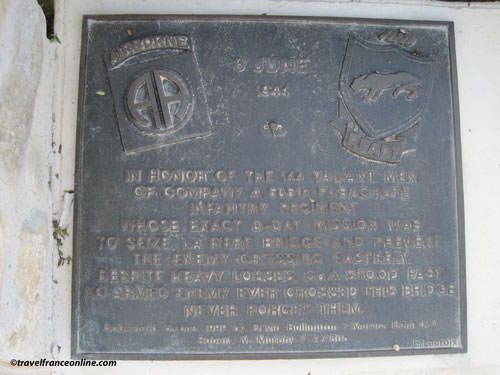
Commemorative slabs line the path leading to the Memorial and movingly recall the bravery and sacrifice of the men of the 505th and 508th Parachute Infantry Regiments, the 80th Airborne Anti-Aircraft Battalion, and the 325th Airborne Infantry Regiment of the 82nd Airborne Division:
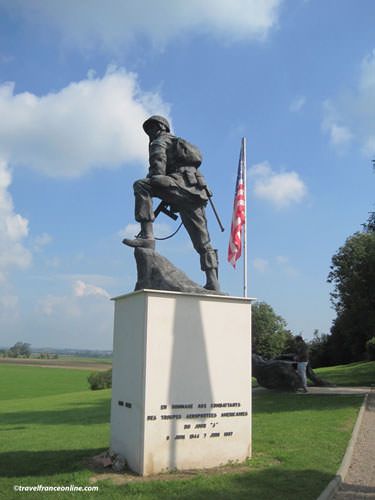
- Iron Mike, a bronze statue depicting a paratrooper, watches over the Merderet marshes, symbolising the courage and resilience of the airborne troops. It was inaugurated on June 7, 1997; its counterpart is in Fort Benning.
- An Observation Table, shaped like a partially unfolded parachute, retraces the course of the fierce fighting on June 6 and 7, 1944, offering a glimpse into these tragic battle.
- A Memorial Stelae pays tribute to all the men who made the ultimate sacrifice in the name of Peace, Dignity and Freedom.
- The Private First Class DeGlopper Memorial honours the exceptional courage of Private First Class Charles DeGlopper of the 325th Airborne Infantry Regiment, posthumously awarded the Medal of Honour for his heroic actions during the final skirmish that secured the bridge.
- La Fière Bridge and the adjacent causway were renamed Marcus Heim Road, in memory of the courageous paratrooper from the 505th Parachute Infantry Regiment who valiantly defended the bridge against the German counter-attack on June 6, 1944.
- The foxhole (trench) where General Gavin assumed command during the assault, is along the D15 road toward Sainte-Mère-l’Eglise
These memorial monuments recall the immense sacrifices made by the courageous men who fought tirelessly to liberate the world from the yoke of Nazism. They pay tribute to those who gave their lives on the battlefield, as well as to the survivors who endured the harrowing experiences of war.
Department of Manche
Coordinates: Lat 49.401038 – Long -1.363536
War Memorials:
Juno Beach: Bernieres-sur-mer – Corseulles-sur-mer – Graye-sur-mer – Douvres-la-Delivrande
Gold Beach: Arromanches – Ver-sur-mer
Sword Beach: Ouistreham-Riva Bella
Landing Beaches:
Sword – Gold – Juno – Omaha – Utah –
Rediscover the landing beaches during the 75th Anniversary Commemorations and Standing with Giants art installation in Ver-sur-mer (2024)


