
Utah Beach – Tare Green, Uncle Red and Victor sectors
Utah Beach held major strategic importance, being the westernmost of the five D-Day landing beaches.

General Dwight Eisenhower‘s inclusion of Utah Beach in the initial D-Day plan was motivated by the objective of capturing Cherbourg, a crucial port located at the northern tip of the Cotentin Peninsula.
Taking control of the port of Cherbourg was essential as it would facilitate the efficient unloading of the considerable equipment needed for the Allied troops’ advance in France.
The landing on Utah Beach was the responsibility of the US 4th Infantry Division. The beach was divided into three sectors: Tare Green, Uncle Red and Victor, from west to east.
The landings were concentrated mainly on Tare Green and Uncle Red, particularly in the Vareville dunes area.
These sectors faced a formidable defence, provided by German batteries stationed at Saint-Marcouf and Azzeville, strategically positioned opposite the Merderet marshes.
Extending along the Merderet and Douve rivers, the marshes and alluvial plains stretched for about 3 kilometres inland, replicating the outline of Utah Beach.
Four causeways crossed these marshes, three of which led directly to the Tare Green and Uncle Red sectors, thus facilitating the movement of troops from the beaches inland.
German coastal defences at Utah Beach were comparatively less significant than those at other landing beaches.
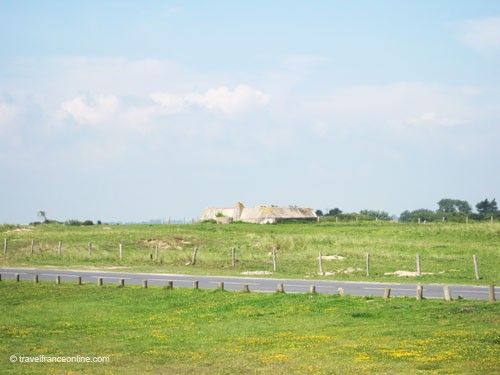
They relied heavily on the natural line of defence offered by the marshes, deeming it sufficient. Thus, their installations consisted mainly of fortified positions equipped with automatic weapons, positioned along the roads.
However, the Germans also controlled La Barquette, the lock located at the mouth of the Douve. This sluice played a crucial role in regulating the water level in the marshes.
By manipulating the valves, they could flood the entire area, creating additional obstacles to any advance by allied forces.
Capturing the Utah Beach area was crucial for the Allies, as the causeways bordering it provided the only access to the interior. These causeways were connected to the roads leading to Carentan and Sainte-Mère-l’Eglise, two strategic crossroads towns in the region.
An important road passing through Carentan extended eastward towards Bayeux, a key strategic point. Control of this route would not only consolidate the Utah Beach bridgehead but also facilitate the deployment of Allied troops to other landing zones such as Omaha, Gold, Juno and Sword.
To the west of this road was Valognes, just 13 kilometres from Cherbourg. Capturing this area would not only prevent any potential reinforcement of German troops from the south but also isolate the Cotentin Peninsula, limiting German mobility and making Cherbourg a potential target for Allied forces.
Landing on Utah Beach – Gal Theodore Roosevelt Jr.
The objective of the D-Day landing was to secure the beach, seize the causeways and roads, and establish contact with the paratroopers of the 82nd and 101st US Airborne Divisions, who had been dropped inland five hours earlier.

The landing on Utah Beach (Tare Green and Uncle Red) was scheduled for 6:30 AM, at rising tide.
The initial assault was entrusted to the 8th Infantry Regiment, supported by thirty-two amphibious tanks. A reconnaissance team swam from the landing craft to the Saint Marcouf Islands, which were believed to be an enemy observation post, but turned out to be deserted.
The first Higgins landing crafts were to reach the beaches of Dunes de Varreville and Saint-Martin-de-Vareville.
The barges transporting the thirty-two amphibious tanks were to follow closely. The following waves landed in fewer than 30 minutes and were expected to bring reinforcements, including engineers and naval mine-clearing teams tasked with clearing obstacles on the beaches.
However, the disastrous weather conditions, rough seas and smoke from the bombings, resulted in the loss of three of the four mine-hunting patrol boats. These vehicles struck mines, slowing the landing’s progress.
The main obstacle encountered during the landing on Utah Beach was the strength of the currents, which caused an unexpected drift of the landing craft, moving them approximately 1,800 metres away from their intended landing area.
As a result, American troops landed on Victor, a less heavily defended sector, as the Germans were expecting an Allied landing farther north.
General Theodore Roosevelt Jr., deputy commander of the U.S. 4th Division, who wished to participate in the first wave of the assault, landed with his men at 6:40 AM.
Despite the distance from the planned landing zone, he decided to launch the attack from this point and uttered the now-famous phrase: “We will start the war from here!”
Faced with the impossibility of returning to the originally planned landing zone due to the unforeseen drift caused by the currents, they had to take advantage of the situation.
The decision and leadership of General Theodore Roosevelt Jr. were essential at coordinating the reorganisation of regimental deployment after the Utah Beach landing, marking the start of the attack.

With expertise, confidence and remarkable composure, he personally addressed the men upon their arrival, instilling courage and determination in them.
For his exemplary leadership and bravery during the landing, General Roosevelt later received the prestigious Medal of Honour.
Less than an hour after the landing, the sappers had cleared the beach of obstacles and neutralised the German defences.
Today, the Liberty Road – Milestone 00 – Borne 00 – Voie de la Liberté marks the spot where Theodore Roosevelt Jr. and his men landed and began their withdrawal from Utah Beach.
Outcome of the landing on Utah Beach
Several key factors facilitated the success of the landing at Utah Beach.
A crucial element was the unexpected change in the drop zone, which led the troops to land in a less defended sector.
The remarkable efforts of the 13,000 paratroopers of the 101st and 82nd Airborne Divisions, dropped behind enemy lines during the night, also played a decisive role.
These paratroopers seized strategic objectives such as Sainte-Mère-Église and secured exits from Utah Beach, paving the way for a relatively rapid advance of the 4th Division inland. By noon, they had joined the paratroopers and, by late afternoon, they had made significant progress.
Unlike the chaotic and deadly landing at Omaha Beach, the landing at Utah Beach resulted in relatively low losses, with just over 200 casualties recorded.
This success is a testament to the meticulous planning and execution of the operation, as well as the courage and determination of the Allied Forces involved.
Utah Beach Memorials in La Madeleine – Audouville-la-Hubert
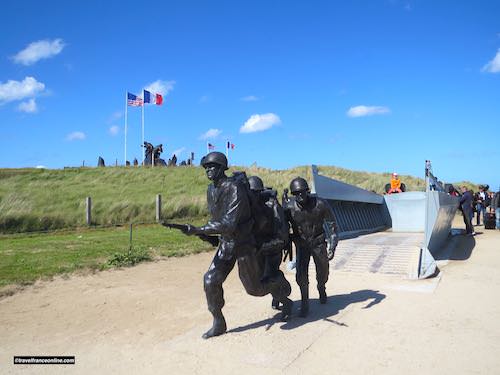
1-The Utah Beach Museum, with its modern silhouette overlooking the shore, poignantly commemorates the landing of the U.S. 4th Infantry Division on D-Day. Inside, you can explore a rich collection of exhibits, while outside, you discover tangible historical artefacts, including an amphibious tank, an M4 Sherman tank, an LCVP landing craft, and various pieces of equipment used during the landing.
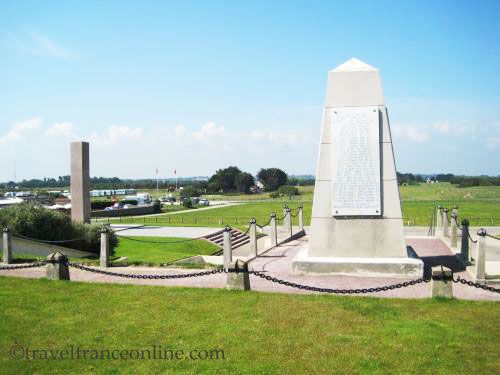
2-Adjacent to the museum, the impressive Monument to the 4th Infantry Division, unveiled by General Bradley in 1967, pays tribute to the brave soldiers who stormed Utah Beach on that fateful day.
3-Heading west from the museum, along the breach at Utah Beach, visitors will discover several other monuments. Among them stands the Kilometre Marker 00 – Liberty Road Milestone 00 – Borne 00 de la Voie de la Liberté installed in 1947. This important landmark connects Utah Beach to Bastogne, Belgium. Marker 00 is located in the breach used by the 4th Infantry Division.
4-The Row Road Memorial pays tribute to Private J.T. Rowe of the 531st Coastal Engineer Regiment, who died in action on D-Day.
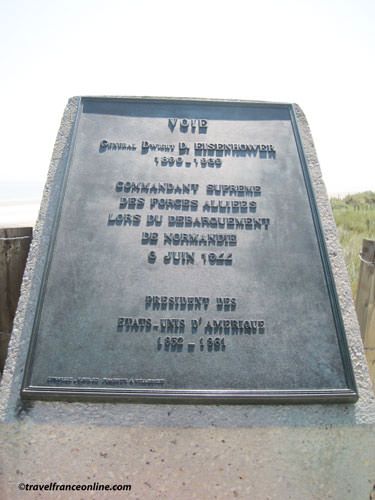
5- Near the Row Road Memorial, the Eisenhower Way Memorial honours General Dwight D. Eisenhower, Supreme Commander of the Allied Forces on D-Day and future President of the United States.
This monument commemorates Eisenhower’s crucial role in organising the largest amphibious landing in history and salutes his leadership during this critical moment of World War II.
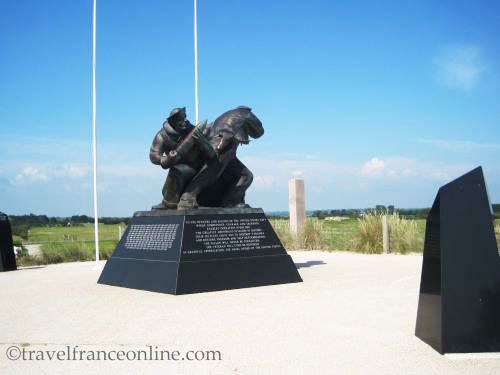
6- By climbing a few steps carved into the dune, visitors reach a platform overlooking the beach, where several commemorative monuments stand. Among them, a magnificent bronze sculpture group honours the Officers and Sailors of the US Navy, whose courage and dedication contributed to the success of the D-Day landings.
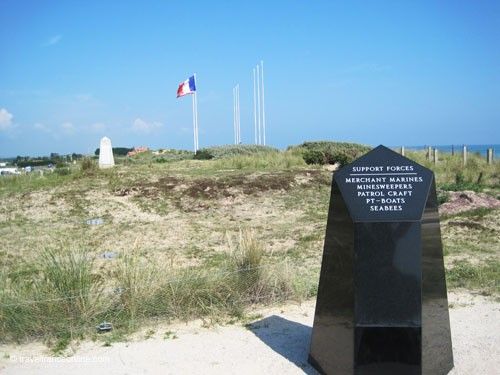
7- Around the platform, several small black granite columns pay tribute to the various units that participated in the landings.
Embedded in the parapet of the platform are two Stelae of the Free French Air Force, commemorating the lives of a crew member of a bomber from the 342nd Squadron of the Lorraine Group and the pilot Jacques Joubert des Ouches, who died in combat on D-Day.
8- The Monument to the 1st Special Engineer Brigade, erected on a bunker platform shaped like a small pyramid, solemnly recalls the crucial role played by the engineer units in the success of the Normandy landings. Positioned in front of a German anti-aircraft gun, the monument symbolises the triumph of the Allied forces over enemy defences.
9- Embedded in the shaft of the monument are Commemorative Plaques from the Allied Navy, honouring the sailors who bravely supported the amphibious assault on Utah Beach.
You will find other memorials further on.
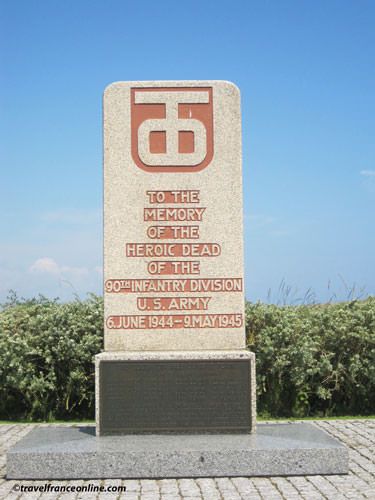
10- General Landrum, commander of the 90th Infantry Division, dedicated his division’s monument in 1974.
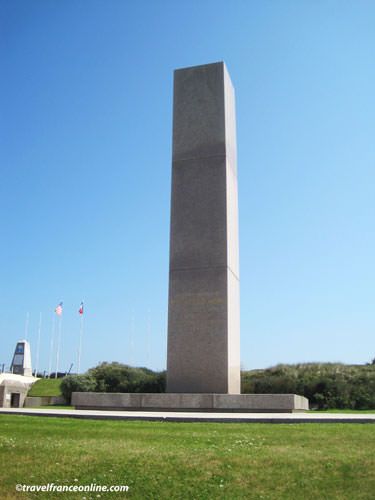
11- The American Soldiers’ Memorial, erected in 1984 by the United States, is an imposing square column of pink granite, dedicated on the 40th anniversary of the D-Day landings.
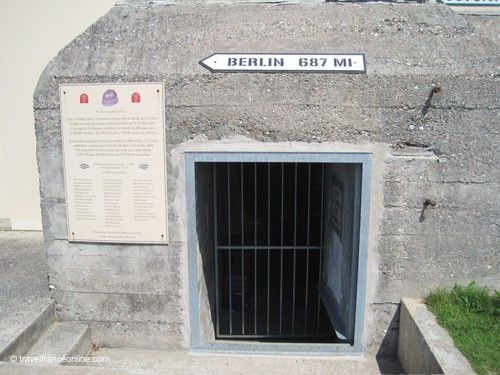
12- The Coast Guard Memorial Plaque, integrated into a German bunker, pays tribute not only to the coast guard units that supported the Normandy landings but also to all those who served all over the world during the conflict.
13- Near the Roosevelt restaurant, the exterior wall of a bunker bears a US Navy Slab paying tribute to the units that controlled maritime traffic on the beaches from June 8 to October 31, 1944.
War Memorials:
Juno Beach: Bernieres-sur-mer – Corseulles-sur-mer – Graye-sur-mer – Douvres-la-Delivrande
Gold Beach: Arromanches – Ver-sur-mer
Sword Beach: Ouistreham-Riva Bella
The other Landing Beaches:
Sword – Gold – Juno – Utah – Omaha
Rediscover all the landing beaches during the 75th Anniversary Commemorations and Standing with Giants art installation in Ver-sur-mer (2024)
Department of Manche
Coordinates: Lat 49.415558 – Long -1.175446


