
The British Normandy Memorial in 2019
We first saw the Normandy British Memorial during the 75th anniversary of D-Day in 2019.
It’s hard to believe it’s already been several years, and it’s heartbreaking to think that this might have been the last time we could honour the veterans who landed on these beaches. Many of them are now well over 90, some even over 100.
In 2019, the Normandy British Memorial consisted only of the D-Day sculpture. It stood alone on a temporary platform, without the pergola that now surrounds it. Yet even then, it was both impressive and deeply moving.
The wreaths laid by the French President and the then British Prime Minister, Theresa May, were still fresh and vibrant. Seeing them just hours after they were laid made us fully realize the historical significance of that moment.
The British Normandy Memorial in 2024
Returning in April 2024 to discover the Standing with Giants art installation for the 80th anniversary of D-Day, everything had changed! A comprehensive memorial had been erected, highlighting the sculptural group and offering a more poignant tribute to the events and heroes of D-Day.
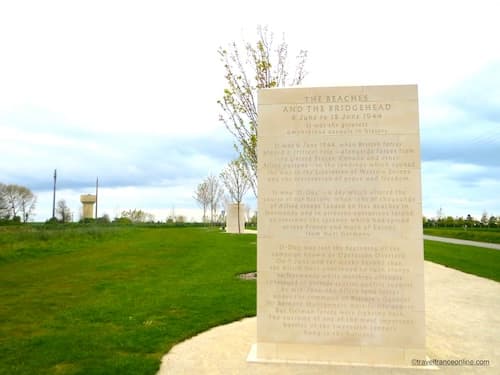
Access to the British Normandy Memorial was complete and open to all. A large parking area had been created at the entrance to the site, providing direct access to a pathway. This Chemin de Mémoire – Path of Remembrance is lined with six large engraved stone stelae recounting the key phases of the Battle of Normandy. These stelae describe the events, from the landings at dawn on D-Day to the liberation of Paris at the end of summer 1944.
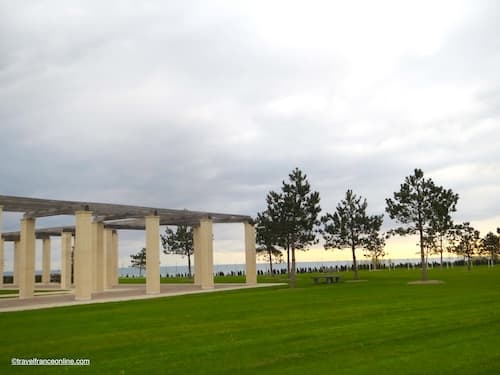
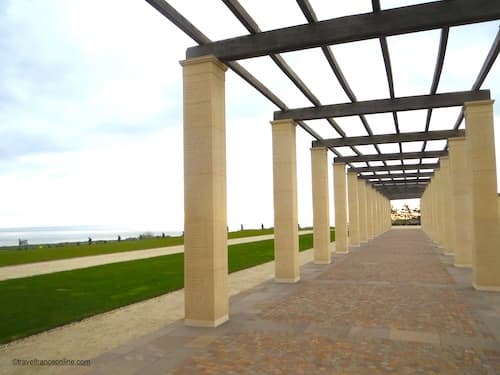
The Path of Remembrance leads to a pergola, the memorial itself: a vast rectangle defined by 160 columns engraved with 22,442 names. Here are the names of soldiers from 38 different nationalities, commemorated for their bravery, whether they died or survived. While the memorial honours British soldiers, it also pays tribute to the many Commonwealth soldiers who landed on the beaches of Normandy to liberate Europe. It also includes the names of Free French fighters, Special Operations Executive (SOE) agents, and Kieffer Commandos, who landed alongside British forces on Sword Beach.
The British Normandy Memorial itands out from others in its unique arrangement of names, listed in chronological order of death. It includes the names of the 1,475 soldiers, sailors, and airmen under British command who died on June 6th, engraved on the main Landing Day Wall, located in the centre of the Memorial.

Also inscribed are the names of two courageous British nurses, Mollie Evershed and Dorothy Field, who died while remaining faithful to their patients, even when their hospital ship was hit.
Walking clockwise along the pergola, you can see the names arranged day by day, listed by branch of the armed forces: Royal Navy, Army, Air Force, Merchant Navy, as well as special agents and war correspondents.
Each column is engraved on two sides: one bears the soldier’s name, the other their age and rank, when known. Thus, by walking around the pergola, the arrangement of names and details allows us to trace the sequence of events and better understand how D-Day unfolded.
D-Day sculpture
Standing alone in 2019, the D-Day Landing sculptural group is now the centerpiece of this magnificent memorial.
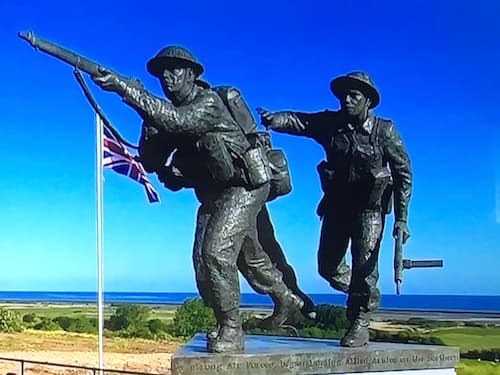
Faced on three sides by 7.6-metre-high walls, it faces inland. It depicts three British soldiers disembarking from their landing craft and walking up the beach. Standing on a single 27-ton granite block, these bronze soldiers are nearly 3 metres tall and each weighs 450 kg.
The sculpture symbolizes the units that landed on D-Day, but bear no division or regimental insignia. Their weapons were chosen to represent the three most common section arms of the infantry and marines. Thus, they embody the universal soldier, paying tribute to every man who landed, fought, and survived on D-Day.
The dynamism of the work gives the impression that the soldiers could spring to life at any moment, thanks to the talent of British sculptor David Williams.
The British Normandy Memorial in numbers
The creation of the British Normandy Memorial began in Northern Ireland, where blocks of rough stone were shipped and shaped into columns by master stonemasons. Each block was then sculpted and engraved before being transported to Ver-sur-Mer, where they were assembled to form the memorial.
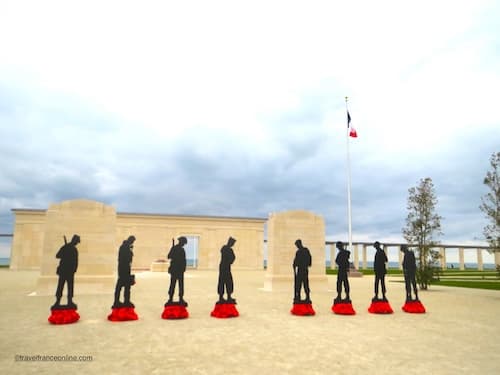
Each column is composed of five blocks of Pierre de Massangis, quarried in Burgundy, each weighing 400 kg.
Additional stones were shipped from Portugal for the column foundations, while the granite for paving the walkways and the base of the D-Day sculpture was imported from Italy. Finally, a 22-tonne block of granite from Finland was used for the bases of the masts.
In total, the British Normandy Memorial required an impressive 3,700 tonnes of stone!
This exceptional project was made possible thanks to the work of skilled and dedicated craftsmen and women from across the continent, and thanks to the financial support of Eiffage and Vallois.
Who initiated the creation of the British Normandy Memorial?
The idea for the memorial took root during the 70th anniversary of D-Day in 2014, when a veteran named George Batts noted the absence of a British memorial dedicated to this historic day.
George, along with a small team, founded the Normandy Memorial Trust to secure funding from the British government and private donors. Remarkably, more than 20,000 people contributed to the project, with donations ranging from modest contributions to substantial sums.
To determine the memorial’s location, the Trust consulted around 100 veterans of the Normandy landings. Their overwhelming choice was Ver-sur-Mer, code-named Gold Beach, the key point in the British attack zone on D-Day.


