Origin of the Nativity Scenes – Crèches de Noël
Nativity scenes, crèches in French, represent the birth of Jesus of Nazareth in the stable (or more precisely, the cave) of Bethlehem, and occupy an important place in French culture.
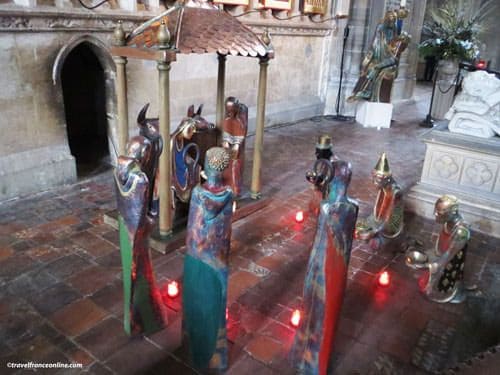
According to the Gospel of Luke, the Infant Jesus was placed in a manger. The Latin term for manger, cripia, evolved to give the French word crèche, which today refers to the entire stable or cave.
The cult of the Nativity cave in Bethlehem dates back to the 3rd century, when small theatrical performances illustrating this event began to appear in villages.
The first recorded nativity scenes in France appeared at the end of the 16th century, after the Wars of Religion, as a way to revive Christianity. The sumptuous nativity scenes in the Baroque style became popular in the 17th century, adorning Parisian mansions and provincial towns.
However, during the French Revolution, it was forbidden to depict religious scenes in public spaces. This led to the development of nativity scenes in private homes, where small figurines and statuettes representing the figures from the Bethlehem stable were made and displayed.
Nativity Scenes’ Santons
The Santons, derived from the Provençal “santoun” meaning “little saint“, are figurines originating from Provence that enjoyed great success at the beginning of the 19th century. Inspired by local life, these figurines represent various religious figures in Nativity scenes.
Santons fall into four main categories:

- Those who live in the stable.
- Those who bring gifts.
- Characters representing different trades of the time: millers, washerwomen, grinders and millers.
- Animals.
Originally made from bread crumbs, the figurines were modelled, dried, painted with oil and varnished. However, their fragility quickly led to the use of clay as the main material.
Although traditional figurines are still made of clay, terracotta figurines are more common today. This tradition gave rise to the profession of santon maker or santonnier , often passed down from father to son. Jean-Louis Lagnel (1764-1822) is considered one of the first santon makers. Each workshop developed its own style, leading to competition among artisans to create the most beautiful and original figurines.
When to install the Nativity Scenes?
In France, families usually set up their nativity scene on the first Sunday of Advent or on Nicholas’ Day, celebrated on December 6.
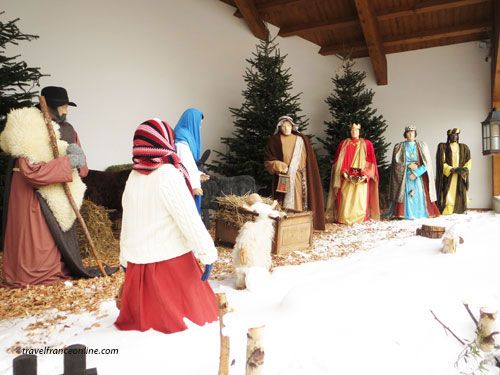
These nativity scenes often depict a natural setting, adorned with moss, logs, pine cones, straw, and stones.
While some families still make their own nativity scenes, many now prefer to buy ready-made nativity scenes and figurines (representing different characters).
Adding one or two items each year allows families to gradually enrich their nativity scene without breaking the bank, as quality figurines can be quite expensive.
Traditionally, nativity scenes are taken down on February 2nd, the date of the presentation of Jesus at the Temple. This marks the end of Christmas festivities in many cultures.
Photo via Wikimedia Commons: The miller by pernmith is CC BY 2.0