
Battle of Crécy – Start of the Hundred Years War
The Battle of Crécy, on August 26, 1346, pitted the forces of Philippe VI de Valois against those of Edward III of England. This historic clash is famous for the remarkable feat of a few thousand Welsh archers who triumphed over a formidable army of French cavalry and infantry.
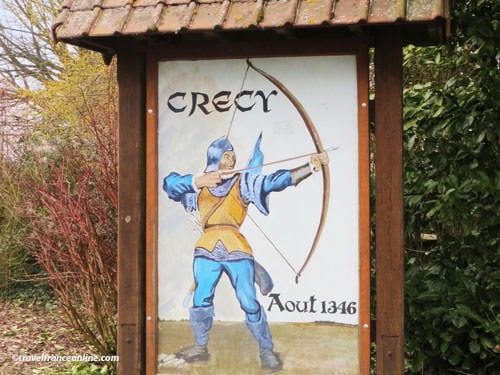
This battle marked the beginning of the Hundred Years War, a series of conflicts between France and England stemming from the complex power struggles of the royal dynasties.
Edward III, grandson of Philip IV the Fair through his mother Isabella of France, stirred up tensions on October 7, 1337, by publicly challenging the legitimacy of his cousin, Philip VI of Valois, and claiming the French crown. He thus launched several military campaigns within the Kingdom of France, forging an alliance with the Flemish along the way.
On July 12, 1346, he landed at Saint-Vaast-la-Hougue with an army of 40,000 men, aiming to march on Paris. Encountering little resistance, he quickly seized the Cotentin Peninsula, where many towns lacked fortifications. From there, he headed north to join his Flemish allies.
However, Edward’s advance was hampered by the crossing of the Seine and the Somme rivers. His first attempt to cross at Rouen failed, as most of the Picardie towns along his route were heavily fortified. Undeterred, he pressed on and finally managed to cross the river further east, at Poissy.
Meanwhile, Philip VI and his army had arrived at Amiens, intending to encircle Edward between the Seine and the sea. In the early hours of August 24, Edward decided to cross the Baie de Somme at low tide via the ford at Blanquetaque, near Saint-Valery-sur-Somme. Once on the other side, Edward and his men had to advance through marshy terrain, while Philip VI’s troops had already reached Abbeville. With retreat impossible, Edward had no choice but to confront the French head-on.
Thus, on the eve of August 25, he established his camp on the heights overlooking the modest village of Crécy-en-Ponthieu. Philip VI’s vast army included not only his vassals, but also external allies, among them John I of Luxembourg, King of Bohemia, Charles IV and Charles II of Valois, and the Duke of Alençon, the king’s brother.
Battle of Crecy – Welsh archers’ victory
The English forces thus positioned themselves strategically on the hill overlooking Crécy and its valley. Under the command of Edward III, the second line was composed of his son, the Black Prince, while the Earls of Northampton and Arundel led the first line.

Although the exact number of soldiers engaged in the Battle of Crécy remains a subject of debate, it is generally accepted that Welsh archers constituted three-quarters of the English troops and were positioned in the front line.
When the French forces reached Crécy and its valley on August 26, adverse weather conditions hampered their advance. A violent storm indeed broke out around 3 p.m., flooding the ground and presenting a further obstacle. Philip VI meticulously organised his troops into three lines, with Genoese archers forming the vanguard to protect his cavalry, strategically positioned in the two subsequent lines. Infantry units were stationed on the flanks and rear to provide additional support.
However, the torrential rains soaked the ground, making it even muddier and more slippery, and also damaged the Genoese crossbows, whose horsehair strings lost their effectiveness when wet.
Aware of the gravity of the situation, Philip decided to postpone the attack until the following day. However, his troops, driven by fervour and a determination to fight the English, ignored his order and impulsively launched an assault on the hill. The lack of discipline and the flawed command of the French army resulted in one of its most crushing defeats!
Tragically, the ineffectiveness of their weaponry and the weight of their equipment hampered the mobility and effectiveness of the Genoese archers on the battlefield. Struggling to advance across the sodden ground, they became easy targets for the deluge of arrows from the Welsh archers, whose hemp bowstrings proved even more effective when wet.
In the chaos and facing mounting losses, panic quickly spread through the Genoese archers. Demoralised and overwhelmed, they succumbed to fear and disarray, and ultimately retreated. Philip, interpreting this retreat as an act of treason, gave the merciless order to his cavalry to execute them on the spot.
This impulsive decision dangerously exposed the French cavalry to the deluge of Welsh arrows, a danger further compounded by the rows of stakes that blocked their advance. Yet, in the early hours of August 27, the French cavalry managed to break through the Welsh lines and launched a brutal assault.
However, this initial success was short-lived. At sunrise, the blinding rays and the cumbersome weight of their armour slowed their advance, leaving them isolated and vulnerable amidst the chaos of battle. The Welsh archers, aware of the French cavalry’s vulnerability, skillfully targeted their horses, forcing the riders to dismount before mercilessly slaughtering them.
Philip VI, wounded in the face, left the battlefield and took refuge in the nearby Château de Labroye. There, he desperately begged for sanctuary, crying out, “Open up! It’s the unfortunate King of France!”
Meanwhile, the valiant John of Luxembourg, undeterred by his blindness, remained steadfast on the battlefield. Displaying unwavering courage, he ordered his men to tie him to his horse and continued to fight bravely to his death.
Aftermaths of the Battle of Crecy
After the triumph at Crécy, Edward III continued his offensive, eventually besieging Calais, which capitulated after a gruelling year-long siege. The exact number of soldiers involved in the Battle of Crécy remains a subject of debate among historians. It is estimated, however, that around 4,000 French soldiers perished in the conflict, including 1,542 knights and 2,300 Genoese archers. Losses among the 50,000 infantrymen remain unknown. In contrast, the English suffered relatively light losses, estimated at between 100 and 300 men—a surprising discrepancy.
The French defeat at Crécy can be attributed to factors such as a lack of discipline and an ineffective command structure. This devastating defeat had profound repercussions, particularly for the French nobility, as many heirs perished on the battlefield, thus ending long-standing dynasties.
The battlefield of Crecy today
Three monuments commemorate the Battle of Crécy.
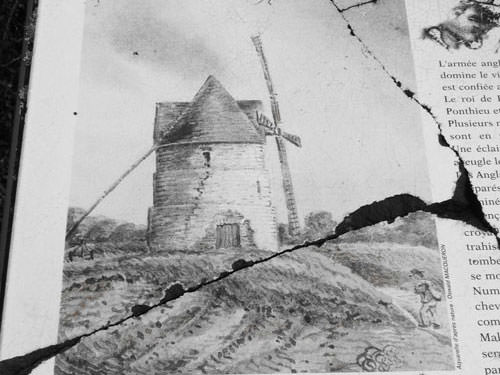
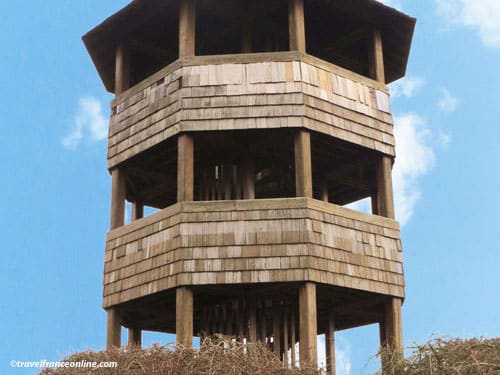
The first is a two-story wooden tower, built in 1984 along the D111 road leading to the village of Dompierre-sur-Authie. This wooden tower, known as Moulin D’Edouard III – Edward III’s Mill, offers a clear view of the battle site and helps visitors understand the course of the battle thanks to two orientation panels located at its upper level, which accurately illustrate the positions of the French and English armies during the battle.
The tower was built on the site of the mill where Edward III oversaw the battle; sadly this mill was demolished in the 19th century.
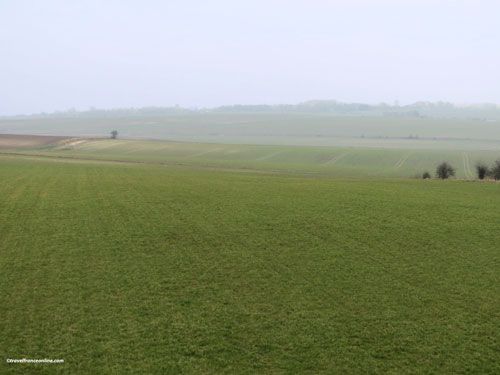
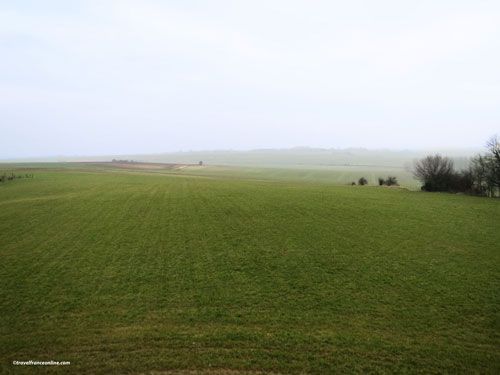
Today, the former battlefield is a vast cultivated field, sloping gently down into the Vallée des Clercs (Valley). It is difficult to imagine, when looking at it, that it was once the scene of one of the most decisive battles in French history. The Battle of Crécy is also commemorated with the Monument to Jean de Luxembourg, located in the main square of the village. And more importantly, a Cross of Bohemia marks the exact spot, where Jean de Luxembourg died in battle.
Department of Somme – Crécy-en-Ponthieu D111 to Dompierre-sur-Authie – Picardie
Coordinates: Lat 50.256241 – Long 1.887441


