
Chateau de Chantilly, a historical gem
The Château de Chantilly is renowned as one of the most beautiful monuments in France, and you have no excuse not to visit it, as it’s located just 40 kilometers north of Paris! While the Petit Château, the 16th-century medieval castle, remains a historical gem, the equally exceptional main building, known as the Grand Château, was rebuilt in the 19th century by Henri d’Orléans.
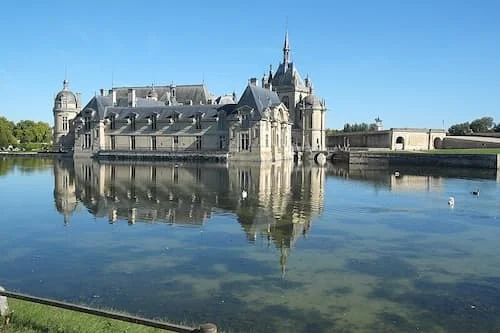
Like many French châteaux, Chantilly was originally a fortress, strategically positioned to protect the road linking the city Senlis to Paris. Nestled in the marshy Nonette Valley, the estate initially belonged to Guy de Senlis, the wine merchant who supplied wine to the court of King Louis VI. The château remained in the hands of Guy’s descendants until its destruction during the peasant revolts of 1386. Rebuilt in the years that followed, the estate changed hands several times over the centuries.
The illustrious Montmorency family owned the château from the 15th to the 17th centuries. During this period, they undertook significant improvements, including the renovation of the fortress and the construction of the Petit Château, also known as La Capitainerie, at its base in the 1550s.
Chantilly, the estate of the House of Condé
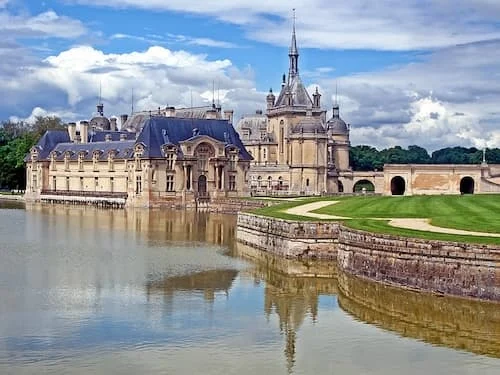
In 1643, Chantilly passed into the hands of the powerful House of Condé. Louis II of Bourbon-Condé, known as “the Great Condé,” invested his colossal fortune in transforming the estate into a cultural masterpiece. He assembled an extraordinary collection of paintings, exquisite objets d’art, and elegant furniture. During his reign, the Petit Château underwent significant renovations, reflecting his refined taste. Condé also undertook substantial improvements to the Grand Château, a colossal project that began, however, after his death in 1686. The work continued for several decades and was completed in the late 1720s.
The magnificent Great Stables – Grandes Ecuries were built during this period of transformation. Stretching 186 meters in length, this exceptional building was designed to house the estate’s horses and hunting party. Several remarkable features, now lost, were also created during this period: the small park and the Allée du Quiconce, a picturesque path leading to it; a giant game of goose and two complex mazes… all testaments to the creativity and refinement of its owners during this golden age.
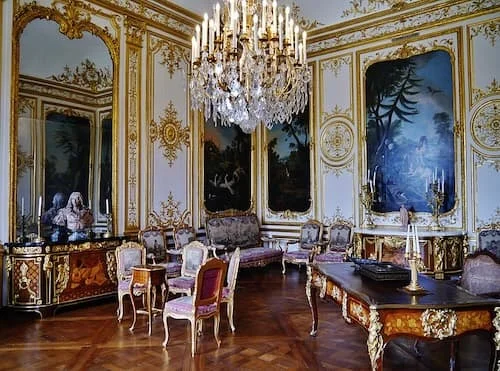
Then came the French Revolution, which brought considerable upheaval to Chantilly, forcing Louis VI de Bourbon-Condé into exile and leaving the estate vulnerable to the turmoil of the time. As expected, its exquisite furnishings and paintings were sold and dispersed, the buildings were converted into prisons, and the once elegant gardens and grounds were divided up and sold off in lots! The château suffered a disastrous fate, serving little more than as a stone quarry. Fortunately, the Petit Château and the Grandes Écuries narrowly escaped destruction!
Upon his return from exile in 1814, Louis VI de Bourbon-Condé reclaimed his estate, which was now but a shadow of its former glory. With his son, he attempted to buy back the remaining parcels of land, seeking to restore Chantilly to its former splendour.
Henri d’Orléans rebuilts Chantilly
However, it was Henri d’Orléans, Condé’s great-nephew and the penultimate son of King Louis-Philippe, who inherited the estate and its treasures in 1830. Driven by the desire to restore Chantilly to its former glory, he undertook an ambitious reconstruction of the château in 1846, breathing new life into this historic monument.
The reconstruction of Chantilly was, however, abruptly interrupted by the fall of the July Monarchy, forcing the Orléans family into exile in England until 1870. Upon their return in 1871, Henri d’Orléans continued the meticulous restoration of the Grand Château, which had fallen into ruin. As a result, the Petit Château is now the oldest part of the château.
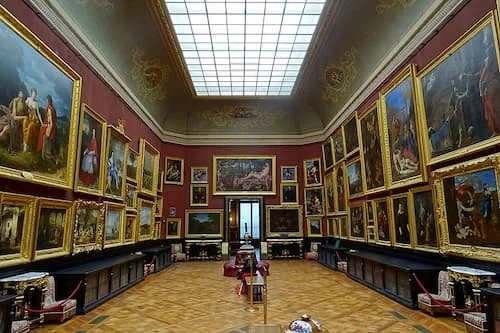
During this period, he adorned the château with an extraordinary collection of rare books and priceless objects, treasures amassed during his exile. Henri d’Orléans died in 1897, a widower without heirs. He bequeathed Chantilly to the Institut de France, having founded the Princes of Condé Foundation in 1886 to ensure the preservation of the estate. The Musée Condé, now housed in the château, brings together these exceptional collections.
Chantilly’s other treasures
Besides the Petit Château and the 19th-century Grand Château, Chantilly boasts several exceptional buildings that enrich its architectural heritage.
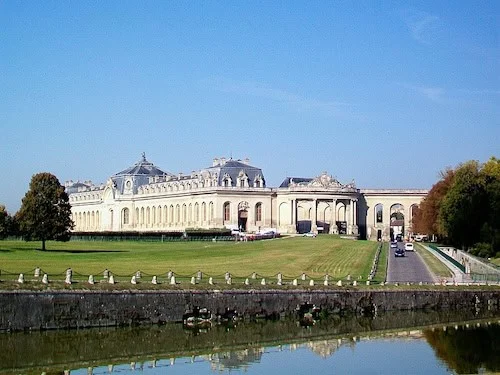
Among them is the Château d’Enghien, built in the 18th century to host distinguished guests. The Jeu de Paume, another 18th-century gem, underwent a remarkable transformation in the 19th century. Originally designed for the traditional game of tennis, it was converted into an exhibition hall to display monumental works of art. The Maison de Sylvie, a charming residence surrounded by a vast 60-hectare park, was built in the early 17th century for Marie des Ursins, wife of Marshal Henri II de Montmorency. This picturesque house was re-imagined in the 19th century in the elegant Mansart style, combining classical beauty with history. Finally, the Grandes Écuries (Great Stables), a true masterpiece of 18th-century architecture, have housed the renowned Musée du Cheval (Horse Museum) since 1982.
However, Chantilly’s splendour isn’t limited to its buildings; it extends to its breathtaking grounds. The estate boasts a vast 115-hectare park, home to a variety of spectacular themed gardens. From the formal French gardens designed by André Le Nôtre to the romantic English and Anglo-Chinese gardens, every corner is a feast for the senses. And of course, let’s not forget one of Chantilly’s most distinctive features: it’s a château on the water, its elegant reflections mirrored in the moats and tranquil ponds that surround it.
After exploring the château, it’s time to discover another delight: the cream that shares its name with this magnificent estate!
The history of the Crème Chantilly
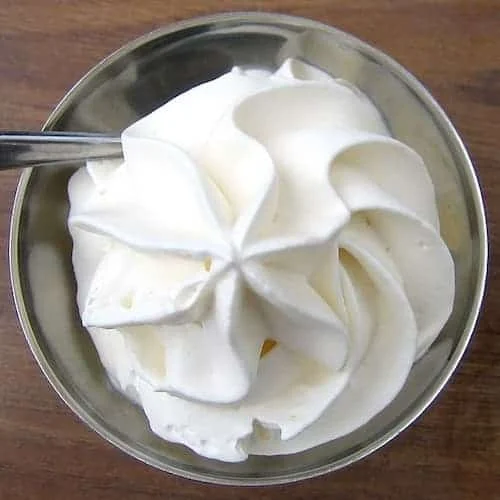
Chantilly cream – Crème Chantilly, that smooth whipped cream we know today, is often mistakenly attributed to François Vatel, the butler of Count Louis II de Bourbon-Condé. To discover the truth, let’s go back to 1671, when the Château de Chantilly belonged to the Condé family.
At that time, Louis II de Bourbon-Condé commissioned Vatel to organize a grand feast in honour of King Louis XIV. The event was intended to be exceptional, with 2,000 guests expected. Vatel, renowned for his impeccable organizational skills, worked tirelessly to ensure everything was perfect.
The pressure was immense, as one can imagine, and it intensified even further when the master pastry chef discovered a shortage of fresh cream in the château’s kitchens, an essential ingredient for the grand dessert he had planned! Faced with this unexpected challenge, he didn’t panic. On the contrary, the ingenious chef had a brilliant idea: he would whip the available cream to increase its volume and thus have enough to serve the 2,000 guests. The dessert was an immediate success with the King and his guests!
However, the recipe already existed in 1531 under the name Neige de crème (Snow cream), as evidenced by one of the writings of Francois Rabelais, the famous French Renaissance writer and humanist. About fifteen years later, a similar recipe, but incorporating whipped egg whites, appeared in England under the name Dischefull of Snow. The recipe was revisited over the following decades; some added sugar, orange blossom water, or grated lemon… each pastry chef bringing their own personal touch and expertise.
A lighter, more liquid version of the cream is attributed to Alexandre Procope, son and successor of Francesco Procopio dei Coltelli, who founded the famous café-restaurant of the same name in 1686 in tthe Cour du Commerce Saint-André in Saint-Germain-des-Prés. Alexandre used whipped milk, which he cleverly called crème de lait (milk cream), to accompany coffee, giving it a light and frothy texture. Over time, he transformed his whipped milk recipe into a precursor to Italian gelato, one of the world’s most beloved desserts. And indeed, Italian gelato is a true marvel: rich, smooth, and irresistibly delicious!
Another, more controversial version claims that Queen Catherine de Medici introduced whipped cream to France upon her marriage to Henry II in 1533. Whatever the origin of the recipe, it was only in the 19th century that the cream became widely known as Crème à la Chantilly, thus permanently associating the castle with it.
A simple recipe for 250g of Chantilly cream
Ingredients:
- 25 cl of very cold liquid cream
- 25 g of icing sugar
- 1 sachet of vanilla sugar (optional but adds a delicious touch)
Though preparing Chantilly cream requires just two simple ingredients—sugar and cream—its secret lies in the technique! The true magic happens with the flick of the wrist, as it’s the air incorporated into the cream that gives it its lightness and volume, and for the cream to whip perfectly, it’s essential to use very cold liquid cream—neither thick nor light. Finally, a real Chantilly cream is made only with raw cream, ensuring the rich, fresh flavour!
On that note, I’ll let you indulge in dreams of light, airy desserts and grand châteaux…
Wikimedia Commons: Header and photo 1 by GFreihalter is CC BY-SA 4.0 – Castle seen from the English garden by Rolf Kranz is CC BY-SA 4.0 – Grandes Ecuries by P.poschadel is CC BY-SA 2.0 fr – Painting Gallery Musee Condé by Pierre Poschadel is CC BY-SA 4.0 – Cream by Paul Downey is CC BY 2.0 – Private apartments by Zairon is CC BY-SA 4.0


