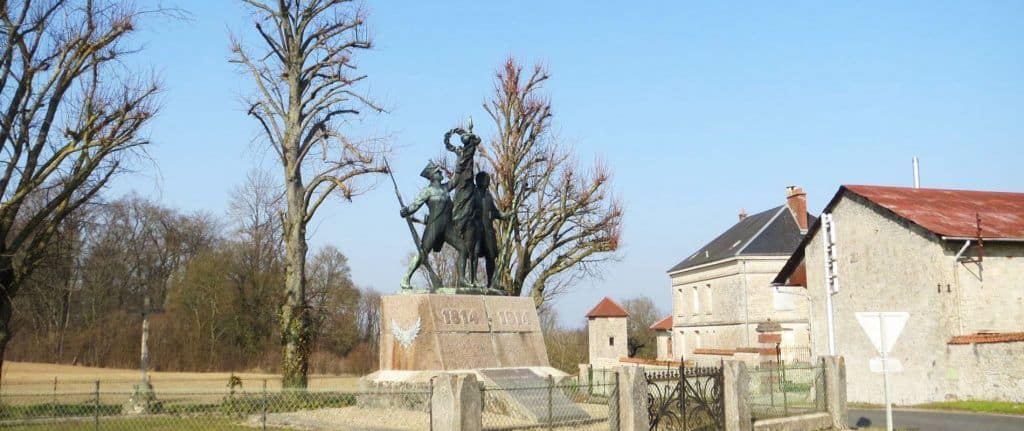
Soldiers buried in Saint-Quentin National Necropolis
The Saint-Quentin National Necropolis was established in 1923. It houses the remains of soldiers who died in the battles of August 28 and 30, 1914, and October 1918, and who were initially buried in temporary military cemeteries in the region.

Further developed between 1934 and 1935, it covers 1.76 hectares. In 1954, the remains of 207 French soldiers, who fell during the Second World War and were buried in temporary military cemeteries, were transferred there.
In total, the cemetery contains the remains of 4,947 soldiers, 3,954 of whom rest in individual graves. Among them are soldiers of various nationalities, including members of the 17th Corsican Infantry Regiment, Romanians, Russians, as well as labourers from Indochina and Tonkin.
The necropolis also houses the remains of 1,319 soldiers, including 853 unidentified French soldiers and 8 Russians, in two ossuaries flanking the memorial. A French flag flies permanently over the monument, bearing the names and ranks of those buried there.
Battle of Guise – August 28-30, 1914
In August 1914, German forces crossed the border, capturing Charleroi and encircling French troops on both flanks.

While the British retreated, General Lanzenac’s French troops were ordered to halt their withdrawal and counterattack the Germans at Saint-Quentin. Despite their efforts, the initiative failed due to a lack of support, allowing the Germans to advance towards Amiens.
French artillery, however, managed to slow their advance from positions south of the city. Lanzenac’s troops then forced the Germans to retreat towards Guise (east of Saint-Quentin), though they retained formidable positions on the south bank of the Oise River, thus trapping the French.
Forced to launch an offensive on August 29, the French slowed the German advance but found themselves encircled on both flanks. Aware of the untenable situation, Lanzenac ordered a retreat to minimise losses, abandoning hard-won positions to the Germans. Saint-Quentin remained under German control until October 2, 1918.
Saint-Quentin under German occupation
From August 28, 1914, to October 2, 1918, Saint-Quentin was under German occupation and transformed into a fortified stronghold, with barracks, hospitals, and food and ammunition depots, as well as the headquarters of the German 2nd Army. Emperor Wilhelm II visited the city twice.

However, in 1917, the French offensive forced the Germans to retreat, placing Saint-Quentin on the front line. The Germans evacuated the civilian population to occupied Belgium and reinforced the city’s defences with 2,000 Russian prisoners.
Despite the significant damage caused by French bombardments, Saint-Quentin retained its strategic importance for the Germans.
The French recaptured Saint-Quentin on October 2, 1918, but fighting continued in the region until November.
The heavy losses suffered by both sides during the battles of August 1914 and October/November 1918 led to the creation of the Saint-Quentin National Necropolis, where the French soldiers who fell in combat now rest.
Saint-Quentin during WWII

The industrial city of Saint-Quentin regained its strategic importance during the Second World War and was once again occupied by the German forces.
From September 1939 to June 1940, French colonial troops, notably the 2nd Moroccan Sapphire Regiment, launched offensives to counter the German advance in the region.
Unfortunately, they also suffered heavy losses, and many of their soldiers are also buried in the Saint-Quentin National Necropolis.
This cemetery is located along the road connecting Saint-Quentin to Amiens.
Department of Aisne – D1029 – Picardie region
Coordinates: Lat 49.855243 – Long 3.262252