
Saint-Valéry-sur-Somme – Origins
Saint-Valéry-sur-Somme is perched on a steep cliff overlooking the mouth of the Somme estuary. Celts, Romans, and Vikings all left their mark on this strategic location.

The Blanquetaque Ford, once a simple ford, allowed passage across the Somme near its mouth at low tide. Sailors named it Blanquetaque, meaning white spot, because it was the most visible point of the chalk cliff overlooking Port-le-Grand, which, from the late 18th century onward, became a bustling port.
The founding of Saint-Valéry-sur-Somme is linked to the arrival of Gualaric in the 7th century. King Clotaire II indeed granted the ancient Gallo-Roman estate of Leuconus, located on the cliff, to the monk. Soon, Gualaric, whose name evolved into Valery, became renowned for its many miracles, and Leuconus becam Leuconay.
The abbey that Saint Valery of Leuconay founded in 622 became, over time, an important pilgrimage site, drawing the faithful to its relics for centuries, and Leuconay was renamed Saint-Valery in the 10th century.
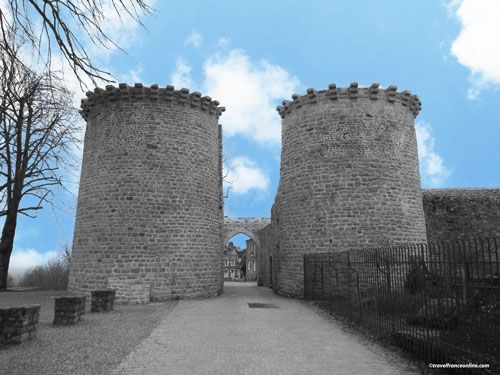
Saint Valery was also renowned for his prophecies, one of which foretold the accession to the Frankish throne of the descendants of Hugh Capet‘. In 981, Hugh Capet crossed the Somme at the Blanquetaque Ford to claim the saint relics, thus fulfilling the prophecy and securing the legitimacy of his dynasty.
The annals of Saint-Valery-sur-Somme were marked by another historic event in 1066, when William the Conqueror‘s fleet established its base there before crossing the English Channel to conquer England. To bless this historic voyage, William had the relics of Saint Valery paraded through the town before embarking.
By 1197, the town had reached a level of development sufficient to obtain its first charter of liberties.
Saint-Valéry-sur-Somme during the Hundred Years War
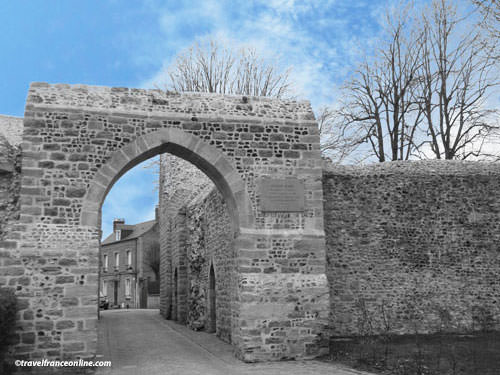
Saint-Valéry-sur-Somme – Peace and prosperity
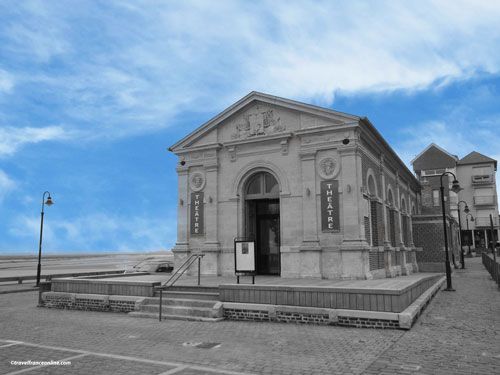
Peace eventually returned to Saint-Valéry-sur-Somme.
The port prospered, thanks to the lucrative wine trade, until the Wars of Religion in the 16th century, when the ramparts, fortifications, and abbey were severely damaged.
The abbey was restored as soon as the conflict finished.
Prosperity returned in 1785 when King Louis XVI authorised the ambitious project to build the Canal de la Somme, which was completed in 1821.
Unfortunately, the abbey and the castle were declared national property in 1791 during the French Revolution.

The abbey was demolished and used as a stone quarry.
Only the convent was spared!
The strategic location of Saint-Valéry-sur-Somme was once again recognised during the First World War.
The town indeedd became a crucial landing base for the British, facilitating the arrival of supplies, military equipment, and troops, including a contingent of Chinese workers recruited in 1917.
King George V even stayed at the Hôtel La Colonne de Bronze when he came to Saint-Valery to inspect the troops stationed in the area.
Over the centuries, the town developed into three distinct districts:
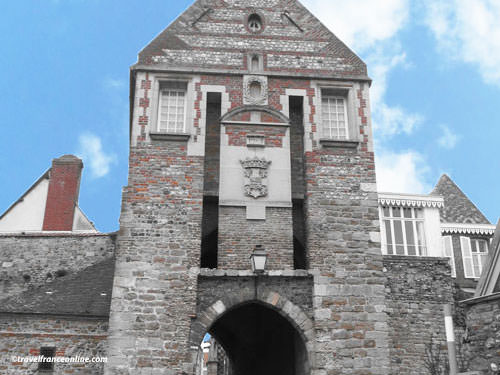
The fortified Ville Haute – Upper Town, the vast Quartier de l’Abbaye – Abbey District, and the lively Ville Basse – Lower Town, the fishermen’s district also called Le Courtgain by the port of La Ferté.

Saint-Valéry-sur-Somme – Port
Thanks to its exceptional location at the mouth of the Baie de Somme, Saint-Valéry-sur-Somme has been a major port since ancient times.
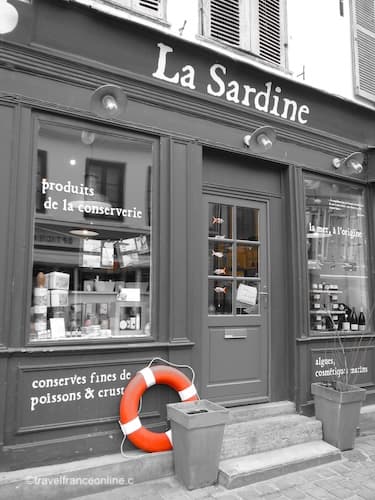
However, it was only in the 15th century that the port truly established itself as a commercial centre, specialising in the lucrative wine trade.
The presence of an armed warship, an imposing vessel equipped with six cannons, permanently anchored there, attest of its role as a vital commercial artery.
The town’s maritime and commercial prosperity increased a century later when the King of France established the Admiralty of Saint-Valéry. A wide variety of goods from distant lands, as well as seafood, including prized herring, which became a local speciality, passed through its bustling quays.
The salt trade also played a vital role in the town’s prosperity, as evidenced by the imposing Entrepôt des Sels – Salt Warehouse, built on the Quai Lejoille in 1736. This vast warehouse could store up to 20,000 tons of salt, meeting the needs of Picardie, Artois, Champagne, and Burgundy.
Saint-Valéry-sur-Somme, together with Calais, also held a coveted monopoly on English cloth. Until the 17th century, the ports of Le Hourdel and La Ferté operated as a single entity.
Today, Le Hourdel is an independent enclave, renowned not only for its maritime heritage but also as a sanctuary for seal watching.
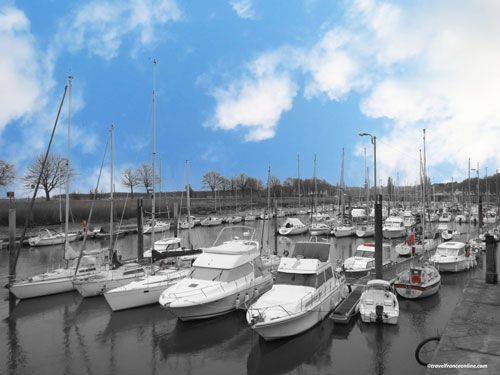
The port of Saint-Valery-sur-Somme still harmoniously combines its maritime and riverine vocations.
The marina indeed boasts some 250 berths, while shops and restaurants are located just steps from the quays in Le Courtgain district.
This marina can accommodate yachts up to 16 metres in length with a draft of 2.30 metres, making the port a vital hub for commerce and leisure.
Today, Le Crotoy, Saint-Valery-sur-Somme, and Le Hourdel form the threeiconic ports of the picturesque Baie de Somme.
Boat buoy Somme II
A different way to discover the stunning Baie de Somme, which has been ranked among the most beautiful bays in the world since 1999, is to embark on the iconic Somme II boat buoy.
Decommissioned on November 2, 1999, the Somme II was the last wooden-hulled buoy still in service in Picardie.
Classified as a historical monument on May 26, 2000, the Somme II was given a second life thanks to the efforts of the Association pour la Sauvegarde du Baliseur Somme II—the Association for the Protection of the buoy Somme II. In 1983, this association undertook the meticulous restoration of the Somme II, and the Somme General Council acquired the vessel in 2000.
Today, the association offers regular educational boat trips onboard the Somme II through the Baie de Somme and along the Somme Canal.
Department of Somme – Picardie
Coordinates: Lat 50.188648 – Long 1.629695


