The Petite Camargue, a unique wetland
The Camargue (the Rhône delta) marked the starting point of our six-day hike along the Via Tolosana, one of the four main routes of the French Camino. After a day spent exploring the magnificent city of Arles and enjoying a hearty breakfast, my friend and I were ready, backpacks on, to set off!
We left Arles by crossing the Rhône via the Trinquetaille Bridge. We then followed a road along the river before turning off towards the Camargue.
Our destination for this first leg was Saint-Gilles-du-Gard, west of the Petit Rhône river, in the Petite Camargue.
Located in the Gard department, the Petite Camargue is thus also known as the Camargue Gardoise. The Petit Rhône river bounds it to the east, the Virdoule river to the west, the Costières de Nîmes plateau to the north, and the Mediterranean to the south. The Petite Camargue shouldn’t be confused with the Camargue proper, the vast, triangular marshland shaped by the Rhône delta!
The Petite Camargue’s main cities are Aigues-Mortes, Le Cailar, and Vauvert, the latter being one of the stops on our Camino. Le Cailar and Vauvert lie in the heart of the Camargue Gardoise, a region of natural wet meadows and traditional cattle-rearing ranches, locally known as manades.
This marshy region was formed by ancient branches of the Rhône that have since disappeared. What remains are larges lagoons and ponds, such as Scamandre, Charnier, and Or. The Petit Rhône is the only ancient branch that still exists.
Due to its extensive wetlands, the Petite Camargue was designated a Ramsar site in 1996. A protected area, it was also awarded the Grand Site de France label in 2014.
The Petite Camargue, a land of various landscapes
Thanks to its unique geographical location, the Petite Camargue serves as a transition zone between the fresh waters of the Rhône and the salt waters of the Mediterranean. This gives rises to a fascinating variety of landscapes: a vast patchwork of reed beds, wet meadows, rice paddies, freshwater marshes, brackish lagoons, and vineyards.
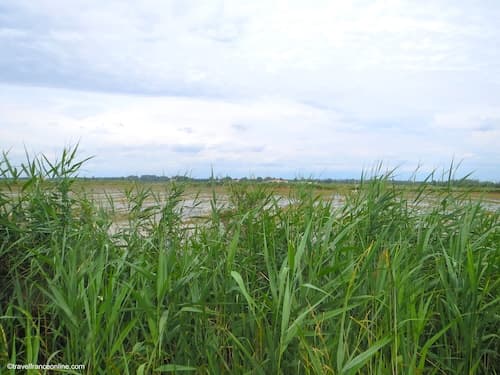
To the north lies the alluvial plain, shaped by prehistoric floods. Expansive reed beds thrive in the freshwater marshes surrounding Vauvert, but also the Scamandre lagoon near the coast. This abundance of reeds has given rise to a flourishing industry producing thatch for roofing traditional local houses. The only way to traverse these expanses of reeds is via a network of floating jetties.
These soils are also ideal for the meadows, and rice paddies that produce the renowned Camargue rice, as the constant supply of fresh water allows residual salt to be flushed out.
Wet meadows, locally known as sansouires, are occasionally submerged by brackish water. These saline mudflats provide a habitat for samphire, which often carpets the ground and changes colour from green to red with the seasons. It is in these prairies that you’ll find the traditional manades, the traditional ranches that raise the iconic black bulls and white horse, emblems of the Camargue.
Along the coast, near Aigues-Mortes, you’ll find the salt flats and their impressive white mounds of sea salt. This area is a haven for pink flamingos, as they find their essential food in this saline environment.
Finally, near Le Grau-du-Roi, the landscape shifts to dunes and lidos, long, narrow strips of sand separating the lagoons from the open sea. Here, you’ll discover a wild, unspoiled 10-kilometre stretch of coastline, punctuated by towering dunes. Stabilised by dune vegetation, such as marram grass, sea holly, and maritime pines, they also form as natural barrier protecting the hinterland from strong sea winds.
That said, the Petite Camargue has been profoundly shaped and developed by humans to protect it from flooding and stagnant water.
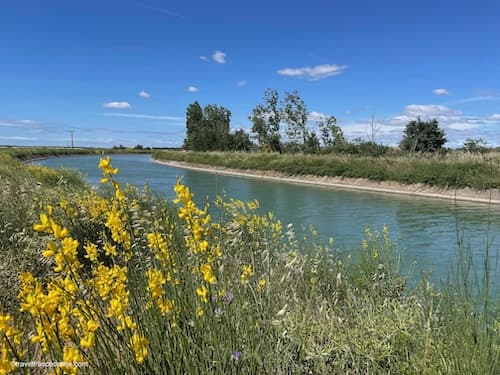
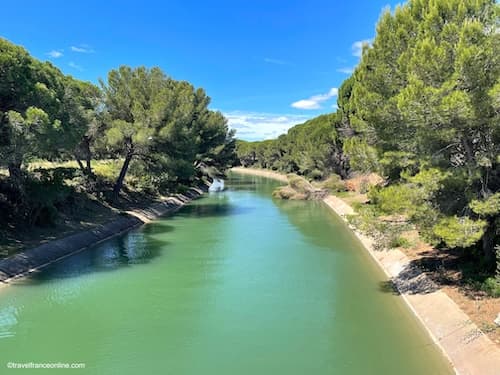
The construction of the Rhône-Sète Canal, for instance, created a geographical barrier that cuts across the wetlands, linking the river to the port of Sète. A network of irrigation canals (such as the Canal du Bas-Rhône-Languedoc), dikes, sluice gates, and pumping systems manages water movement throughout the region. Fresh water is indeed pumped to the northern rice paddies, while saltwater near the coast evaporates in salt pans to produce sea salt.
One major natural factor also shapes local life: the Mistral wind! This cold, dry, and mighty wind rushes down the Rhône Valley and sweeps across this flat, exposed landscape, causing sudden drops in temperature.
So, if you plan to walk the pilgrimage route through the Petite Camargue, don’t forget to pack a waterproof, windproof jacket in your backpack!
Petite Camargue, a land of vineyards
The first vineyards were planted in the late 19th century on the long strips of sand near Aigues-Mortes and Les Saintes-Maries-de-la-Mer.
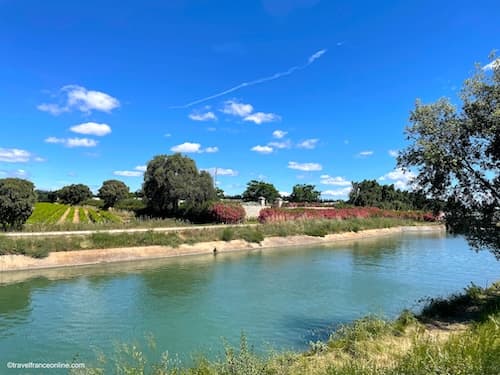
Remarkably, these vineyards escaped the phylloxera epidemic that devastated nearly all of France’s wine-growing regions. The water-saturated sand indeed prevented the spread of the aphid-like insect responsible for the disease, as it couldn’t reproduce under an aquatic environment.
The region thus developed a unique method to combat the pest by flooding the vines for nearly 50 days, using the newly constructed irrigation system.
Today, these vineyards, perfectly adapted to the moist, sandy soil, are cultivated mostly according to organic methods.

That said, vines had been introduced as early as the 14th century in the Costières de Nîmes, and in the Saint-Gilles area to produce wine prized by the Popes in Avignon!
These wines made from the Mourvèdre grape variety (also known as Plant de Saint-Gilles), were said to rival those from Beaune! The Vaccarèse (or Camarèse) grape variety, used in the production of Châteauneuf-du-Pape, was also part of the blend. It is widely considered to have originated in the Camargue, in the area around the Etang de Vaccarès.
Today, the Petite Camargue vineyard covers approximately 3,000 hectares.
Camargue rice
The moist, sandy soils and favourable climate of the Petite Camargue have also proven ideal for rice cultivation, yielding the renowned Camargue rice, celebrated for its quality and distinctive taste.
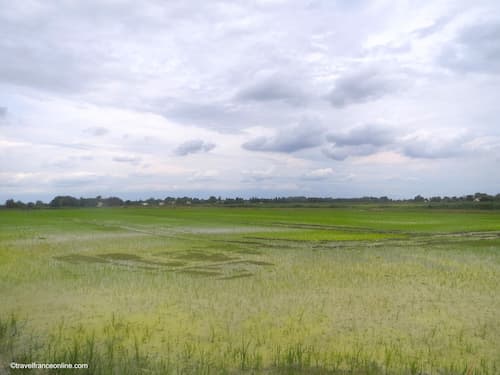
The first rice paddies were planted in the mid-19th century. The primary objective, then, was to absorb floodwaters and desalinize the land in preparation for future vineyards. Until World War I, rice was thus cultivated mainly for animal feed. While these early paddies produced lower-quality rice, by the start of World War II, they had been replanted with high-quality varieties suitable for human consumption.
Since 1998, Camargue rice has enjoyed Protected Geographical Indication (PGI) status. Today, it is cultivated across 15 communities in the Gard (Petite Camargue) and Bouches-du-Rhône (Camargue) departments.
Black bulls and white horses of the Petite Camargue
The Petite Camargue is a prime destination for ecotourism and migratory bird watching, especially in spring and autumn: egrets, herons, ibises, and, of course the iconic pink flamingos that inhabit the wetlands.The region is also renowned for the traditional raising of black bulls (the famous Camargue breed) and emblematic white horses.

Camargue bulls are a protected breed raised for local festivals. Fortunately, there is no bullfighting (corrida) here; these hardy bulls, with their black or dark brown coats and lyre-shaped horns, combine power physiques with great agility, making them perfect for traditional bull games!
The most famous of the events take place in the arenas of Aigues-Mortes and Le Grau-du-Roi, near the coast. During these contests, a rosette adorned with ribbons and strings is attached between the bull’s horns.
A man, traditionally dressed in white, must run towards the animal and try to snatch these items using a small metal hook. The bulls are never injured or killed; on the contrary, they receive excellent care. Champion bulls are even granted a peaceful retirement in their old age!

The Camargue bulls live in a semi-wild state in the wetlands, in herds. They are tended by the local gardians (horsemen), who guide them through the wetlands using long tridents.
Sorry if this offend some readers, but meat lovers will be delighted to learn that the Camargue breed, fed exclusively on local vegetation such as wild rosemary, thyme, samphire, and sea grass, produce meat of exceptional quality!
The white Camargue horses is another of the region’s stars; it is considered one of the world’s oldest horse breeds. Like the bulls, these horses live in a semi-wild state within herds in the wetlands.

Some are trained from a young age by gardians, as they are the only horses capable of working with the powerful and ‘spirited’ Camargue bulls! These horses are indeed renowned for their agility, energy, and gentle temperament.
Interestingly, these magnificent white horses are not born white; they sport a dark grey, brown, or even black coat at birth! They gradually acquire their iconic white coat as they age, usually around five years old.
Relatively short and sturdy, they are also perfectly adapted to the wetlands thanks to their broad hooves, which prevent them from sinking into the mud. As an ancient breed, they thrive in all conditions, from the cold Mistral wind to hot, dry summers, and can even graze on aquatic plants.
Our route through the Camargue and the Petite Camargue

Thus, the first leg of our journey was fairy easy, as the terrain was perfectly flat. Leaving Arles, our path took us through vineyards and then apricot orchards.
It was the start of the harvest season; farm workers, realising we were walking the Camino, generously offered us handfuls of juicy apricots (the locals were incredibly warm and kind).
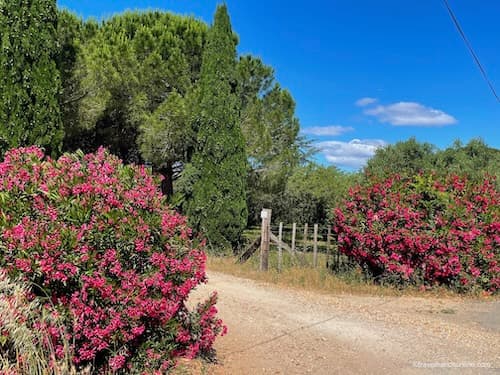
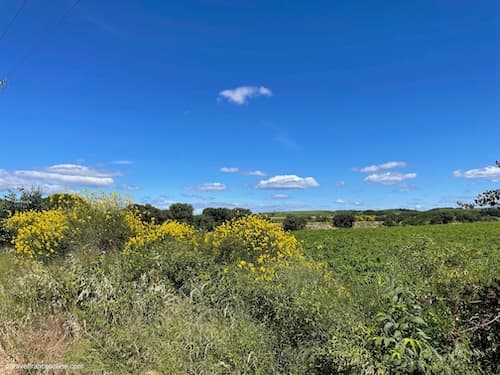
The road then gave way to a trail crossing fields where a few bulls were grazing. In early June, nature was at its peak: wildflowers, such as broom and bell-flowers, and pink oleanders were in full bloom, attracting a multitude of insects and butterflies.
As we walked along the rice paddies, dark rain clouds seemed to be closing in on us, but they quickly drifted off in another direction.

At midday, we arrived in the village of Saliers and stopped at Mas de Capellane, a manade-gite for pilgrims, where we could refill our water bottles.
The owner kindly invited us to have our picnic in the garden, sheltered by large trees.
Once again, I want to highlight the exceptional hospitality and kindness of the locals! If you pass through Saliers, now you know where to stop.
Just as we were crossing the Petit Rhône, the clouds returned, and we arrived at our hotel in Saint-Gilles just as the first drops of rain began to fall!
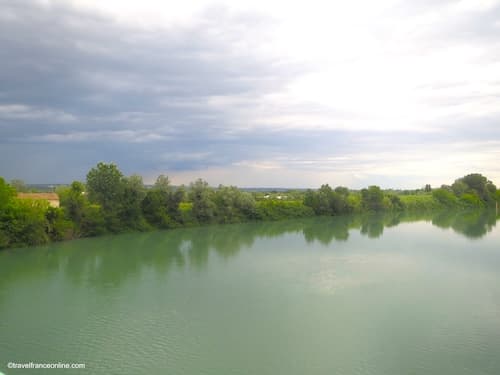
In a way, this first leg went by too quickly, and I regret having caught of only a few Carmargue bulls and white horses. Moreover, although it was early June, the ground was already very dry, with many ponds reduced to stretches of cracked mud.
I also regret not having time to make a detour to Les Saintes-Maries-de-la-Mer.
However, our destination on that first day, Saint-Gilles-du-Gard, more than made up for these disappointments!
Photos via Wikimedia Commons: Pink flamingos by Olga1969 License – Horse Marais du Vigueirat by Tylwyth Eldar CC BY-SA 4.0 – Gardian by Georges Seguin (Okki) CC BY-SA 4.0