
Hôtel-Dieu de Beaune – Palais des Pôvres
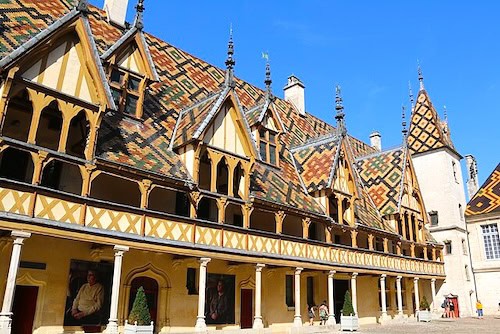
The Hôtel-Dieu of Beaune, also known as the Palais des Pôvres (Palace of the Poor), was founded in 1443, at the end of the Hundred Years’ War. Indeed, the plague, famine, and misery that ravaged France prompted Nicolas Rolin, Chancellor to the Duke of Burgundy, and his wife, Guigone de Salins, to create a hospital to provide aid and comfort to the poor and sick. Beaune was then the capital of Bourgogne.
They endowed the institution with an annual income and a vineyard to ensure its operation. From 1452, the year the first patient arrived, until 1971, devoted nuns cared for the destitute at the Hôtel-Dieu.
The charity and compassion shown by Rolin and his wife inspired the inhabitants to follow their example. They thus contributed financially to the hospital’s operation, enabling its development and expansion over time.
In 1457, Guillemette Levernier donated the first vineyard to the Hospices de Beaune, a generous endowment that was followed by many others over the next five centuries.
On April 21, 1971, the Hôtel-Dieu became a retirement home, the Centre Hospitalier Philippe le Bon, a modern hospital. With 982 beds, the new hospital focuses primarily on short-term hospitalisation needs.
In 2015-2016, the Hospices Civils de Beaune merged with the hospitals of the Centres Hospitaliers d’Arnay-le-Duc, Nuits-St-Georges, andSeurre, a merger that allows them to offer comprehensive medical services to the region’s population. As a public health institution, the Hospices Civils de Beaune thus includes a general hospital as well as several retirement homes.
Hospices de Beaune, former charitable almshouse converted into a museum
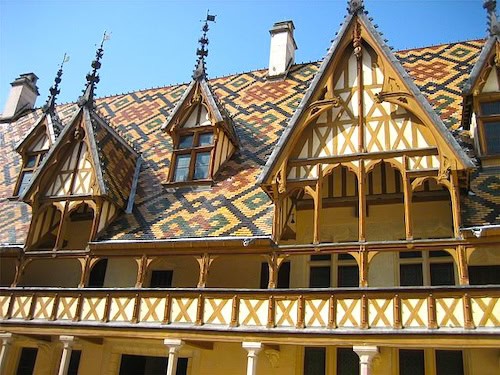
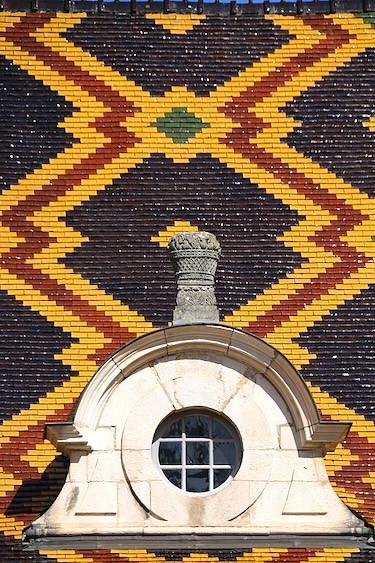
The four original Hospices de Beaune buildings are listed as Historical Monuments. These splendid buildings, with their polychrome tile roofs and finely crafted Flamboyant Gothic facades, are remarkably well preserved and are the emblem of the Hospices de Beaune.
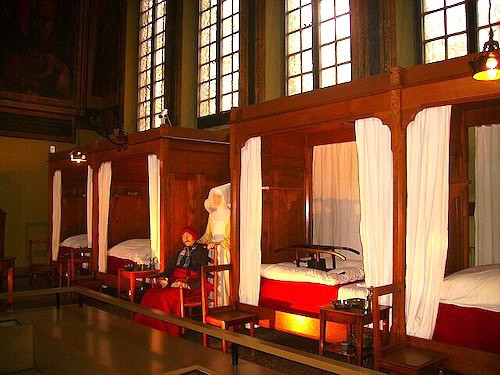
Over the centuries, generous donations have enabled various expansions, resulting in additional courtyards, outbuildings, and a 15th-century bastion, all forming a splendid example of medieval French civil architecture.
Today, the Hôtel-Dieu is a museum showcasing a vast collection, including 2,500 pieces of furniture, objects and tapestries. It incorporates the original bequest of Nicolas Rolin and Guigone de Salins, as well as numerous medieval artefacts essential to the hospital’s operation over the centuries.
One of the star exhibits is undoubtedly the The Last Judgment, a masterpiece by Rogier van der Weyden.
And of course, the Hospices de Beaune also house wine cellars!
Worldwide renowned charity wine auction
The Hospices de Beaune owns a prestigious 60-hectare vineyard, renowned for its exceptional Burgundy wines. This vineyard is primarily around Beaune but has extended since 1994 into the Côte de Nuits and Mâconnais regions.
Remarkably, 85% of the wines produced by the Hospices de Beaune are Premier Cru and Grand Cru, illustrating the exceptional quality and reputation of these sought-after vintages. The red wines, made exclusively from Pinot Noir grown on 50 hectares, and the white wines, elegantly produced from Chardonnay, are carefully cultivated by a team of 22 expert winemakers.
Each winemaker oversees a plot of approximately 2.5 hectares, ensuring meticulous attention at every stage of wine-making. The vineyard adheres to traditional methods, with harvesting done entirely by hand.
The Hospices de Beaune also organise an annual charity wine auction, orchestrated by Christie’s since 1924. Held on the third Sunday of November, this prestigious event offers exceptional Burgundy wines for sale, with proceeds used to improve hospital infrastructure and preserve the Hôtel-Dieu. Thanks to this tradition, wine lovers from around the world have the opportunity to contribute to the excellence and philanthropic endeavours of the Hospices de Beaune.
Department of Burgundy
Coordinates: Lat 47.022023 – Long 4.836451
Photos via Wikimedia Commons: Roofs by Nguyenld CC BY-SA 3.0 – Salle St. Hugo by Zairon CC BY-SA 3.0 – Close-up roofs and Exterior and Header by FrDr CC BY-SA 4.0


