Aigues-Mortes, a water city
Aigues-Mortes is located in the Petite Camargue an area of marshes and ponds west of the Grande Camargue.
The Petit Rhône, the western branch of the Rhône River, marks the border between these two Camargues, one in Languedoc-Roussillon and the other in Provence.

The name Aigues-Mortes, derived from the Latin Aquae Mortuae, meaning “dead waters” or “stagnant waters,” a region of ponds and salt marshes that were exploited as early as the Neolithic period.
Aigues-Mortes is undeniably a town of water and a river port, situated at the confluence of several waterways, including the Rhône-Sète Canal, the Bourgidou Canal, and the Grau-du-Roi Canal.
Located inland, not far from the seaside resort and fishing port of Grau-du-Roi, the town is already mentioned in documents dating back to 1248. “Grau” is an Occitan term meaning “pond with a millrace,” a common expression in the region. Grau-du-Roi thus means “king’s pond.”
Aigues-Mortes, a walled city
Aigues-Mortes is also renowned for its magnificent ramparts. Indeed, around 790, Emperor Charlemagne commissioned the construction of the Tour Malafère to protect the village and the surrounding coastline from invaders and pirates.

This tower was the first stone structure in the town, as Aigues-Mortes had been a modest fishing hamlet nestled among the salt marshes until then.
King Louis IX, known as Saint-Louis, undertook the construction of the town’s ramparts in the 13th century. He replaced Charlemagne’s Tour de Constance to house a garrison. He commissioned the construction of an access road across the marshes and a defensive tower, the Tour Carbonnière, now a listed historical monument. The king also expanded the port, creating a network of basins and inland canals, such as the Canal Viel and the Grau du Roi, thus connecting the city to the Mediterranean.
Aigues-Mortes became the main port of embarkation for troops departing on crusade. It was from here, in fact, that Saint Louis embarked for the Seventh and Eighth Crusades.

His son, Philip the Bold, oversaw the completion of the ramparts and the expansion of the port to improve access to the sea. Then, at the beginning of the 15th century, new canals and an inland port were built, but the city started to decline after the annexation of the County of Provence and Marseille to the Kingdom of France in 1481.
However, the resurgence of salt production led to the construction of the Grau-Henri Canal, which was inaugurated in 1532. Excessive silting resulted, though, in the reopening of the Grau-du-Roi Canal in 1752, which also eventually suffered from silting. To make matters worse, the extensive land clearing undertaken during the French Revolution exacerbated soil erosion and sediment deposition, further worsening the problem.
The definitive solution to this silting problem was found in 1806 with the opening of the Rhône-Sète Canal, restoring Aigues-Mortes to its status of prosperous river port.
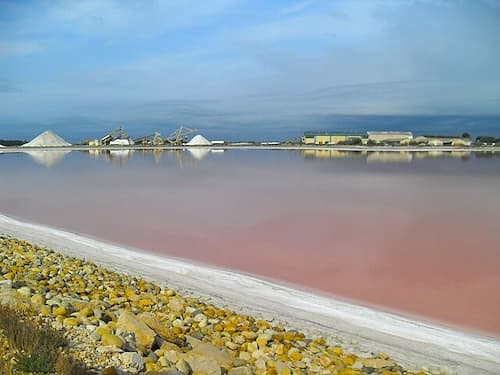
Salt production has long been the main economic activity of Aigues-Mortes, but it has not always been without conflict.
In August 1893, a violent altercation broke out between French and Italian seasonal workers. What began as a simple scuffle quickly escalated into deadly clashes, resulting in the deaths of seven Italians and leaving many others permanently disabled.
Known as the “Massacre of the Italians of Aigues-Mortes,” this riot severely strained Franco-Italian diplomatic relations for some time.
Aigues-Mortes today
Aigues-Mortes is connected to the Mediterranean Sea by the Grau-du-Roi Canal. Nestled behind its ramparts, is centred around Place Saint-Louis, a historic square that has preserved its medieval charm.

The town attracts thousands of French and international visitors each year. Some come for the annual pilgrimage to Saintes-Maries-de-la-Mer in May, while others flock there for the grape and salt harvests in September. Bullfighting enthusiasts gather in the arena to watch the Camargue bull races. This arena, built at the end of the 19th century, can accommodate 600 spectators and has been listed as a historical monument since 1993. Finally, the nearby beaches of La Grande Motte and Grau-du-Roi-Port-Camargue are also popular destinations for vacationers seeking sun and sand.
Note: Aigues-Mortes is located in Languedoc-Roussillon, but is part of the Camargue region. For the sake of consistency, we have included it in our Provence section.
Department of Gard
Coordinates: Lat 43.567172 – Long 4.192587
Photos via Wikimedia Commons: Leaving for the 7th Crusade by Unknown XIVe Public domain – Ramparts by Johan Allard CC BY-SA 4.0 – Header and Seen from the salt marshes by Hyppolyte de Saint-Rambert CC BY-SA 4.0 – Salt marshes by Chabe01 CC BY-SA 4.0 – Le Grau du Roi by Daniel VILLAFRUELA CC BY-SA 3.0