Founding of Saint-Honorat Church

In the 12th century, Saint-Honorat Church was one of the French starting points for the Way of Saint-James (Camino); it was therefore an essential stop for my friend and me before we began our stretch of route along the Via Tolosana, one of the Camino’s four main routes!
Today, Saint-Honorat Church is one of Arles’ eight monuments inscribed on the UNESCO World Heritage List along with the Roman Amphitheatre, Ancient Theatre, Obelisk and Forum Cryptoporticus, Saint-Trophime Cathedral and cloister, and the Alyscamps necropolis where it is located.
You’ll indeed find Saint-Honorat Church at the far end of the famous Allée des Tombeaux (Avenue of the Tombs) within the Roman necropolis that was established twenty centuries ago along the Via Aurelia. This pagan cemetery became a Christian burial ground following the Council of Nicaea (325 AD), which established freedom of worship.
In the 1040s, the Archbishop of Arles transferred ownership of the Alyscamps necropolis to the Abbey of Saint-Victor in Marseille. The influent abbeys of Saint-Victor and Cluny, both governed by the Benedictine Rule and renowned in the medieval monastic world for their strict discipline and excellency, had been charged by the Pope with reforming the religious system and freeing monasteries from the control of local lords.
As Cluny, located in Burgundy, exerted little influence in Southern France, the Abbey of Saint-Victor took ownership of the Alyscamp. The monks built a priory and replaced the old Saint-Genest Church, constructed over the crypt where the martyr Genesius had been buried in 303 AD, with an imposing Romanesque church dedicated to Saint-Honorat.
Saint-Honorat Church, a starting point for the pilgrimage to Santiago
Indeed, since the early 4th century, the Alyscamp necropolis had attracted pilgrims who came to pray at the tombs of Saint-Genest (Genesius), Saint-Honorat (Honoratus), and Saint-Trophime to seek their protection.
Saint-Trophime was one of seven missionaries sent from Rome to evangelise Gaul (France). He became Bishop of Arles in 250 AD, died in 280 AD and was buried at the Alyscamps.
Saint-Genest, a Roman scribe who had secretly converted to Christianism, refused to translate an imperial edict ordering the persecution of Christians. Arrested and beheaded in 303 AD, he was laid to rest in the necropolis.
Saint-Honorat cam from a noble Roman family, but he, too, converted to Christianity. He founded the Abbey of Lérins, off the coast of Cannes, became Archbishop of Arles in 426 AD, and was buried at the Alyscamps in 429 AD.
As you can imagine, this pilgrimage to the Alyscamps generated steady and substantial revenue, both through donations and the sale of burial plots, as many of the faithful wished to be interred near the holy men.
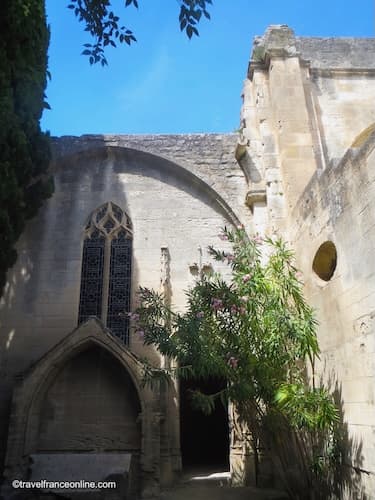
However, its popularity experienced an unprecedented boom in the mid-11th century, when the Abbey of Saint-Victor took possession of the Alyscamps. The monks skillfully capitalised on the growing enthusiasm for the Camino de Santiago.
They indeed made Saint-Honorat Church the gathering place and official starting point of the pilgrimage along the Via Tolosana (also know as Arles Route), for pilgrims arriving from Italy and Central Europe via the Via Domitia.
In collaboration with Cluny, they developed the route by establishing hostels, hospitals, and secure accommodations for travellers.
For over a century, the two abbeys thus largely benefited from the generous donations made by pilgrims…right up until the construction of Saint-Trophime Cathedral.
The unfinished Saint-Honorat Church
The renown of the Alyscamps necropolis as a major stop of the Camino was such that, in the early 12th century, the Abbey of Saint-Victor decided to rebuild a “larger” Saint-Honorat Church.
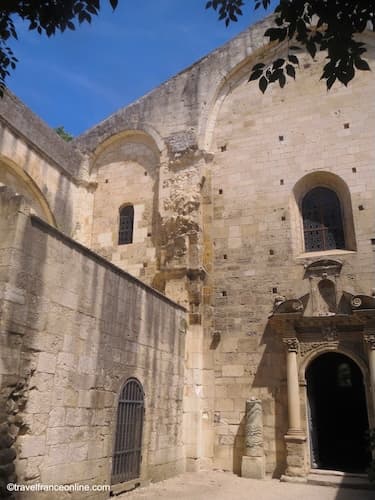
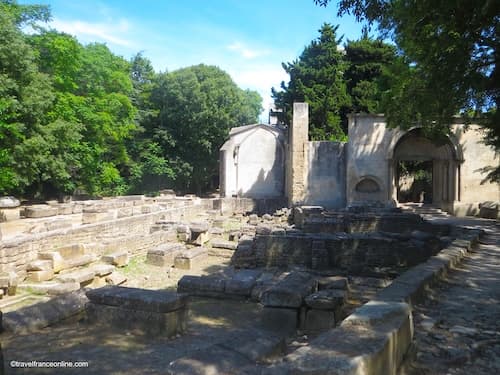
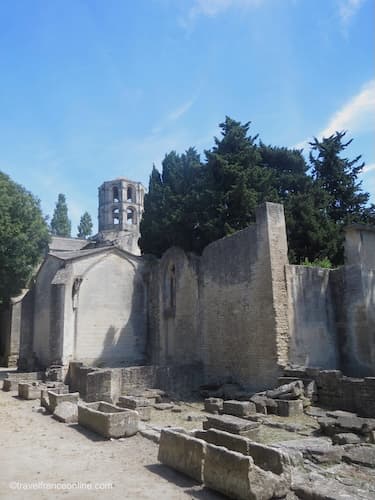
However, the ambitious plans for this Provencal Romanesque structure proved too costly. Only the eastern apse, three chapels, and the imposing two-storey octagonal lantern-tower were completed. The five-bay nave and the side aisles, originally intended to complete the church, were never built for lack of funds, leaving an open courtyard in their place.
The abrupt decline in revenue coincided with the construction of Saint-Trophime Cathedral. Indeed, in 1152, the Archbishop of Arles had the relics of Saint-Trophime exhumed from the Ayscamps and transferred to the new cathedral, which he consecrated to the saint.
Pilgrims, who had until then stopped a Saint-Honorat Church to venerate the holy relics, turned to the cathedral instead. Deprived of donations and resources, the monks of Saint-Victor were forced to halt construction on Saint-Honorat.
Saint-Trophime Cathedral thus became the new gathering place and starting point for pilgrims bound for Compostela.
Saint-Honorat Church: Neglect and rescue
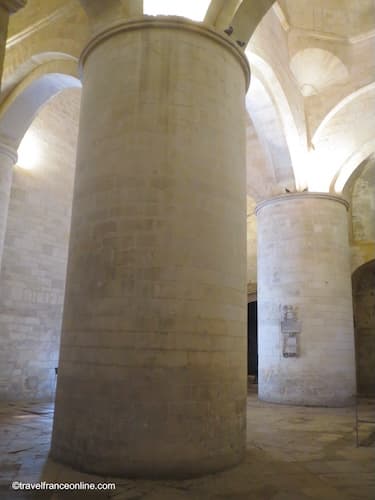
It goes without saying that, from then on, Saint-Honorat Church was more or less left to fall into ruins! As early as the 16th century, its structure required significant reinforcement to prevent collapse.
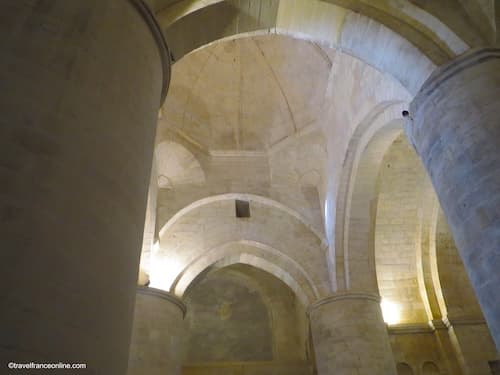
The original cruciform columns supporting the transept and the lantern-tower were thus encase in massive circular pillars, and new supporting arches were added. Although these modifications prioritised stability over aesthetics, a fact immediately apparent upon entering the building, they nonetheless ensured the structure’s survival!
Due to a lack of burial plots, surprising additions were also made during the 15th and 16th centuries. Wealthy families indeed commissioned chapels in the space left vacant by the “never-built” nave. the Flamboyant Gothic Mollégès family chapel was added to the north side of the church in the 15th century!
Two centuries later, a new entrance portal was created when two more modest chapels were built on the south flank of the existing nave.
However, one of the church’s most unusual features is the wall niches (or enfeux) found in its facade and outer walls.
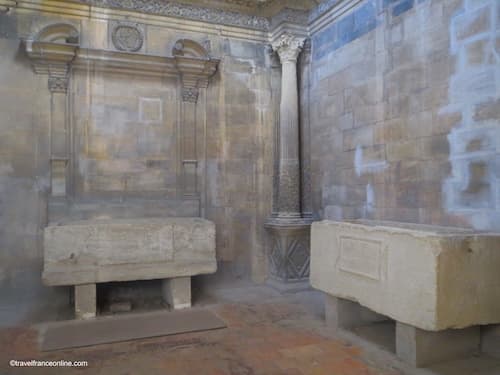
Wealthy families paid fortunes to have these flat-backed, arched alcoves carved inside the stonework to house family sarcophagi and recumbent effigies.
Yet, the 17th century also brought further deterioration to the church. In 1615, the Regent of France, Catherine de Medici, unwisely entrusted the site to the religious order of the Minims, counting on them to maintain it. Instead, the Friars looted the church, carrying sarcophagi and stones to reuse as building materials for their own monasteries!
By the early 18th century, Saint-Honorat Church had thus once again fallen into advanced disrepair: the roof leaked, allowing water to seep into the masonry and weaken the structure.
To limit the damage, the open courtyard occupying the site of the “never-built” nave was converted into an open-air lapidary museum to protect the most precious sarcophagi from looters.
The situation worsened during the French Revolution: the Minims were expelled, and the church was confiscated, striped of its remaining furnishings, and left exposed to the elements and grave looters.
This state of neglect persisted until 1840, when Saint-Honorat Church was finally designated a Historical Monument, thereby securing the funds and resources needed for its restoration. Architects and engineers were dispatched to stabilise the structure, including, of course, the magnificent 12th century lantern-tower. The masonry was restored, joints were sealed to prevent water infiltration, and the upper arches were once again reinforced.
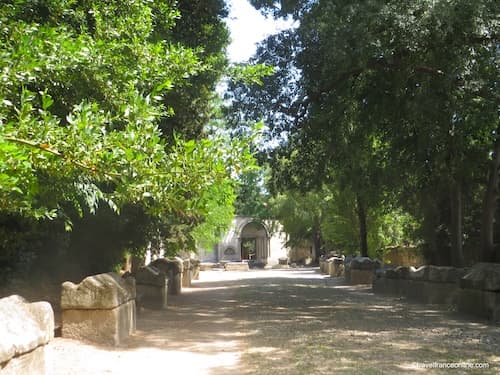
Today, as you stroll along the superb Allée des Tombeaux, you cannot help but be charmed by the silhouette of the medieval Saint-Honorat Church, standing at the very end of the rows of sarcophagi. Nestled in the shade of tall trees, amidst open-air tombs, it is easy to see why this romantic setting once inspired Van Gogh and his friend Paul Gauguin.
Although it has lost its former status, Saint-Honorat Church retains a timeless and understated beauty. The interior is simple and austere, true to the Provencal Romanesque tradition. While the massive columns may be surprising at first, you quickly grow accustomed to them! The crypt remains; though empty today, it lends to site a mysterious atmosphere.
It is easy to picture the thousands of pilgrims who, centuries ago came to pray at the tombs of their saints.

One can imagine them walking reverently among the rows of graves, whispering prayers for the departed before reaching the church, where they would eventually gather before embarking on their long and sometimes perilous pilgrimage.
Even today, the rustling of leaves in the trees seems to carry the echo of that distant era; listen and let your imagination run free…
A single ticket grants access to bot the necropolis and the church. How much time should you allow for the visit? We easily spent a good hour there; it’s a truly fascinating and unusual site!